Handing client work to a company you’ve never worked with is a leap. Your name goes on whatever comes back. Your client doesn’t know anyone else is involved. If the work is late or poor, nobody else takes the blame. So the sensible move isn’t to sign a contract and hope. It’s to test. A free trial white label agency offer exists for exactly this reason: it lets you put real work in front of a partner and judge the result before any money changes hands.
This guide explains how our trial works at Wordout Media, what you can send, what to watch for and how to get the most out of eight free hours. We’ll also tell you how to run the test fairly, even if you end up deciding we’re not the right fit. If you’re still deciding whether outsourcing makes sense at all, start with our explainer on what a white label digital marketing agency is.
What Is the Wordout Media 8-Hour Free Trial?
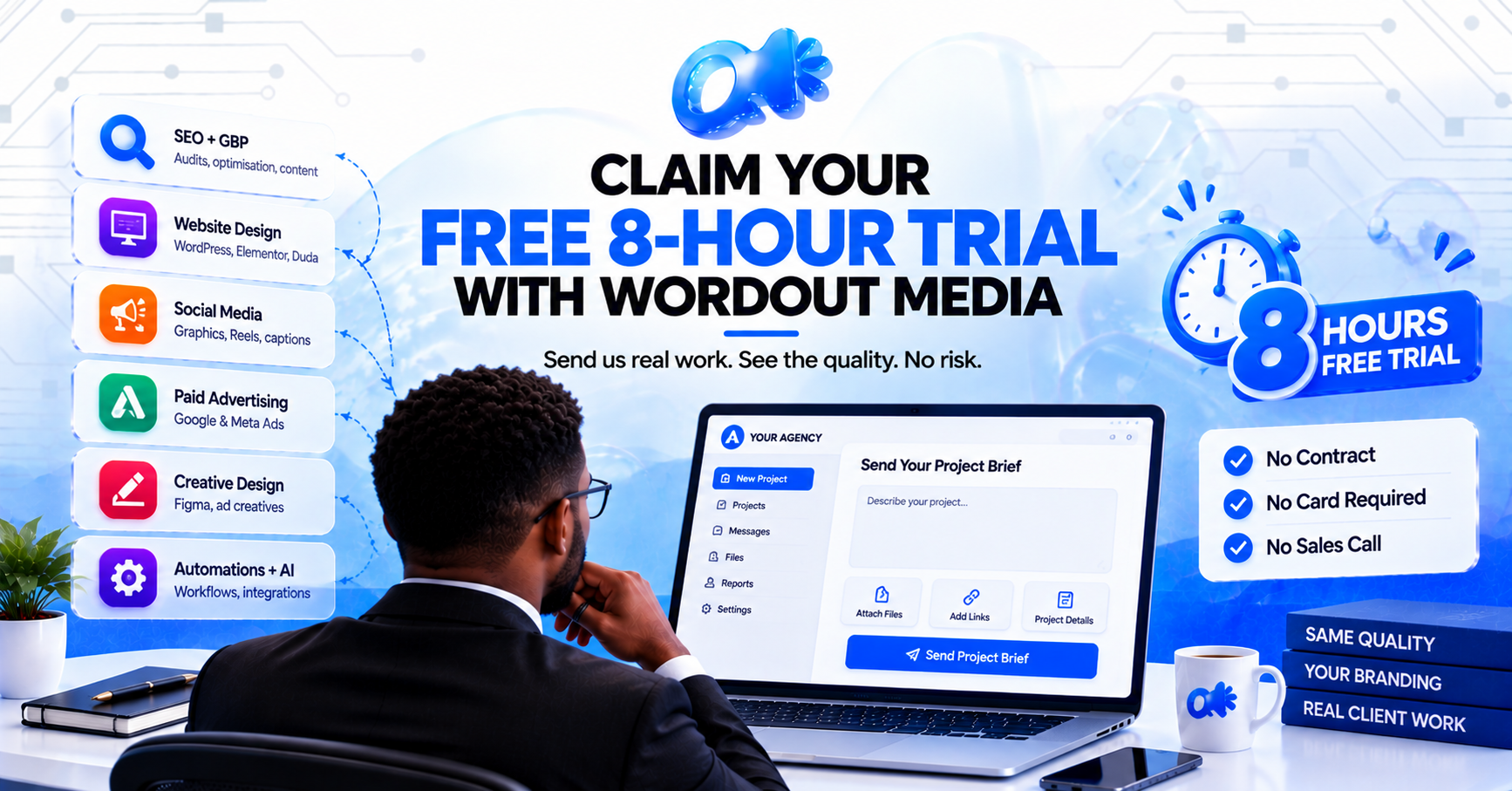
It’s simple. You send us eight hours of real work. We do it, under your branding, and send it back. You judge the output and the working relationship. If it isn’t for you, you walk away having spent nothing.
The terms are plain:
- No contract. You’re not committing to anything.
- No card. We don’t ask for payment details.
- No sales call required first. You don’t have to sit through a pitch before you see our work.
The point is to remove every barrier between you and the one thing that matters: evidence.
Why We Offer a Free Trial
We could say it’s generosity, but the honest reason is more practical. A partner’s sales page can say anything. A trial can’t. Quality, communication and reliability are things you only learn by working together, and we’d rather you learn them on our time than yours.
It also protects both sides. If our team isn’t the right fit for your standards or your clients, you’ll find out in a week instead of a quarter. And we’d much prefer an honest “no” after eight hours to a frustrated “yes” after eight weeks.
What Can You Send?
Anything that reflects the kind of work you’d actually hand us. The more realistic the task, the more useful the trial. Good examples include:
- A landing page. A real page for a real client or for your own agency. See our Website Design & Development service for what we build, including WordPress and Elementor.
- A batch of social creative. Graphics, carousels, Reels or captions for a content calendar. Our Social Media Management team handles these.
- A technical SEO audit. A full crawl-and-review of a client site, one of the most popular trial tasks. It’s part of our White Label SEO + GBP service.
- A Google Ads build. Campaign setup, ad copy and structure. See Paid Advertising – Google & Meta.
- Design work in Figma. Mockups, ad creative or presentation design, covered by Creative Design + Figma.
- An automation or AI workflow. A lead follow-up sequence, a reporting flow or an internal process, through our Automations + AI Workflows service.
Because hours aren’t tied to a single service, you can also split the trial across two small tasks if you’d like to see more than one team in action.
What Eight Hours Gets You
Eight hours is enough for a meaningful test, though not for everything. Roughly speaking, it can cover tasks like:
- A single, well-defined landing page.
- A technical SEO audit for a small or medium site.
- A set of social graphics for a month of posts.
- A first Google Ads campaign structure.
- A few Figma mockups.
It won’t cover a full multi-page website build or a large SEO project. If your task is bigger, we’ll tell you upfront and suggest a slice of it that makes a fair test. Larger builds get a scoped timeline before we start, so nothing is a surprise.
How the Trial Works, Step by Step
Step 1: Contact us to request the trial. You don’t need to book a call first.
Step 2: Choose your task. Pick something real and well defined. If you’re unsure, tell us what’s overloading your team this month and we’ll suggest a task.
Step 3: Send your brief. Include the goal, the client context, the deliverable you need, brand guidelines, any access and a deadline. A good brief gives you a fair test. A vague one tests your brief more than our work.
Step 4: Meet your account manager. One person owns your project and briefs the right specialist. You deal with one contact, not four.
Step 5: We do the work. Most design, ad setup and video editing tasks come back same day to 48 hours. Larger tasks come with a scoped timeline. We work EST hours, so a brief sent in your morning is usually moving before lunch.
Step 6: You receive branded deliverables. Everything carries your logo and your branding, with nothing pointing back to us.
Step 7: You review and give feedback. Treat it as you would any partner’s work. Tell us what’s right, what’s wrong and what you’d change.
Step 8: You decide. If it worked, you can continue with an hour block. If not, you’ve lost nothing.
How to Judge the Trial Fairly
A trial is only useful if you evaluate it properly. Here are the five things worth measuring.
1. Quality
Would you put your own logo on this without changes? Compare it with what your team would have produced. Be honest about gaps in either direction.
2. Accuracy to the brief
Did the work match what you asked for? Misreading the brief is a sign of poor communication, either yours or theirs. Note which.
3. Speed
Was it delivered when promised? Did anything slip, and was it flagged in advance?
4. Communication
Were questions asked early? Was your account manager responsive and clear? Communication during a trial is a preview of communication later.
5. Your own time
How many hours did you spend briefing, reviewing and giving feedback? A partner who delivers perfect work but needs ten hours of your time hasn’t saved you much. Track it.
A simple scorecard helps. Rate each of the five from 1 to 5, and write one sentence on the reason. After eight hours of work, you’ll have enough evidence for a confident decision.
How to Get the Most From Your Free Trial
A few habits make the difference between a useful test and a wasted one.
Send a real task, not a toy one. The trial should resemble the work you’d actually outsource. A trivial task proves little.
Write the brief you’d write for a live client. If it’s too polished, the test won’t reflect real conditions. If it’s too thin, you’ll get thin results.
Don’t pick your most sensitive client. Choose something meaningful but not make-or-break.
Give specific feedback. “I don’t love it” can’t be acted on. “The headline is too long and the CTA should say ‘Call now’” can.
Test the revision process too. How the team handles feedback tells you as much as the first draft does.
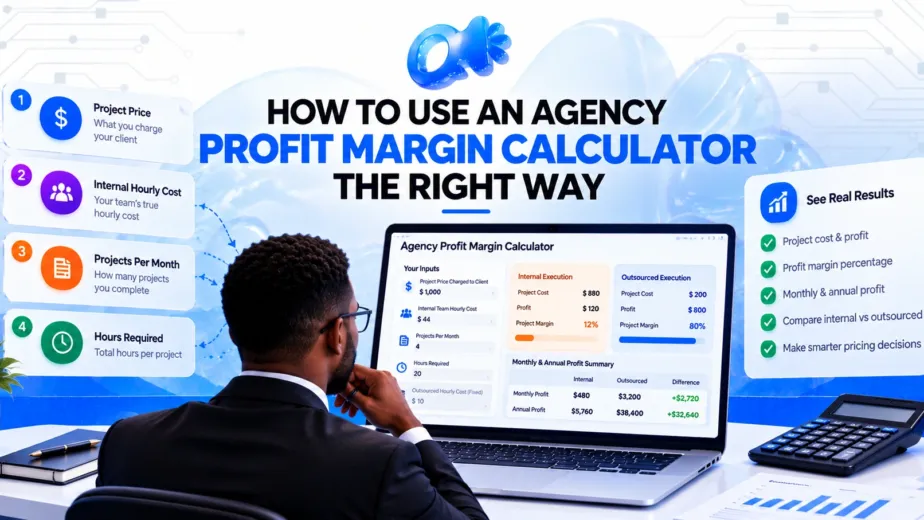
Compare with your own cost. Work out what the task would have cost you internally. Our Agency Profit Margin Calculator makes this easy, and How to Use an Agency Profit Margin Calculator the Right Way explains each input.
A Sample Trial Timeline
To make this concrete, here’s how a typical trial might run for a technical SEO audit. The timings are illustrative.
Day 1 (morning, EST): You send the brief: the client’s URL, the goal (more local calls), two competitors and access details. Your account manager confirms receipt and asks two short questions about the site’s platform and any past SEO work.
Day 1 (afternoon): The specialist begins the crawl and technical review. You hear nothing more, which is normal.
Day 2: The audit is drafted, checked and formatted under your branding. A summary of priority fixes is added so you can explain it quickly to your client.
Day 3: You receive the finished report. You read it, mark two points you’d phrase differently and send feedback.
Day 3 or 4: The revisions return. You’ve now seen the full cycle: brief, delivery, feedback, revision.
By then you’ve used a few hours of your trial and have a complete picture of quality, speed, communication and revision handling. The remaining hours can go on a second small task, such as an on-page optimization of the three most important pages.
Common Mistakes People Make During a Trial
Sending a vague brief. If the instructions are thin, the result will be too, and you’ll blame the wrong thing.
Testing the wrong task. A task that doesn’t resemble your real work tells you little.
Going silent. A trial is a two-way relationship. If questions go unanswered, the work stalls.
Judging only the first draft. How a team handles feedback matters as much as the first delivery.
Forgetting to track your own time. The hours you spend reviewing are part of the cost.
Comparing against perfection instead of reality. Compare the result with what your team or your current provider would realistically have produced.
What Happens After the Trial?
There’s no obligation. If you decide to continue, our model is simple.
- Our rate is $10 an hour.
- Hours are sold in blocks: Starter is $200 for 20 hours, Growth is $400 for 40 hours and Scale is $800 for 80 hours.
- The rate is the same on every block. No volume pricing games.
- Hours don’t expire. If you buy 40 and use 25, the other 15 are waiting when you come back.
- Hours aren’t tied to one service. Spend them on SEO one month and a website build the next.
- You get a shared task tracker showing exactly what each hour went to.
Starter suits testing us out or covering an overflow month. Growth suits one or two active client accounts. Scale suits multiple accounts and ongoing delivery.
If you decide not to continue, that’s fine. Keep the trial work, use what’s useful and tell us what we could have done better. We mean that.
What a Free Trial Doesn’t Tell You
In the spirit of honesty, a trial has limits.
It doesn’t prove long-term consistency. One good task isn’t a guarantee of twelve good months, though it’s a strong signal. Watch the second and third tasks closely.
It doesn’t show how we handle your hardest client. If your most demanding account is the one that matters, move across gradually.
It doesn’t test volume. Eight hours won’t show how a team copes with fifty.
It’s not a substitute for clear briefs. A partner can only work with what you give them. If briefing is a weakness, the trial will reveal it, which is useful in itself.
This is why we recommend starting small after the trial too: one task, then one client, then more. We explain the rollout in How Does White Label Marketing Work, Step by Step?.
Questions to Ask Any Provider That Offers a Trial
Not every trial is equal. Whether you try us or someone else, ask:
- How many hours or how much work is included?
- Is the work done by the same team that would serve me as a client?
- Do I need a card, a contract or a sales call?
- Does the trial work come back fully branded as mine?
- Who’s my contact during the trial?
- What’s the turnaround?
- What happens if I’m unhappy with the work?
- Are there hidden charges afterwards?
If a provider is vague on any of these, treat that vagueness as information. We cover this in more detail in Top White Label Digital Marketing Agencies to Consider in 2026.
Who Should Take the Trial?
The trial is a good fit if you:
- Have more demand than capacity.
- Want to add services such as SEO, ads or web without hiring.
- Are comparing white label partners and want evidence.
- Are curious but cautious about outsourcing.
- Want to protect your margins. See How to Calculate Your Agency’s Profit Margin.
- Are weighing hiring against outsourcing. See White Label vs. In-House Marketing Team.
It’s probably not the right move if you have no real work to send yet, or if your clients’ contracts prohibit outside contractors. In that case, tell us and we’ll be straight about whether we can help.
Frequently Asked Questions
Is the free trial really free?
Yes. The 8-hour trial involves no contract, no card and no sales call required first.
What counts as real work?
Anything you’d actually outsource: a landing page, a batch of social creative, a technical SEO audit, a Google Ads build, design work or an automation.
Will my clients see Wordout Media’s name?
No. Everything is delivered under your branding.
How fast will I get the work back?
Most design, ad setup and video editing tasks come back the same day to 48 hours. Larger tasks get a scoped timeline before we start.
Do I have to buy hours after the trial?
No. There’s no obligation. If you want to continue, hours are $10 each in blocks of 20, 40 or 80.
Can I split the trial across two tasks?
Yes. Hours aren’t tied to one service, so you can use them on smaller tasks of different types.
What time zone do you work in?
We work EST hours, serving agencies in the US, Canada and Europe.
Who will I work with?
A dedicated account manager who owns your projects and briefs the right specialist from our in-house team of fifteen.
You wouldn’t hire a full-time employee without an interview, and you shouldn’t trust a partner with client work without a test. A free trial white label agency offer replaces guesswork with evidence: real work, real turnaround, real communication and a real measure of how much of your own time it takes.
Run the trial seriously. Send a genuine task. Score it honestly. If it works, you’ve found a partner. If it doesn’t, you’ve spent nothing and learned what to look for next.
Claim Your 8-Hour Free Trial, No Card Required
Ready to test it?
Claim your 8-hour free trial, no card required. Send us a landing page, a batch of social creative, a technical SEO audit or a Google Ads build, and judge the work and the working relationship before you spend anything.
Want to read more first? Browse our FAQs or see all our services.