Ask ten agency owners how profitable their last project was and you’ll hear ten confident answers. Ask them to show the working and most of them go quiet.
That’s not a criticism. Agency life is busy, and the numbers that matter are scattered: what the client paid sits in your invoicing tool, what the work cost sits in payroll, and the hours sit in a timesheet that may or may not be up to date. Nobody sits down and puts the three together, so people rely on a feeling. The project felt profitable. The client seemed happy. Money came in.
Feelings are a poor way to run a business, though, and the gap between “money came in” and “money was made” is where many agencies quietly lose.
This guide walks you through how to calculate agency profit margin step by step, with the formula, plain-English definitions and worked examples you can copy. By the end you’ll be able to work out the margin on any project in about two minutes, spot the projects that are costing you money and understand how changing your delivery model changes the result.
We’re Wordout Media, a white label partner for marketing agencies, so we’ll also show how outsourcing at $10 an hour affects the math. We’ll be upfront about the parts that don’t look as good as the headline figures, because a margin calculation that ignores your own time isn’t worth much.
What Is Profit Margin? A Plain-English Definition
Profit margin tells you what share of your revenue you keep as profit after paying the costs of producing the work.
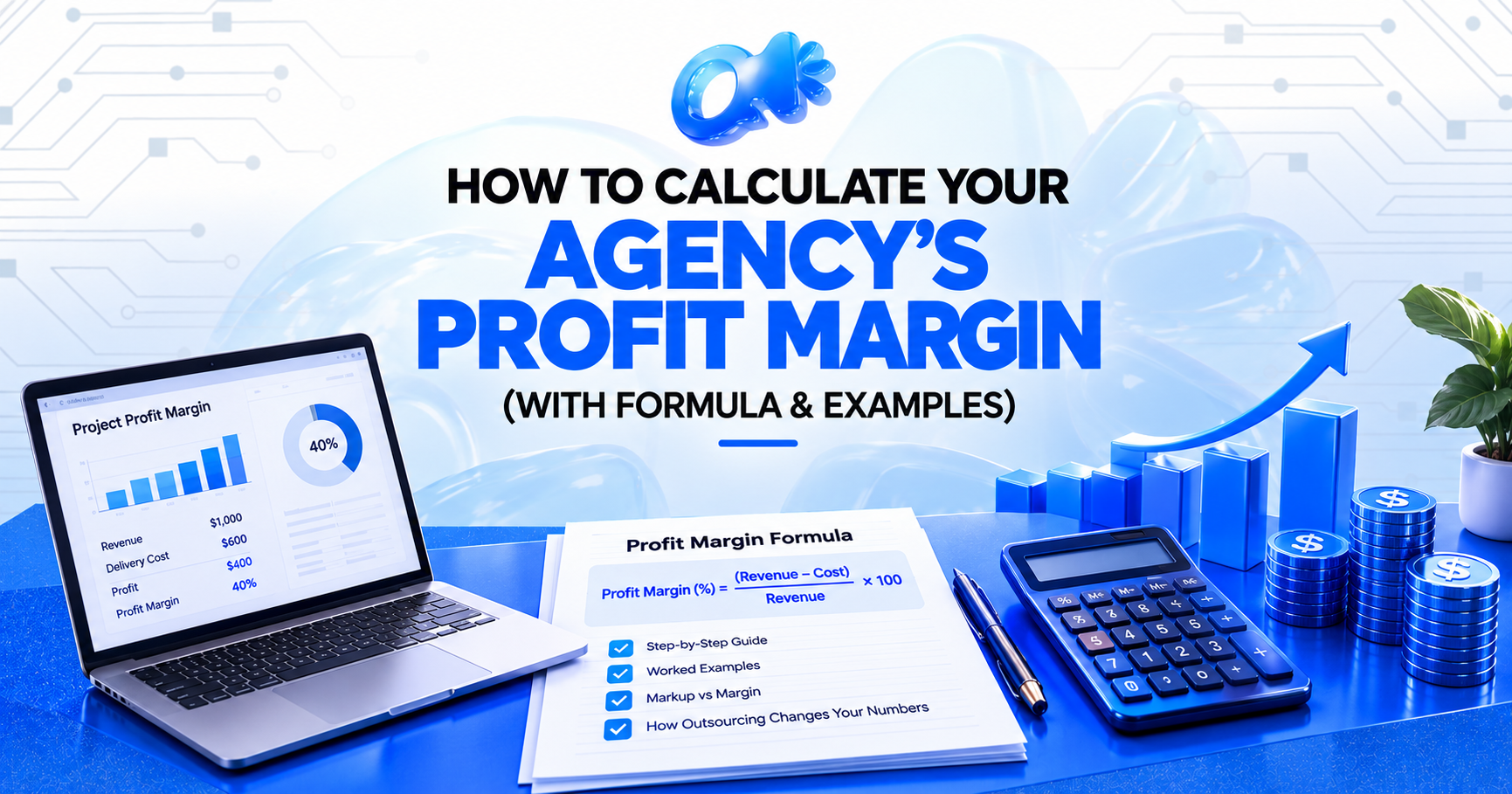
If a client pays you $1,000 and delivering the work costs you $600, you keep $400. Your profit margin is 40%: for every dollar of revenue, forty cents is yours.
That’s really all it is. The rest is knowing which costs to include and how to avoid the mistakes that make the number misleading.
The Agency Profit Margin Formula
Here’s the formula. It’s short.
Profit Margin (%) = (Revenue − Cost) ÷ Revenue × 100
Broken into steps:
- Revenue is what the client pays you for the project or the month.
- Cost is what it costs you to deliver it. For an agency, that’s mostly labor.
- Profit is Revenue minus Cost.
- Margin is Profit divided by Revenue, expressed as a percentage.
And the cost side of the equation for labor-based work is simple too:
Delivery Cost = Hours Required × Hourly Cost
So how to calculate agency profit margin comes down to finding these numbers: the price you charged, the hours the work took and the hourly cost of whoever did it.
Step-by-Step: How to Calculate Agency Profit Margin
Let’s walk through it properly.
Step 1: Write down the project price
This is the total amount you’re charging the client. For a retainer, use the monthly fee. For a fixed project, use the total project fee.
Step 2: Estimate or record the hours
How many hours will the work take, or how many did it take? Be honest and include everything: the actual production, revisions, meetings, project management and reporting. Most agencies undercount hours by leaving out the small tasks.
Step 3: Work out your true hourly cost
This is where most people go wrong. Your internal hourly cost isn’t just the hourly wage. It should include employer costs on top of salary, such as payroll taxes, benefits, software and equipment. And it should account for the fact that nobody is productive for every paid hour.
A quick method: take the annual total cost of an employee, divide by their genuinely productive hours in a year. For a rough illustration, a $55,000 salary plus roughly 25% overhead is about $68,750 a year. Divide that by around 1,560 productive hours and you get roughly $44 an hour. Your own numbers will differ, so use them instead of ours.
If you don’t have exact figures yet, a rough estimate is better than ignoring it.
Step 4: Calculate delivery cost
Multiply hours by hourly cost.
Step 5: Calculate profit
Subtract cost from price.
Step 6: Calculate margin
Divide profit by price and multiply by 100.
That’s it. Six steps, one calculator, and you’ll never have to guess again.
Worked Example 1: A Website Project
Let’s put real numbers through the process. These figures are illustrative, so replace them with your own.
The project: A five-page business website.
- Price charged to client: $3,000
- Hours required: 50
- Internal hourly cost: $35
Internal delivery:
- Cost = 50 hours × $35 = $1,750
- Profit = $3,000 − $1,750 = $1,250
- Margin = $1,250 ÷ $3,000 = 41.7%
That’s a decent project. Now let’s run the same job through an outsourced model.
Outsourced delivery at $10 an hour:
- Cost = 50 hours × $10 = $500
- Profit = $3,000 − $500 = $2,500
- Margin = $2,500 ÷ $3,000 = 83.3%
Same client, same price, same website. The only thing that changed is who did the work, and the profit doubled from $1,250 to $2,500.
Scaling the Example: What Happens Over a Year
One project is interesting. A pattern is where the money lives.
Say you complete four projects like this every month.
| Internal | Outsourced | |
|---|---|---|
| Profit per project | $1,250 | $2,500 |
| Projects per month | 4 | 4 |
| Monthly profit | $5,000 | $10,000 |
| Additional monthly profit | $5,000 | |
| Additional annual profit | $60,000 |
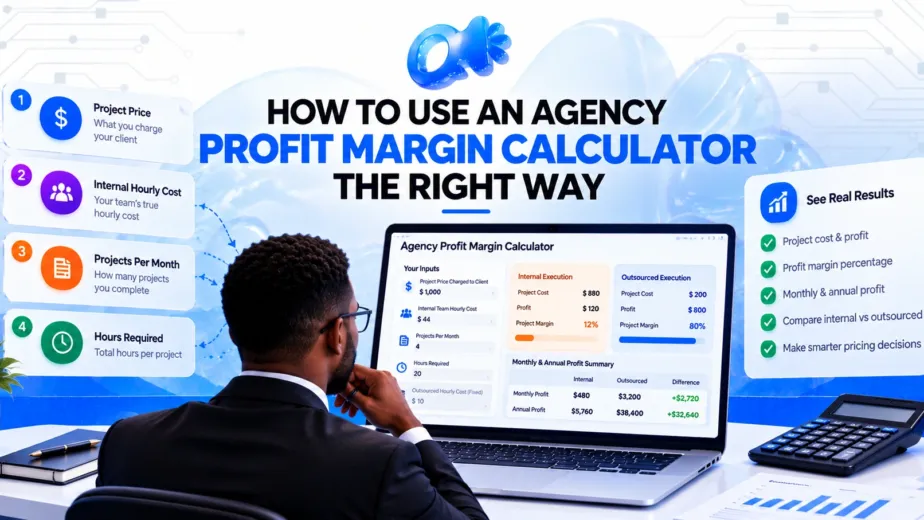
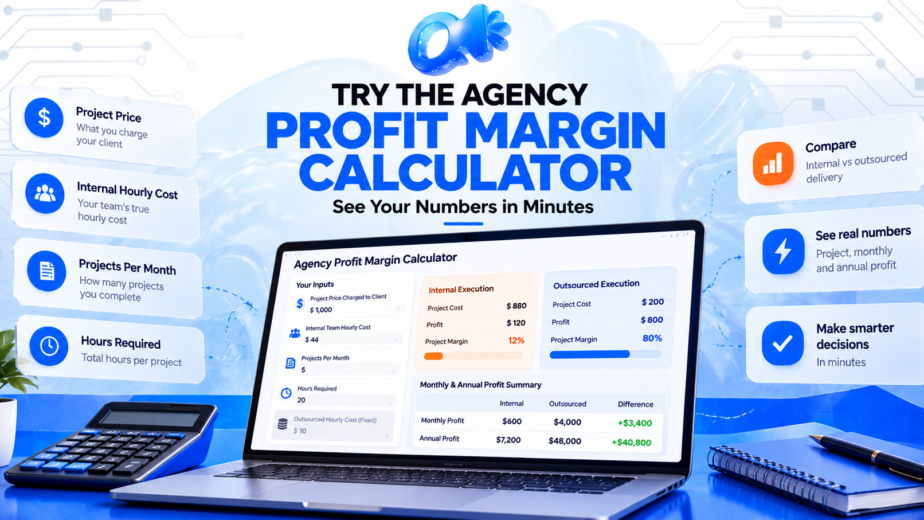
That’s a $60,000 annual difference from the same workload, and it’s exactly the calculation our Agency Profit Margin Calculator runs when you enter a project price, an internal hourly cost, projects per month and hours required. You can try it on our Agency Profit Margin Calculator with your own numbers.
But we said we’d be honest, so here’s the catch.
The Honest Adjustment: Add Your Own Time
The outsourced figures above assume the work costs only $10 an hour. That leaves something out: you still have to brief the work and review it.
Let’s adjust the example. Suppose you or your account manager spend five hours briefing, reviewing and handling feedback on the website project, and your time is worth $35 an hour.
- Management cost = 5 hours × $35 = $175
- Total outsourced cost = $500 + $175 = $675
- Profit = $3,000 − $675 = $2,325
- Margin = $2,325 ÷ $3,000 = 77.5%
It’s still a big improvement over 41.7%, but it’s not 83.3%. Always include your own time in the calculation. It gives you a realistic figure and stops you from being disappointed later.
If a partner’s rate looks very cheap but requires ten hours of your time per project to fix problems, the real margin gets worse quickly. That’s why quality, clear briefs and reliable turnaround matter as much as the hourly rate. We covered how to pick a partner in what is a white label digital marketing agency.
Worked Example 2: A Monthly SEO Retainer
Retainers behave differently from projects, because the hours can drift upward while the price stays fixed. Here’s an example.
The service: Monthly SEO for a local business.
- Monthly fee: $1,500
- Hours per month: 25
- Internal hourly cost: $30
Internal:
- Cost = 25 × $30 = $750
- Profit = $750
- Margin = 50%
Outsourced at $10 an hour:
- Cost = 25 × $10 = $250
- Profit = $1,250
- Margin = 83.3%
Now imagine the client keeps asking for extras and the real hours creep to 35 a month. Internally, the cost becomes 35 × $30 = $1,050, profit drops to $450 and margin falls to 30%. Outsourced, cost becomes $350, profit is $1,150 and margin is 76.7%.
The lesson: fixed-price work is sensitive to scope creep, and a lower hourly cost cushions you against it. Still, the better fix is to define scope clearly and track hours on every account. If you offer SEO, our White Label SEO + GBP service is built for this kind of repeatable monthly work.
Markup vs Margin: The Mistake That Costs Agencies Money
This one catches people all the time. Markup and margin are not the same thing.
- Markup is profit as a percentage of cost.
- Margin is profit as a percentage of revenue.
Example: it costs you $400 to deliver a project and you charge $1,000.
- Profit = $600
- Markup = $600 ÷ $400 = 150%
- Margin = $600 ÷ $1,000 = 60%
Same project, two very different-sounding numbers. If you decide “I want a 50% margin” but apply a 50% markup, you’ll end up with much less profit than you planned. A 50% markup on $400 cost means charging $600, which gives a margin of only 33.3%.
To hit a target margin, use this formula:
Price = Cost ÷ (1 − Target Margin)
For example, with a cost of $400 and a target margin of 60%:
$400 ÷ (1 − 0.60) = $400 ÷ 0.40 = $1,000
Keep that formula handy. It removes the guesswork from pricing.
Gross Margin vs Net Margin
The examples so far show gross margin: revenue minus the direct cost of delivering the work. That’s the right number for judging individual projects.
Net margin is what’s left after all business costs, including rent, software, marketing, admin staff, insurance, your own salary and taxes.
Both matter, for different reasons.
- Gross margin tells you whether each project or service is worth doing.
- Net margin tells you whether the business as a whole is healthy.
An agency can have a healthy 60% gross margin and still lose money if overheads are too high. So work out both, but start with gross margin per service, because that’s where you have the most control.
What Counts as a “Good” Agency Margin?
We’ll be careful here. Benchmarks vary by size, service, location and the way people calculate them, so any single “industry standard” figure should be treated with suspicion.
A more useful approach is to set your own target based on your goals. Ask yourself:
- What net profit do I need the business to make?
- What overheads do I have to cover?
- What gross margin does each service need to reach that?
Work backward from there. Then measure each service against the target. If your web design projects average 42% and your SEO retainers average 50%, you’ll know where to focus your improvement efforts.
Five Ways to Improve Your Agency’s Profit Margin
Once you know how to calculate agency profit margin, the next question is how to improve it. There are really only five levers.
1. Raise your prices
The most direct lever, and the one agencies avoid most. If your margin is thin and clients aren’t complaining, you may be underpriced. Price on the value you deliver, not just the hours you spend.
2. Reduce delivery cost
This is where outsourcing comes in. Moving production to a partner at $10 an hour can lower your cost significantly, as the examples above show. If you want to compare it with hiring, see White Label vs. In-House Marketing Team.
3. Reduce hours per project
Templates, checklists and documented processes cut the time each project takes. We explore this in Stop Doing More: Why Smart Agencies Build Systems Instead.
4. Control scope creep
Write clear scopes, define revision limits and charge for extras. Every unpaid hour comes straight out of your margin.
5. Improve utilization
If your team has idle hours, you’re paying for capacity you’re not using. Variable-cost delivery, such as buying outsourced hours only when you need them, avoids that.
Often the best results come from combining two or three of these.
Common Mistakes When You Calculate Agency Profit Margin
Forgetting non-billable hours. Meetings, revisions, emails and reporting all take time. Include them.
Using salary instead of loaded cost. Salary alone understates what an employee costs you.
Ignoring your own time. Your hours are not free. Price them in.
Confusing markup with margin. Covered above, and worth checking twice.
Calculating once and never again. Costs, hours and prices change. Review your numbers quarterly.
Only measuring the total. An average across all clients hides the unprofitable ones. Calculate per project and per client.
Not tracking time at all. If you don’t record hours, you can’t calculate accurate margins. Even rough time tracking beats none. Our shared task tracker gives partners’ agencies a clear view of where every outsourced hour went.
A Quick Template You Can Copy
Use this on any project:
- Price charged to client: $________
- Hours required: ________
- Hourly cost (internal or outsourced): $________
- Extra management/review hours: ________ × $________ = $________
- Total cost = (hours × hourly cost) + management cost
- Profit = price − total cost
- Margin = profit ÷ price × 100
Do this for your last five projects. The results will probably tell you something you didn’t know.
How Outsourcing at $10 an Hour Changes the Picture
Since this blog is written by a white label partner, let’s be clear about what we offer and what we don’t claim.
Our rate is $10 an hour. You buy hours in blocks: $200 for 20 hours (Starter), $400 for 40 hours (Growth) and $800 for 80 hours (Scale). The rate is the same on every block, and hours don’t expire, so if you buy 40 and use 25, the other 15 are waiting when you return. You can spend them across SEO, web, social, ads, design or automation.
What that means for your margin depends on your current cost and your pricing. For agencies with an internal hourly cost of $30 to $45, moving production to a $10 rate can change project margins dramatically, as the examples show. For agencies that already deliver at a very low cost, the gap is smaller.
We also don’t claim outsourcing removes your workload entirely. You still brief, review and manage the client relationship. What it removes is much of the production grind, and it turns a fixed cost into a variable one.
If you’d like to test it, our 8-hour free trial lets you send real work, such as a landing page, a batch of social creative, a technical SEO audit or a Google Ads build, and judge both the result and the time it took you to manage.
Frequently Asked Questions
What is the formula for agency profit margin?
Profit Margin (%) = (Revenue − Cost) ÷ Revenue × 100. Revenue is what the client pays, and cost is what it takes to deliver the work.
How do I calculate profit margin on a single project?
Take the project price, subtract the delivery cost (hours × hourly cost, plus any management time), divide the profit by the price and multiply by 100.
What’s the difference between markup and margin?
Markup is profit divided by cost. Margin is profit divided by revenue. A 150% markup equals a 60% margin, so don’t mix them up when setting prices.
Should I include my own time in the calculation?
Yes. If you spend time briefing, reviewing or managing, that’s a cost. Leaving it out makes margins look better than they are.
What is a good profit margin for a marketing agency?
It depends on your services, size and overheads. Rather than chasing a generic benchmark, work out the margin you need to reach your net profit goal and set targets by service.
How often should I recalculate my margins?
At least quarterly, and whenever you change pricing, hire staff or take on a new type of work.
How does outsourcing affect my agency’s margin?
If your partner’s rate is lower than your internal cost per productive hour, your delivery cost falls and your margin widens, even after adding your review time. Use a calculator with your own numbers to see the effect.
Learning how to calculate agency profit margin takes about ten minutes and could change how you run your business. Price, hours and hourly cost are the only inputs. Once you have them, you can see which projects make money, which ones quietly lose it and what happens when you change the way you deliver.
Don’t stop at one calculation. Run your last five projects through the formula, compare the results and look for patterns. Then test what would change if you moved some of that work to a partner, remembering to include your own review time.
Numbers won’t run your agency for you, but they’ll stop you making decisions in the dark.
Skip the Math: Use Our Agency Profit Margin Calculator
Don’t want to do the arithmetic by hand?
Skip the math and use our Agency Profit Margin Calculator. Enter your project price, internal hourly cost, projects per month and hours required, and it shows your internal margin, your outsourced margin at $10 an hour and the extra profit you could make every month and every year.
When you’re ready to test the outsourced side on real work, claim your 8-hour free trial. You can also read our FAQs or explore our services.