A white label digital marketing agency is a company that does marketing work for other agencies and lets those agencies put their own name on it. You sell the service. You own the client relationship. You set the price. The white label partner does the work quietly in the background, and the client never sees their name on anything.
That’s the short answer, and if it’s all you needed, you can stop reading here. But most agency owners who search for a white label digital marketing agency aren’t really asking for a definition. They’re asking something closer to this: Can I hand off real client work to someone I’ve never met, keep my standards intact, and still make more money than I do today?
The honest answer is yes, but only if you pick the right partner and set the arrangement up properly. This guide walks through how the model works, what you can outsource, what it typically costs, where it goes wrong, and how to choose a partner you can trust with your clients.
We’re Wordout Media, and we are a white label digital marketing agency ourselves, so we have an obvious interest here. We’ve tried to write this the way we’d explain it to an agency owner across a table: plainly, with the downsides included.
The Word “White Label” Comes From Product Manufacturing
The term isn’t new and it isn’t unique to marketing. In retail, a white label product is made by one company and sold under another company’s brand. The plain white packaging is where the name comes from: a blank label that any retailer can stamp their own logo on.
Supermarket own-brand goods work this way. So do many software products, and so does a lot of what gets sold as “in-house” by companies you’d recognize. Digital marketing borrowed the idea because the economics are the same. Some businesses are better at selling and managing relationships. Others are better at production. Splitting the two lets each side do what it’s good at.
In agency terms, a white label marketing agency handles production (the SEO work, the website build, the ad campaign, the design files) while you handle the front end: the pitch, the strategy conversation, the monthly call, the invoice.
How a White Label Digital Marketing Agency Actually Works
The mechanics vary from partner to partner, but the flow is usually close to this.
1. You win or already have a client. Nothing changes on your side of the relationship. The client signs with you, pays you, and speaks to you.
2. You send a brief to your partner. This might be a one-line request (“build a five-page WordPress site for a dental practice”) or a detailed scope with brand files, login access and reference sites. Good partners will tell you quickly if the brief is missing something.
3. The partner assigns the work to a specialist. At a well-run white label digital marketing agency, one account manager owns your projects and briefs the right person internally. That matters, because the alternative is you chasing four different people across four time zones.
4. The work comes back under your branding. Reports carry your logo. Deliverables carry your logo. Some partners will even use email addresses on your domain and join client calls as a member of your team if you want that.
5. You review, adjust and send it to the client. You remain the quality gate. The partner’s job is to make that review quick and uneventful.
6. You invoice your client at your own rate. The difference between what you pay your partner and what you charge your client is your margin. That gap is the whole point of the model.
That’s it. There’s no magic. It’s a delivery arrangement, and it works well when the brief is clear, the partner is reliable and you keep a sensible review process.
What Services Can a White Label Marketing Agency Handle?
Most white label partners specialize in one or two areas. A smaller number cover the full range. At Wordout Media, we cover six, and we’ll use them as a practical map of what’s usually available:
White Label SEO and Google Business Profile
This is one of the most commonly outsourced services because it’s repeatable, time-consuming and easy to package. It includes keyword research, on-page optimization, technical audits, content briefs and Google Business Profile management for local clients. If SEO is the service you want to add first, our White Label SEO + GBP page explains what the work looks like in practice.
Website Design and Development
Business websites, landing pages, WordPress and Elementor builds, and updates to existing sites. Web projects are a natural fit for outsourcing because they have a clear start and finish. You can see what we build on our Website Design & Development.
Social Media Management
Content calendars, Reels, carousels, graphics and captions. This is high-volume, deadline-driven work that overwhelms small in-house teams quickly. Our Social Media Management service is built around that rhythm.
Paid Advertising on Google and Meta
Campaign setup, ad copy, creative, audience building and ongoing optimization. If you’re running paid media for clients but don’t want to keep a full-time buyer on payroll, a partner can carry the day-to-day. See Paid Advertising – Google & Meta.
Creative Design and Figma Work
Brand graphics, ad creative, mockups, presentation design and interface design in Figma. Details are on our Creative Design + Figma page.
Automations and AI Workflows
Building automations in tools like n8n and GoHighLevel so your clients’ lead follow-up, reporting and internal processes run without manual effort. This is a newer service line for many agencies, and it’s where a lot of them are finding fresh retainer revenue. Read more on our Automations + AI Workflows page.
You don’t need all six. Most agencies start with one, usually whatever is causing the most pain in their delivery schedule.
Who Uses a White Label Digital Marketing Agency?
The model is used by a wider range of businesses than people expect.
Small and mid-size marketing agencies use white label partners to take on more clients without hiring. This is the most common case, and it’s who we mainly serve across the US, Canada and Europe.
Freelancers who are outgrowing themselves. A solo consultant who’s booked solid can add a partner and turn into an agency without the overhead of employees.
Web design studios that want to add SEO, ads or social to what they already sell, so a one-off website turns into a monthly retainer.
IT companies and consultancies whose clients keep asking “can you also do our marketing?” and who’d rather say yes than refer the client elsewhere.
Larger agencies with overflow. Even established shops use a white label agency partner to absorb busy seasons, so they don’t turn work away or burn out their team.
What these groups share is a simple problem: demand for their services is bigger than their capacity to deliver, or they want to sell services they don’t have in-house.
The Real Benefits (and Where They Come From)
Every article on this topic lists “benefits.” Let’s be more specific about why each one exists.
Better margins
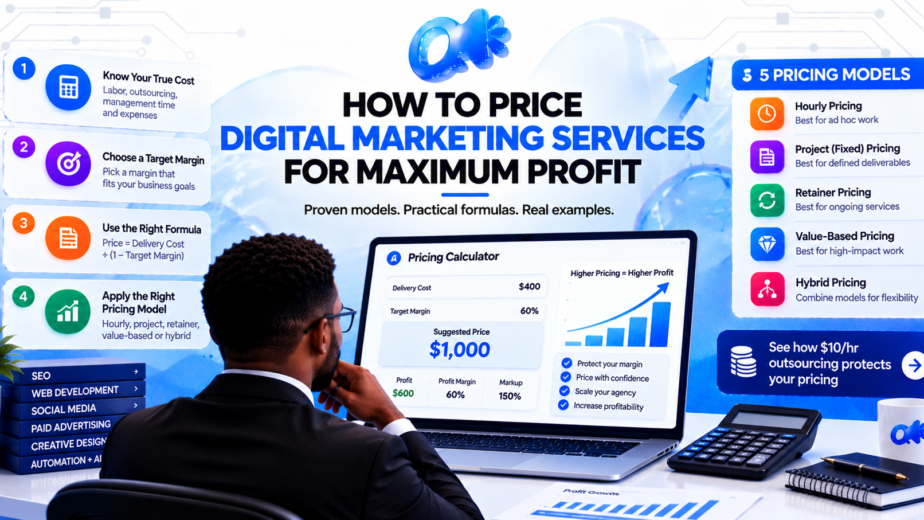
This is the headline reason. If you pay $10 an hour for work you then bill to a client at a multiple of that, your margin widens. Compare that with paying a salaried employee whose cost doesn’t change whether they’re busy or not. We cover the math in detail in our guide on how to calculate your agency’s profit margin, and you can test your own numbers with our Agency Profit Margin Calculator.
Flexible capacity
Hiring is slow and firing is worse. A white label partner lets you scale up in a week and back down the next month. You buy hours when you need them.
No recruiting or training overhead
Finding, interviewing, onboarding and managing a new hire consumes real time even before they produce anything. A good partner arrives already trained.
Access to specialists
Hiring a technical SEO, a paid media buyer, a motion designer and a WordPress developer as full-time staff would be unrealistic for most small agencies. Through a partner, you get access to all of them, paid for only when you use them.
Faster turnaround
Because a white label team is already set up to produce, many tasks come back the same day or within 48 hours. Larger builds get a scoped timeline up front.
More time for the work only you can do
This one gets overlooked. When production is handled, you get your calendar back for sales, client strategy and the relationships that keep retainers alive. We’ve written about this trap before in Why Being Constantly Busy Is Killing Your Agency’s Profit.
The Downsides Nobody Puts in the Sales Deck
A fair guide has to include this section. White labeling isn’t risk-free, and pretending otherwise is how agencies get burned.
Quality control is still your responsibility. Your client doesn’t know your partner exists. If the work is poor, it’s your name on it. You must review what comes back, at least until you trust the partner’s standard.
Communication gaps cost time. A vague brief produces a vague result. Agencies that get the most from a partner are the ones that write clear briefs and share brand guidelines, logins and examples upfront.
Some partners subcontract. This is the biggest hidden risk. Some providers pass your work to freelancers or another agency, and you end up several steps removed from the person actually doing it. Ask directly who does the work. We keep our team of fifteen in-house for exactly this reason.
Time zones and availability vary. A partner who sleeps while your client is awake creates delays. Look for overlap with your working hours. We work EST hours so briefs sent in a US morning are usually in motion before lunch.
Confidentiality has to be real. You’re handing over client logins and business information. Make sure your partner is comfortable with NDAs and has a clear approach to access and data.
You can become dependent. If one partner does everything and disappears, you’re exposed. Sensible agencies keep documentation of what’s been built and where the assets live.
None of these problems are reasons to avoid the model. They’re reasons to be selective, and to ask better questions before you sign anything.
How Much Does a White Label Digital Marketing Agency Cost?
Pricing is where the market is most inconsistent, so it helps to know the common structures.
Fixed monthly retainers. You pay a set amount per month for a defined package, such as “SEO: 10 pages optimized, 4 blog posts, monthly report.” Predictable, but you can pay for capacity you don’t use.
Per-project pricing. A flat fee for a defined deliverable, like a website or an audit. Clear scope, but changes often trigger extra charges.
Percentage or markup models. The partner sets wholesale prices and you add your markup. Simple in theory, but the wholesale rates are sometimes higher than they look.
Hourly or hour-block pricing. You buy a number of hours and spend them on whatever work you need. This is the model we use. Our rate is $10 an hour, sold in blocks: $200 for 20 hours (Starter), $400 for 40 hours (Growth), and $800 for 80 hours (Scale). The rate stays the same on every block, and unused hours don’t expire. If you buy 40 and use 25, the remaining 15 are there when you come back.
The advantage of hour blocks is flexibility. You aren’t locked into one service, so you can put hours into SEO this month and a website build the next. Each agency also gets a shared task tracker showing what every hour went to, so there’s no guessing.
A note on cost: the cheapest option isn’t automatically the best. Very low prices often come with heavy turnover, weak communication or outsourced-to-outsourcers arrangements. What you want is a rate that’s low enough to protect your margin and stable enough that the team stays consistent. As a rough benchmark, agencies that outsource commonly bill the work at two to three times the cost. That multiple is what makes the model worth doing.
How to Choose a White Label Marketing Agency: A Practical Checklist
Use this list when you’re comparing providers. It works for us and for anyone else you’re considering.
- Is the team in-house? Ask who does the work and where they’re employed. Subcontractor chains are a risk.
- Is it truly white label? Reports, files and communications should carry your brand only.
- Can you see a sample? Ask for examples of deliverables, or better, a trial.
- What’s the turnaround? Get a specific answer for small tasks and for larger builds.
- Who’s your point of contact? One account manager is much easier to work with than a ticket queue.
- How is pricing structured? Look for clarity, no hidden setup fees and no surprise rate changes.
- What tools do they use? Familiarity with the platforms your clients already use saves onboarding time.
- How do they handle revisions? Find out what’s included and how feedback is handled.
- What’s their communication style? Response time in the sales phase is usually a fair preview of response time later.
- Do they reduce your workload or add to it? A partner who needs constant supervision defeats the purpose.
We offer an 8-hour free trial for exactly this reason. Send us eight hours of real work (a landing page, a batch of social creative, a technical SEO audit, a Google Ads build) and judge the output and the working relationship before you spend anything. There’s no contract and no card required.
Common Mistakes Agencies Make When They Start Outsourcing
Most problems with a white label agency partner come from the agency side, not the partner side. Here are the patterns we see most often.
Starting with your hardest client. Test the relationship on something lower-stakes first. Build trust before you hand over your most demanding account.
Writing thin briefs. “Do their SEO” isn’t a brief. Include goals, competitors, target locations, brand voice, examples of work you like and anything the client has said they dislike.
Skipping the review step. Even a great partner benefits from your eye. Build a short review checklist and use it every time.
Pricing based on cost instead of value. Your client isn’t paying for hours. They’re paying for results and peace of mind. Don’t pass your savings straight to the client; keep the margin that makes the arrangement worth it.
Treating the partner like a vendor instead of a team. Share context. Explain the client’s business. The more your partner understands, the less you correct.
Not documenting anything. Keep a record of logins, decisions and deliverables. It protects you if either side changes.
Myths About the White Label Digital Marketing Agency Model
“My clients will find out.” Not if the arrangement is done properly. Your name is on everything, and communication flows through you. Many agencies also present their partner’s account manager as part of their own team, which is normal industry practice.
“It’s only for tiny agencies.” Agencies of all sizes use it. Larger firms often use partners to handle overflow or specialist tasks.
“Quality will drop.” It can, if you choose badly. A good partner often raises quality by putting specialists on tasks your generalist staff would struggle with.
“It’s cheating clients.” Clients hire agencies for outcomes. What matters is that the work is good, on time and accountable to you. Businesses subcontract all the time in every industry.
“I’ll lose control.” You keep the client, the strategy, the pricing and the final say. What you give up is the production grind.
A Simple Way to Start
If you’re curious but cautious, here’s a low-risk approach.
Week 1: Pick one recurring task that drains your team, such as monthly SEO reporting, social graphics or landing page builds.
Week 2: Write a proper brief and send it as a trial. Judge the output against your own standard.
Week 3: Give feedback. Notice how the partner responds. Adjustment speed tells you a lot.
Week 4: If it went well, move one live client’s task across. Keep reviewing.
Month 2 onward: Expand gradually, adding services and clients as you build trust.
This approach limits your risk and gives you real evidence instead of a sales pitch.
Frequently Asked Questions About White Label Digital Marketing Agencies
What is a white label digital marketing agency in simple terms?
It’s an agency that does marketing work for other agencies, under the other agency’s brand. You sell and manage the client relationship; the partner delivers the work behind the scenes.
Will my clients know I use a white label marketing agency?
They shouldn’t. At Wordout Media, deliverables and reports carry your logo, and we work inside your systems. The client only ever sees your agency.
Is a white label agency partner the same as a freelancer?
Not quite. A freelancer is one person with one skill set and limited capacity. A white label agency has a team, an account manager and a process, so it can cover multiple services and keep going if one person is unavailable.
How much does it cost to work with a white label digital marketing agency?
It depends on the model. Ours is $10 an hour, sold in blocks of 20, 40 or 80 hours ($200, $400, $800). The rate is the same on every block.
What services should I outsource first?
Start with whatever is most repetitive and time-consuming: often SEO tasks, social media production or web builds. These are easy to define and easy to review.
How long does delivery take?
For most design, ad setup and video editing tasks, same day to 48 hours. Larger projects such as full websites get a scoped timeline before work starts.
Can I try a partner before committing?
Yes, and you should. We offer an 8-hour free trial with no contract, no card and no sales call required first.
Is white labeling ethical?
Yes. Outsourcing production while keeping accountability is normal across industries. The ethical responsibility is to deliver good work, protect client data and stay honest about results, and that stays with you and your partner.
A white label digital marketing agency isn’t a shortcut or a trick. It’s a division of labor. You focus on winning clients, shaping strategy and keeping relationships strong. Your partner focuses on production. When it’s done well, you widen your margins, take on more accounts and stop being the bottleneck in your own business.
When it’s done badly, you inherit somebody else’s mistakes under your own name. The difference comes down to choosing a partner who’s transparent about who does the work, honest about turnaround, clear on pricing and willing to prove themselves before you commit.
Ready to See How It Works?
If you’re weighing up a white label agency partner, the quickest way to find out is to test one on real work.
Read the Wordout Media FAQs to see how our model works, or explore our white label services to find the right starting point. When you’re ready to try us, claim your 8-hour free trial and judge the work for yourself.