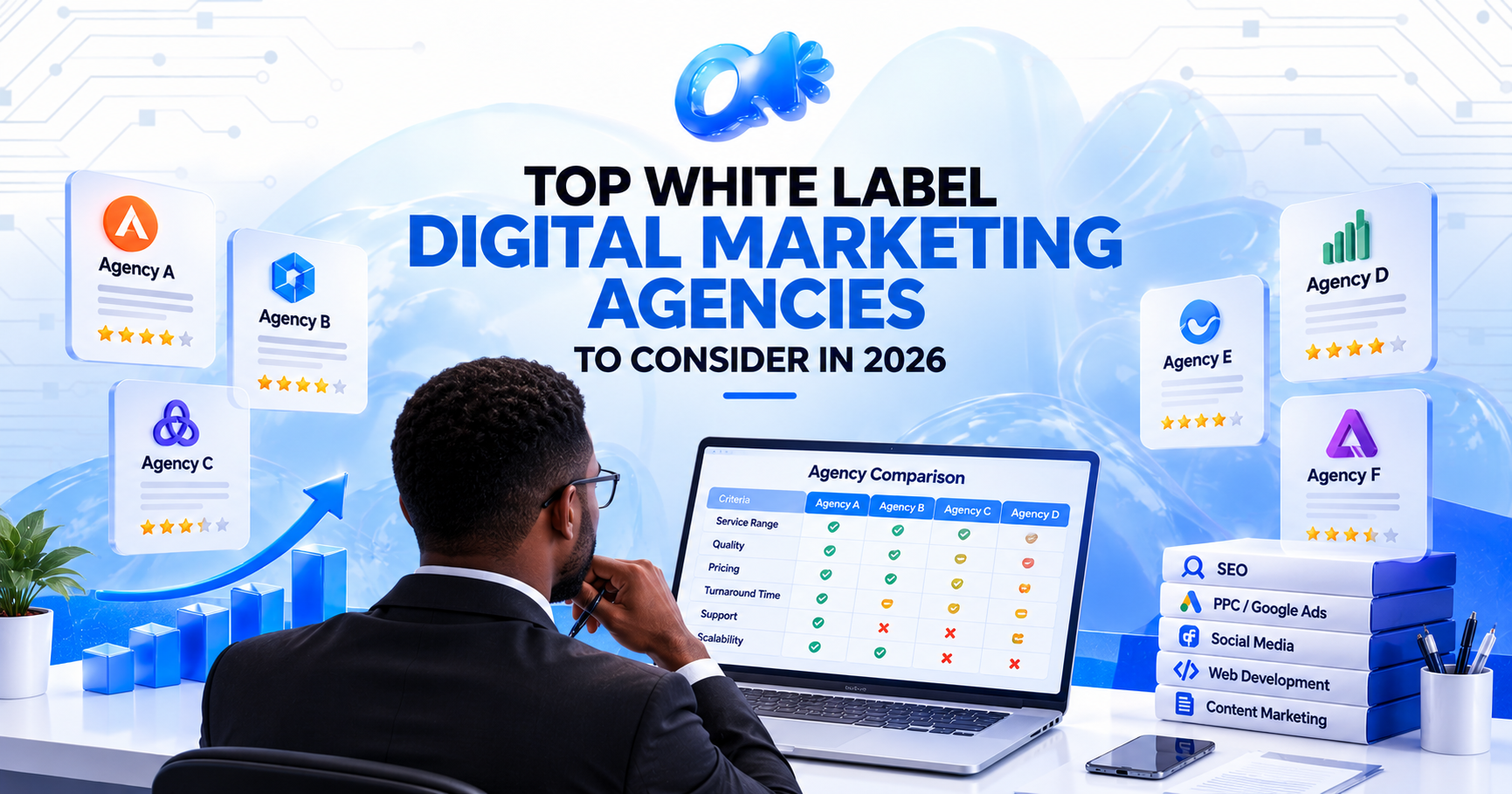
Most “best white label digital marketing agencies” articles are a ranked list of company names with a paragraph of praise for each. Many are written by one of the companies on the list, and the ranking tends to put the author first.
We’re Wordout Media, and we are a white label partner ourselves, so we have the same conflict of interest. Rather than pretend otherwise, we’ve written this guide differently. Instead of declaring winners, we’ll show you the main types of white label provider you’ll run into in 2026, explain what each is good and bad at, give you a scorecard to rate any candidate (including us) and then tell you plainly where Wordout Media fits and where it might not.
Naming and ranking specific competitors would mean making claims about their pricing, quality and clients that we can’t verify from the outside, and you’d be right to be suspicious of any list that did. Pricing, teams and terms change quickly in this industry. What stays useful is knowing how to evaluate them.
If you’d like a primer first, start with our explainer on what a white label digital marketing agency is. If you already know the basics, read on.
What “Best” Actually Means for an Agency
There’s no single best partner. There’s the best partner for your situation, and the right answer changes depending on a handful of factors.
- What you need to outsource. One service or six?
- Your volume. A few hours a month or several hundred?
- Your clients. Local businesses, e-commerce brands, professional services?
- Your standards. Are you selling premium work or volume work?
- Your budget and margin targets. What can you afford to pay and still make the margin you need?
- Your time. How much management effort can you spare?
An agency serving local dentists with SEO and websites needs something different from one running paid media at scale for e-commerce brands. So before you shortlist anyone, write down your answers to those six points. You’ll use them below.
The Main Types of White Label Provider in 2026
Here’s a map of what’s out there. Most providers fit into one of these categories, though many blend two.
1. Full-service white label agencies
What they are: Companies that offer a broad menu of services, such as SEO, web development, social, paid ads and design, under one roof, usually with a dedicated account manager.
Good for: Agencies that want one partner for several services and prefer to brief one person.
Watch out for: Breadth can hide thin skills. Ask who actually does each service and whether the team is in-house or subcontracted.
2. Specialist white label providers
What they are: Providers that do one thing deeply, such as SEO only, paid media only or web development only.
Good for: Agencies that need top-tier expertise in a single discipline and are happy to manage several vendors.
Watch out for: Managing three specialist partners can cost you more time than one full-service partner. You become the coordinator.
3. White label platforms and marketplaces
What they are: Online platforms where you order packaged deliverables (a set of backlinks, a blog post, a site audit) from a menu, often at fixed prices.
Good for: Small, well-defined, repeatable tasks.
Watch out for: Quality can vary widely between orders, and there’s often little relationship or context. Complex or nuanced work usually suffers.
4. Freelancer networks and agencies built on freelancers
What they are: Providers that assign your work to independent contractors, sometimes several layers removed from you.
Good for: Cheap, occasional tasks with low stakes.
Watch out for: Consistency and accountability. If the freelancer disappears, so does your context. Ask directly whether work is passed to contractors.
5. Hourly or hour-block white label teams
What they are: In-house teams that sell blocks of hours you can spend on any service. This is the model Wordout Media uses.
Good for: Agencies that want flexibility, predictable rates and the freedom to shift effort between services month to month.
Watch out for: You need to write good briefs, because you’re buying time rather than a fixed package. Ask how hours are tracked and reported.
6. Large, established white label agencies
What they are: Bigger providers with many staff, formal processes and often higher minimums.
Good for: Agencies with high volume and larger budgets that need serious capacity.
Watch out for: Minimum commitments, longer onboarding and the feeling of being a small client in a big queue.
How to Score Any White Label Partner: A Practical Scorecard
Use this scorecard for every candidate. Give each factor a score from 1 to 5, then total them. Weight the factors that matter most to you.
| Factor | What to ask | Score (1-5) |
|---|---|---|
| Who does the work | Is the team in-house or subcontracted? Can you meet them? | |
| True white labeling | Do reports, files and communications carry only your brand? | |
| Service fit | Do they cover the services you need at a quality you’d stand behind? | |
| Turnaround | What’s realistic for small tasks and larger builds? | |
| Pricing clarity | Are rates transparent, with no setup fees or surprise increases? | |
| Flexibility | Can you scale up and down, or are you locked in? | |
| Communication | How fast do they respond during the sales stage? Who’s your contact? | |
| Time zone overlap | Do their working hours overlap with yours? | |
| Reporting and visibility | Can you see what each hour or task produced? | |
| Trial or proof | Can you test on real work before committing? |
A partner who scores 40 or more across these ten is worth serious consideration. Below 30, keep looking.
You’ll notice the price is only one of the ten. That’s deliberate. The cheapest partner often costs more once you count revision rounds, missed deadlines and your own management time. We covered this in more depth in How to Calculate Your Agency’s Profit Margin.
The Questions Every Agency Should Ask Before Signing
Print these out and take them into every sales conversation.
About the team
- Is everyone who touches my work a direct employee?
- How long has the team worked together?
- Who will be my day-to-day contact?
About the work
- Can you show me examples or run a trial on real work?
- What’s your revision process and how many rounds are included?
- What happens if the work doesn’t meet my standard?
About speed and reliability
- What’s your turnaround for a small task? For a large build?
- What hours do you work and how does that overlap with mine?
- What happens if my contact is on holiday or leaves?
About money
- What exactly does the rate cover and what does it not cover?
- Are there setup fees, minimums or long-term contracts?
- Do unused hours or credits expire?
About confidentiality
- Will you sign an NDA?
- How do you handle access to client accounts and logins?
- Will my clients ever see your name?
A partner who answers all fifteen clearly, without hedging, is showing you how they’ll behave once you’re a client.
Common Pricing Models Compared
Pricing structures differ enough to change your margins, so here’s how the common models stack up.
| Model | How it works | Advantage | Drawback |
|---|---|---|---|
| Monthly retainer | Fixed fee for a defined package | Predictable | Pay for unused capacity |
| Per-project fee | Flat price per deliverable | Clear scope | Changes often cost extra |
| Wholesale markup | Partner sets wholesale prices, you add markup | Simple to resell | Wholesale rates can be higher than they look |
| Hourly / hour blocks | Buy hours, spend them on any service | Flexible, transparent | Requires clear briefs |
No model is always best. Agencies with steady, well-defined work often like retainers. Agencies with varied, changing demand often prefer hour blocks. Whichever you choose, run the numbers on your own margins before committing, and remember to include the time you’ll spend managing the work.
Where Wordout Media Fits
Now, the part you may have been waiting for. Here’s an honest description of what we are, using the scorecard’s terms.
Who does the work
Wordout Media is a team of fifteen people, all in-house. We don’t use subcontractor chains, and we don’t hand your client’s work to people we’ve never met. You get one account manager who learns your standards and briefs the right specialist internally.
True white labeling
Everything we deliver carries your branding. Clients only ever see your agency. If you’d like our account manager to appear as a member of your team on client calls, that’s something we do regularly.
Services
We cover six areas:
- White Label SEO + GBP: keyword research, on-page, technical SEO and Google Business Profile optimization
- Website Design & Development: business websites, landing pages, WordPress and Elementor builds
- Social Media Management: content calendars, Reels, carousels, graphics and captions
- Paid Advertising – Google & Meta
- Creative Design + Figma
- Automations + AI Workflows: built with tools such as n8n and GoHighLevel
Pricing
Our rate is $10 an hour, sold in blocks:
- Starter: $200 for 20 hours, best for testing us out or covering an overflow month
- Growth: $400 for 40 hours, best for one to two active client accounts
- Scale: $800 for 80 hours, best for multiple accounts and ongoing delivery
The rate is the same on every block, and hours don’t expire. Hours aren’t tied to a single service, so you can spend them on SEO one month and a website build the next. Every agency gets a shared task tracker showing exactly what each hour went to.
Turnaround and hours
Most design, ad setup and video editing tasks come back same day to 48 hours. Larger builds, such as full websites or multi-page SEO projects, get a scoped timeline before we start. We work EST hours, so a brief sent in your morning is usually moving before lunch.
Trial
We offer an 8-hour free trial: no contract, no card and no sales call required first. Send us real work and judge the result.
Where we might not be the best fit
Since honesty is the point of this guide, here’s when you should probably look elsewhere.
- If you need a single, highly specialized discipline at the very top of its field, and nothing else, a dedicated specialist may suit you better.
- If you need very large, round-the-clock capacity, a bigger provider with a much larger team may be more appropriate.
- If your clients strictly require in-country or employee-only delivery, an outsourced model may not satisfy the contract.
- If you want a fixed monthly package with no briefing on your side, an hour-block model asks more of you than a done-for-you retainer would.
We’d rather you choose well than choose us by default.
Red Flags When Comparing the Best White Label Digital Marketing Agencies
Watch for these warning signs, whichever provider you’re looking at.
- Vague answers about who does the work. “Our network of experts” often means contractors.
- No trial or sample work. A provider confident in their quality usually lets you test it.
- Prices that look far too good to be true. Very low rates often mean high turnover or corners cut.
- Long lock-in contracts up front. Fair partners earn your business over time.
- Slow replies during the sales process. It rarely gets faster after you sign.
- No reporting or task visibility. If you can’t see what your money bought, you can’t manage the relationship.
- Pressure to decide quickly. Good partners let you evaluate at your own pace.
- Guarantees of rankings or results. Nobody can honestly promise a particular search position.
A Simple Four-Step Process to Choose Your Partner
Rather than reading a dozen more lists, do this.
Step 1: Define your needs. Write down the services, the monthly volume and the standard you require.
Step 2: Shortlist three providers. Pick different types, such as a full-service team, a specialist and an hour-block partner, so you compare models as well as companies.
Step 3: Score them. Use the scorecard above and ask the fifteen questions.
Step 4: Run a trial. Send each shortlisted partner the same small, real task and compare the results, the communication and the time you spent managing it.
That last step is worth more than any review. The way a partner handles a real brief tells you nearly everything you need to know. And if you’d like to see how the numbers work on your side before you begin, our Agency Profit Margin Calculator lets you compare your internal cost with outsourced delivery in a couple of minutes.
How to Get the Best Results From Any White Label Partner
Whichever partner you pick, a few habits make the relationship work.
- Write detailed briefs. Include goals, examples, brand guidelines and anything the client dislikes.
- Start small. Test with a lower-stakes account before handing over your most demanding client.
- Review everything. Your name is on the final work.
- Give clear, specific feedback. It speeds up improvement.
- Share context. The more your partner understands the client, the fewer corrections you’ll make.
- Document everything. Keep records of logins, decisions and deliverables.
- Treat them like a team. Partners who feel included tend to do better work.
We explore this further in Smart Outsourcing: How Agencies Grow Without Burnout.
Frequently Asked Questions
What are the best white label digital marketing agencies in 2026?
There’s no universal answer, because “best” depends on your services, volume, clients and budget. The most reliable way to find the best fit is to shortlist a few providers of different types, score them on the same criteria and test each on real work.
How do I choose a white label digital marketing agency?
Check who does the work (in-house or subcontracted), confirm that everything is truly white label, compare pricing models, ask about turnaround and communication and run a trial before committing.
How much do white label digital marketing agencies charge?
Models vary: monthly retainers, per-project fees, wholesale markups and hourly blocks. At Wordout Media, the rate is $10 an hour, sold in 20, 40 and 80-hour blocks for $200, $400 and $800.
Is it safe to give a white label agency access to client accounts?
It can be, if you choose carefully. Ask about NDAs, how logins are handled and who has access. Give access on a need-to-have basis and keep your own records.
Can clients tell I’m using a white label partner?
Not when it’s done properly. Reports, files and communications should carry only your brand.
Should I use one partner or several?
One full-service partner is simpler to manage. Several specialists can offer deeper expertise but cost you more coordination time. Many agencies start with one partner and add specialists later if needed.
Is a free trial worth doing?
Yes. It’s the best way to judge quality, communication and the effort the relationship takes before you spend money.
The best white label digital marketing agencies aren’t the ones with the loudest marketing or the top spot on somebody’s list. They’re the ones that are transparent about who does the work, honest about turnaround and pricing, easy to communicate with and willing to prove themselves on your real work before you commit.
Use the types, the scorecard and the questions in this guide to compare candidates fairly. Include us in that comparison if you like. We’d be glad to be judged the same way as everyone else.
See Where Wordout Media Fits
The quickest way to find out whether we belong on your shortlist is to test us.
See where Wordout Media fits and get your free 8-hour trial. Send us real work, whether that’s a landing page, a batch of social creative, a technical SEO audit or a Google Ads build, and judge the output and the working relationship before you spend anything.
Prefer to read more first? Browse our services, check the FAQs or learn more about us.