Talk to three agency owners about outsourcing and you’ll hear three vocabularies. One says she “resells” SEO. Another says he “white labels” his web builds. A third is shopping for a “private label” partner. Are they all doing the same thing?
Sometimes. Often not. And the difference matters, because the model you choose decides whose name appears on the work, who owns the client, how much margin you keep and how much risk you carry.
This guide untangles white label vs reseller marketing, and where private label fits in. We’ll define each term in plain language, show how they differ with a simple example, compare them side by side, point out where the labels get blurry and help you choose. We’re Wordout Media, a white label partner, so we obviously have a view. We’ll explain the other models fairly, because the right choice depends on your agency, not on our preference.
If you want the broader picture first, read What Is a White Label Digital Marketing Agency?
The Short Answer
- White label: A provider does the work. You sell it under your brand. The client never sees the provider.
- Reseller: You sell a provider’s existing service or product, often with the provider’s brand, platform or name still visible somewhere. You earn a margin on the sale.
- Private label: A provider creates a service or product made specifically for you, often exclusive to your brand. The term comes from retail and is used loosely in marketing.
The common thread is that someone else produces what you sell. The differences are about branding, exclusivity, control and customization.
White Label Marketing, Explained
In white label marketing, a partner delivers finished work and you put your name on it. Reports carry your logo. Deliverables carry your branding. Communication can come from your domain. The client sees only your agency.
Example: You sell a monthly SEO retainer to a local dentist. Your partner performs the keyword research, on-page optimization and Google Business Profile work. The dentist receives a report with your logo, explained by you, and pays you.
Who owns the client: You.
Who sets the price: You.
What the client sees: Only you.
Where the provider’s work comes from: People doing custom work for your clients, usually inside your processes.
At Wordout Media this is what we do: you keep the client, the branding and the invoice, and we handle SEO, web builds, social, paid ads, design and automation behind the scenes. See How Does White Label Marketing Work, Step by Step? for the workflow.
Reseller Marketing, Explained
In reseller marketing, you sell a service or product that already exists as the provider’s offering. You earn a margin or commission, but the product usually remains recognizably theirs.
Example: You sign up as a reseller of an SEO reporting platform or a pre-packaged ad management service. You sell it to clients at a markup. The client may log into the provider’s dashboard, see the provider’s name on invoices or reports, or be contacted by the provider’s support team.
Who owns the client: Often shared, or at least partly visible to the provider.
Who sets the price: Frequently the provider sets a wholesale price and you add margin, though some programs set a retail price too.
What the client sees: Sometimes only you, but often some trace of the provider.
Where the product comes from: A standard offering, built for many resellers, not custom to you.
Reselling is common with software, hosting and packaged services. It’s usually quick to start and low on setup, but it gives you less control over the experience.
Private Label Marketing, Explained
Private label comes from retail, where a store sells a product made exclusively for it under the store’s brand. In marketing, “private label marketing agency” is typically used to describe a provider that creates services or deliverables tailored for one specific brand, sometimes exclusive to it.
Example: A provider builds a branded audit tool, a custom reporting template or a bespoke service package exclusively for your agency, under your name.
Who owns the client: You.
What the client sees: Only you.
How it differs from white label: Private label implies exclusivity and customization. A white label service might be the same offering delivered to many agencies under different logos. Private labels are shaped specifically around one brand.
In practice, though, the terms are used interchangeably across the industry, which is where the confusion starts.
White Label vs Reseller Marketing: A Side-by-Side Comparison
| Factor | White label | Reseller | Private label |
|---|---|---|---|
| Whose brand does the client see? | Yours only | Often yours, sometimes the provider’s too | Yours only |
| Who owns the client relationship? | You | You, but the provider may be visible | You |
| Who delivers the work? | Provider’s team, under your direction | Provider’s product or standard service | Provider’s team, tailored for you |
| Customization | Medium to high | Low | High |
| Exclusivity | Usually none | None | Often some |
| Pricing | You set your own | Provider often sets wholesale (sometimes retail) | Negotiated |
| Setup effort | Low to medium | Low | Medium to high |
| Control over quality | High (you review everything) | Lower | High |
| Typical margin | Usually widest | Often narrower | Varies |
| Best for | Agencies that want to scale delivery | Agencies that want a quick add-on | Agencies that want a unique offer |
A table can flatten things, but the pattern is clear: white label gives you the most control over what the client sees and what you charge, reselling gives you the fastest start, and private label gives you the most exclusive result.
Where the Labels Blur
Be careful with terminology, because providers use these words loosely. You might meet:
- A “reseller program” that is really white label. Some providers call it reselling but deliver unbranded work under your logo.
- A “white label” offer that is really reselling. The platform, the invoices or the support email may still show the provider’s name.
- “Private label” used as a synonym for white label. Common, and not wrong in casual use.
- “Partner programs” that mix all three. Some combine resale pricing, co-branded reports and optional white labeling.
The solution is simple: ignore the label and ask the questions underneath it.
The Seven Questions That Matter More Than the Name
When a provider says “white label,” “reseller” or “private label,” ask:
- Whose logo is on everything the client sees? Reports, files, dashboards, invoices and emails.
- Will the client ever contact or be contacted by you? The provider should never reach out to your clients directly in a true white label arrangement.
- Who sets the price? You, or the provider?
- Is the work custom or standard? Tailored to your client, or the same package for everyone?
- Who does the work and where? In-house or subcontracted?
- Can I see the client-facing materials first? Samples of reports and deliverables.
- What happens to the relationship if I leave? Do you keep the client and the assets?
Honest answers will tell you which model you’re actually looking at.
Advantages and Drawbacks of Each Model
White label
Advantages
- Full control over branding and pricing.
- Custom work for each client.
- Wide margins when delivery cost is low.
- Scalable without hiring.
Drawbacks
- You must brief and review the work.
- Quality depends on your partner.
- Requires clear processes to run smoothly.
Reseller
Advantages
- Fast to start with little setup.
- Usually no briefing required for standard products.
- Predictable pricing.
Drawbacks
- Less control over the client experience.
- The provider’s brand may be visible.
- Margins are often narrower, and the provider may set your price.
- Limited customization.
Private label
Advantages
- A distinctive offer that competitors can’t copy easily.
- Deep alignment with your brand.
- Strong client ownership.
Drawbacks
- More setup and cost.
- Needs a provider willing to customize.
- Can lock you into one provider.
Which Model Fits Which Agency?
Choose white label if:
- You want to deliver more client work without hiring.
- Your clients expect custom work and your standards matter.
- You want to control pricing and branding.
- You’d like flexibility across several services.
Choose reseller if:
- You want to add a standardized product, such as software or a packaged service, quickly.
- You don’t need much customization.
- You’re comfortable with the provider’s name appearing somewhere.
Choose private label if:
- You want an exclusive, branded offer that sets you apart.
- You have a clear idea of the product and the budget to build it.
Many agencies mix models. They may resell a software tool, white label their SEO and website production, and develop a private label audit product on top.
A Worked Example: The Same Client, Three Ways
Let’s use a plain example to show how margins can differ. These numbers are illustrative.
Your client pays $1,500 a month for local SEO.
- Reseller model: You buy a packaged SEO product at a wholesale price of $900. The provider’s dashboard is visible. Profit: $600 (40%).
- White label model: You buy 25 hours of custom SEO work at $10 an hour from a white label partner, $250. Everything carries your brand. Profit before your review time: $1,250 (83.3%). If you spend four hours reviewing at $35 an hour, that’s $140, leaving $1,110 (74%).
- Private label model: A provider builds a branded SEO package exclusively for you for a negotiated price of, say, $600 a month. Profit: $900 (60%), with an exclusive offer you can’t easily be undercut on.
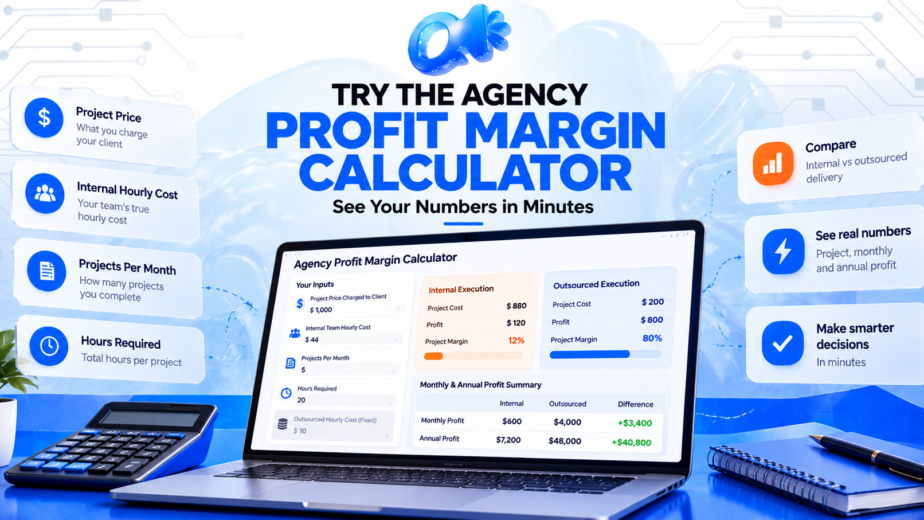
None of these numbers is universal. What matters is the pattern: more control and customization often means more of your own time, while pre-packaged products mean less effort and less margin. If you want to test your own numbers, use the Agency Profit Margin Calculator, and read How to Calculate Your Agency’s Profit Margin for the formula.
Common Misunderstandings
“White label means the work is lower quality.”
No. The label describes branding, not quality. Quality depends on the people doing the work.
“A reseller doesn’t do any real work.”
Resellers do real work: sales, support, client management and sometimes strategy. They just don’t produce the underlying product.
“Private label is always better.”
It’s more exclusive, not automatically better. It can also be more expensive and less flexible.
“My clients will know if I white label.”
Not if it’s done properly. Reports, deliverables and communications carry only your brand.
“Reselling and white labeling are the same thing.”
They overlap, but reselling typically sells a provider’s existing offering, often with visible provider branding, while white label delivers custom work under your name.
“One model has to fit everything.”
You can use different models for different services.
Ethics and Transparency
Some agency owners worry that white labeling or reselling is somehow dishonest. It isn’t, as long as you:
- Deliver good work that meets your promises.
- Stay accountable to your client.
- Protect client data and confidentiality.
- Don’t misrepresent results.
- Follow any contractual rules about subcontracting.
Outsourcing production is normal across every industry. Clients hire agencies for outcomes, judgment and accountability, and you remain responsible for all three.
How to Choose a Provider, Whatever You Call It
Once you’ve settled on a model, choose the provider carefully. Look for:
- An in-house team. Not chains of subcontractors.
- Genuine branding control. True white labeling, not branding in name only.
- Clear pricing. No surprise fees.
- Reasonable turnaround. With specifics.
- A single point of contact.
- A way to test. A trial or sample.
Our own setup is straightforward: a team of fifteen, all in-house, one dedicated account manager, a rate of $10 an hour in blocks of 20, 40 or 80 hours ($200, $400 or $800), hours that don’t expire and a shared task tracker. We also offer an 8-hour free trial with no contract and no card, so you can judge the work before you commit. For a deeper comparison framework, see Top White Label Digital Marketing Agencies to Consider in 2026.
Frequently Asked Questions
What’s the main difference between white label and reseller marketing?
In white label, a provider does custom work that you sell under your own brand, and the client never sees the provider. In reselling, you sell a provider’s existing offering, and the provider’s brand or platform is often still visible.
Is private label the same as white label?
Often used interchangeably. Strictly, private label implies a service made exclusively for one brand, while white label may be the same service delivered to many agencies under different logos.
Which is more profitable?
It depends on your costs and pricing. White label tends to offer wide margins when delivery cost is low, but requires your review time. Reselling may offer narrower margins with less effort.
Will my clients know I’m using a white label partner?
Not if it’s done properly. Everything should carry your branding.
Can I use more than one model?
Yes. Many agencies resell some tools and white label their production services.
Do I need to disclose that I outsource?
That depends on your contracts and local rules. Check your client agreements and be transparent where required.
Which model is best for a small agency?
Often white label, because it lets you scale delivery without hiring while keeping control of branding and price. But the right choice depends on your services and clients.
Where can I find more definitions?
Our FAQ page covers more common questions.
White label vs reseller marketing isn’t a question with one right answer. It’s a question about control, customization and who owns the client experience. White label gives you the most control over branding and price with custom work. Reselling gives you the quickest start with the least customization. Private label gives you the most exclusive result with the most setup.
Whatever a provider calls their model, ask what’s underneath: whose logo the client sees, who sets the price, who does the work and who owns the relationship. Those answers matter far more than the label.
Read Our Full FAQ Page for More Definitions
Still have questions about terms, pricing or how the model works?
Read our full FAQ page for more definitions, covering what a white label agency is, whether clients will know, how much it costs, turnaround times and how the free trial works.
When you’re ready to test a partner on real work, claim your 8-hour free trial. You can also browse our services.