You’ve just signed a new client. Your team is already stretched. Somebody has to build the website, write the content plan, set up the ads and send the reports, and nobody in the building has the hours.
So you sit down and ask the question that shapes the next few years of your business: do I hire someone, or do I hand this to an outside partner?
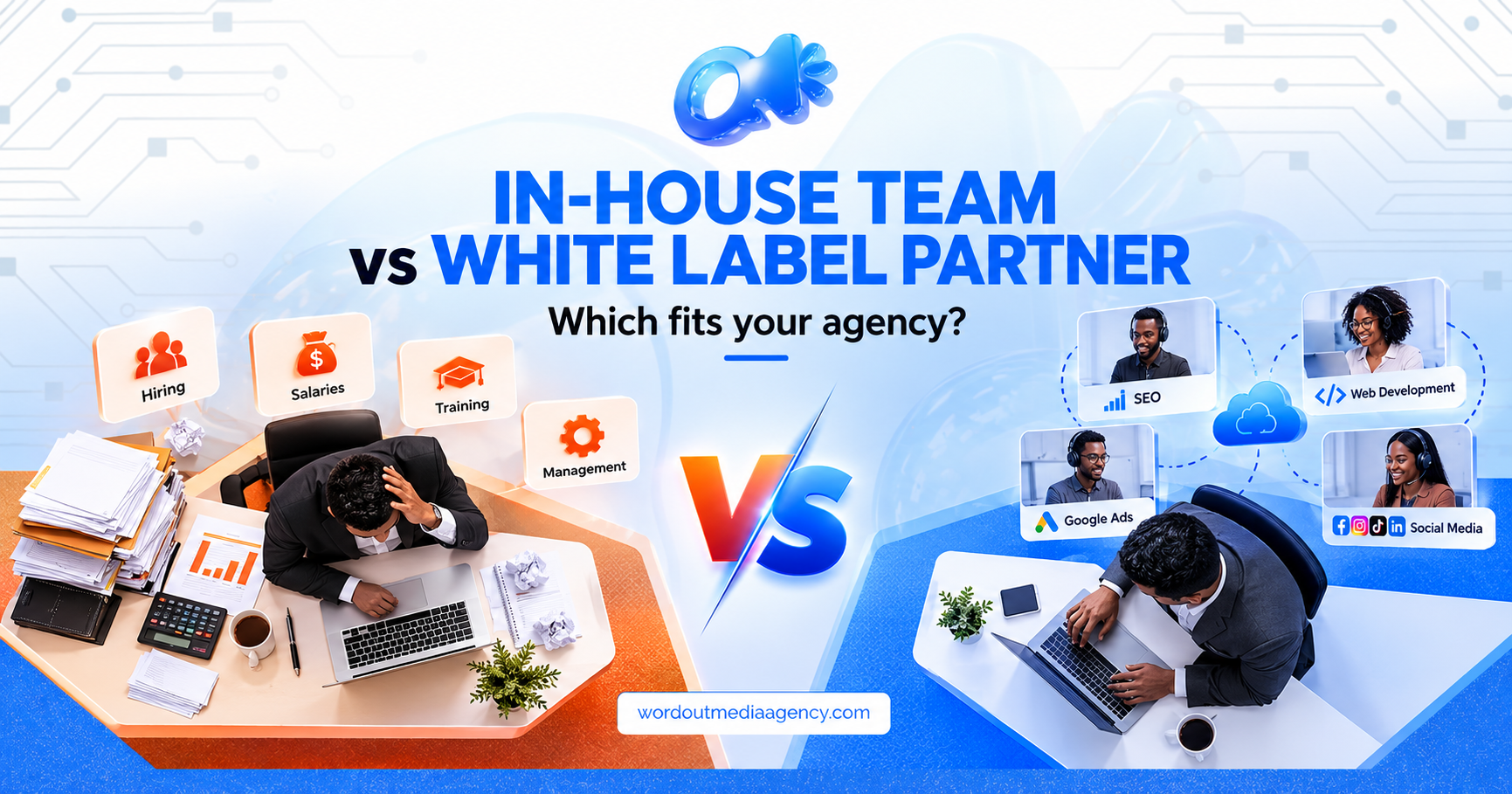
The white label vs in house marketing team debate is rarely settled by opinion. It’s settled by numbers, by workload patterns and by how much risk you’re willing to carry. Plenty of articles on this topic will tell you that outsourcing is “cheaper” or that in-house is “more reliable” without showing any working. This one won’t do that.
We’re Wordout Media, a white label digital marketing partner for agencies in the US, Canada and Europe. We obviously have a stake in the outcome, so we’ll say this upfront: there are situations where hiring is the right call, and we’ll point those out. What we’d like you to leave with is a clear framework for deciding, not a sales pitch.
What We Mean by “In-House” and “White Label”
Let’s define both sides so we’re comparing the same things.
An in-house marketing team means employees on your payroll: a designer, an SEO specialist, a paid media buyer, a project manager. They work for you full time, they sit inside your systems, and you manage them directly.
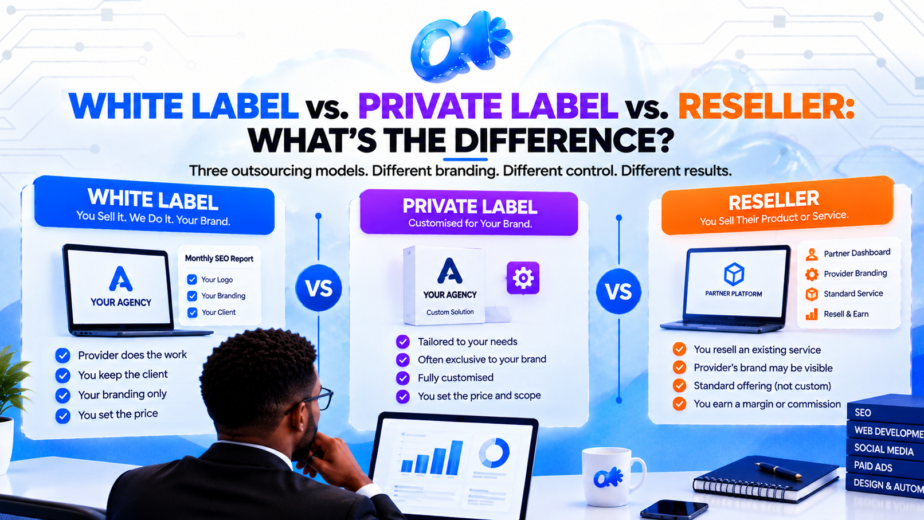
A white label partner means an outside company that does the work under your brand. You send briefs, they deliver the finished work, and your client only ever sees your agency. If you’d like a longer explanation of how that arrangement works, we cover it in our guide to what a white label digital marketing agency is.
Some agencies also use freelancers, which sits somewhere in between. We’ll touch on that later, because it’s a common third option in any agency staffing decision.
The Real Cost of an In-House Hire
Most agency owners underestimate what an employee costs, because they look at salary and stop. Here’s a more honest breakdown.
Let’s use an illustrative example. These numbers are assumptions to show the method, so swap in your own.
- Base salary: $55,000 a year for a mid-level marketing specialist
- Employer overhead: roughly 25% on top (payroll taxes, benefits, software licences, equipment, paid time off contributions). Call it $13,750
- Total annual cost: $68,750
- Monthly cost: about $5,730
Now the part people skip: a person isn’t productive for every paid hour. Holidays, sick days, internal meetings, admin, training and slow weeks all take a bite. If you’re generous and say 75% of the 2,080 working hours in a year are genuinely productive, that’s 1,560 hours.
$68,750 ÷ 1,560 productive hours = roughly $44 per productive hour.
That $44 figure assumes your hire is busy for those 1,560 hours. If they’re only busy 60% of the time because client demand is uneven, the effective cost per useful hour climbs past $55.
Compare that with a white label partner charging $10 an hour, where you only pay for hours you actually use.
The point isn’t that in-house is “bad.” The point is that an employee is a fixed cost that doesn’t shrink when the workload does. That’s the piece of the white label vs in house marketing team question that trips up most agency owners.
The Real Cost of a White Label Partner
Fairness requires the same honesty on the other side. A partner’s hourly rate isn’t your only cost.
Your management time. Writing briefs, reviewing work and giving feedback takes hours. If you spend one hour managing for every ten hours outsourced, your real cost is closer to $10 plus a tenth of your own time.
Revision cycles. Early in a relationship, work may need more rounds until the partner learns your standards.
Onboarding effort. Sharing brand guidelines, logins and examples takes some upfront time, though it’s usually far less than training a new employee.
Even with those added in, the hourly gap is wide. But it’s worth being straight about it, because agencies that treat outsourcing as “free” get disappointed. It’s cheap, not effortless.
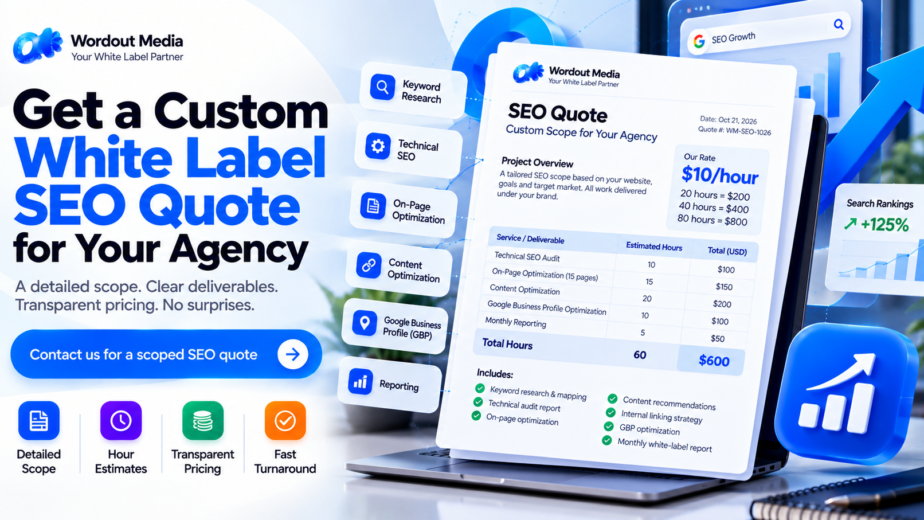
At Wordout Media, our rate is $10 an hour, sold in blocks: $200 for 20 hours, $400 for 40, $800 for 80. The rate doesn’t change with volume, and unused hours don’t expire. If you want to see how that lines up against your own hiring costs, you can try our profit margin calculator lets you plug in your internal hourly cost and compare directly.
A Side-by-Side Cost Example
Let’s put it into a practical scenario. Say your agency needs about 40 hours of production work each month for a new SEO client: keyword research, on-page updates, a couple of content briefs and reporting.
| In-house hire | White label partner | |
|---|---|---|
| Monthly cost | ~$5,730 (fixed) | ~$400 (40 hours at $10) |
| Cost if demand drops to 20 hours | ~$5,730 | ~$200 |
| Cost if demand rises to 80 hours | Need another hire or overtime | ~$800 |
| Notice needed to scale | Weeks to months | Days |
| Management time | Ongoing | Briefs and reviews |
That table is deliberately simple, and it favors outsourcing at low volume. So let’s be equally clear about the other end.
If you have 160 or more hours of steady, predictable work every single month, month after month, the fixed cost of an employee starts to look more reasonable, because you’re filling their capacity. Even then, an employee at $68,750 a year for 1,560 productive hours still costs more per hour than $10, but the gap narrows once you factor in the value of having someone embedded in your business, available at any moment, who knows your clients deeply.
Where an In-House Team Genuinely Wins
A white label vs in house marketing team comparison that only praises one side isn’t useful. In-house has real strengths.
Deep client knowledge
An employee who works on the same accounts every day builds context that’s hard to replicate. They know the client’s quirks, their history, the previous campaigns that failed and why.
Immediate availability
Need a change made in ten minutes? Someone sitting in your team chat can do it. A partner in another time zone or with a queue can’t always match that.
Cultural fit and shared standards
Employees absorb your way of working over time. That’s valuable when your agency’s brand depends on a distinctive approach.
Strategic thinking
Strategy is different from production. Senior strategic work, such as positioning, client advisory and creative direction, usually belongs in-house, because it’s the core of what you sell. Many agencies keep strategy in-house and outsource execution.
Full control
You decide exactly how people work, what tools they use and how they’re trained. You never depend on another company’s priorities.
Intellectual property and confidentiality comfort
Some clients, especially in regulated sectors, are more comfortable knowing everyone touching their data is a direct employee.
If two or three of those points matter a lot to your agency, that’s a real argument for hiring.
Where a White Label Partner Genuinely Wins
Flexibility
Client work is lumpy. One month you’ve got three launches; the next, it’s quiet. A partner scales with you. An employee doesn’t.
Speed to capacity
Hiring takes time: writing the job description, screening, interviewing, negotiating, onboarding. Many agencies spend one to three months before a new hire is productive. A white label partner can start on a brief in days. At Wordout Media, most design, ad setup and video editing tasks come back the same day to 48 hours, and a brief sent in a US morning is usually moving before lunch because we work EST hours.
Range of skills
A single hire brings one skill set. Even a strong generalist can’t be an expert SEO, paid media buyer, WordPress developer and motion designer at once. A partner gives you access to specialists across those areas.
Lower risk
If an employee doesn’t work out, you’ve lost months of salary and hiring effort. If a partner doesn’t work out, you’ve spent a few hours of trial work and move on.
Better margins on delivery
This is the practical bottom line. When your cost of delivery falls and your client pricing stays the same, your margin widens. We break down exactly how in our guide on how to calculate your agency’s profit margin.
No management overhead of a growing team
Every employee adds management responsibility: one-to-ones, performance reviews, holiday cover, payroll admin. A partner replaces much of that with a brief-and-review workflow.
The Freelancer Option: The Middle Path That Often Disappoints
Many agencies try freelancers before they try either of the other options, so it deserves an honest look.
Freelancers can be excellent, and cheap for specific projects. The problems tend to show up over time.
- Capacity is limited to one person. If they get sick, take a holiday or land a bigger client, your work waits.
- The skill range is narrow. A great designer probably isn’t also a great technical SEO.
- Reliability varies. A freelancer with several clients may prioritize whoever pays most or shouts loudest.
- You become the project manager. Every freelancer needs briefing, chasing and reviewing, and that adds up as you use more of them.
A white label agency with an in-house team and one account manager addresses those issues: someone else is accountable for capacity, skill coverage and consistency, so you brief one person instead of juggling five. We’ve written more on this in Smart Outsourcing: How Agencies Grow Without Burnout.
Ten Questions to Ask Before You Decide
Instead of picking a side by instinct, run your agency through these questions. Be honest with your answers.
- Is the work steady or spiky? Steady work suits employees. Spiky work suits partners.
- How many hours a month do I actually need? Under about 100, hiring rarely pays off. Well over 150 and consistent, in-house starts to make more sense.
- Is it strategic or executional? Keep strategy close. Outsource repeatable production.
- How fast do I need capacity? If it’s this week, hiring can’t help.
- How many different skills do I need? More than two or three usually points to a partner.
- What happens if this hire leaves? If losing one person would stall client delivery, you have a concentration risk.
- How much cash can I commit to fixed cost? Payroll is a commitment. Outsourced hours are variable.
- How much time do I have to manage? A team needs leadership. A partner needs briefs and review.
- Do my clients need employees only? Some contracts or industries require it.
- Am I hiring because I need capacity, or because I’m avoiding a system problem? Sometimes an agency is overloaded not because it lacks people but because its processes are messy. We explore that in Stop Doing More: Why Smart Agencies Build Systems Instead.
Score your answers roughly. If most point one way, that’s probably your answer.
The Hybrid Model: What Most Sensible Agencies End Up Doing
Here’s something the “white label vs in house marketing team” framing hides: it doesn’t have to be either-or.
In our experience, many well-run agencies land on a hybrid arrangement.
Keep in-house: strategy, client relationships, account management, creative direction, quality control and anything that defines your agency’s distinctive value.
Outsource: repeatable production such as SEO tasks, website builds, social graphics, ad setup, reporting and automation work.
This split does two things. It protects the parts of your business that only you can do well, and it lets you scale the production side without taking on fixed cost.
A practical example: an agency with two account managers and a creative director hires no production staff at all. Every client project is briefed by one of the three, produced by a white label partner and reviewed by the same person before it reaches the client. The agency can serve twenty accounts without a growing payroll, and the owner’s time goes to sales and strategy.
That’s just one shape, not a formula, but it illustrates the principle: hire for judgment, outsource for volume.
Common Mistakes in the Agency Staffing Decision
Hiring too early
The most common mistake is hiring ahead of steady demand. A new hire sits half-idle for months while the salary keeps running.
Hiring for a skill you’ll only need occasionally
If you need a motion designer twice a quarter, don’t put one on payroll.
Choosing a partner on price alone
The cheapest option often costs more in revision cycles, missed deadlines and lost trust. Look for consistent rates, transparent processes and a team that stays put.
Outsourcing without a review process
A partner can only deliver what you brief. Skip the review and you’ll pass mistakes to clients under your own name.
Outsourcing your strategy
Production can be handed off. Client relationships and strategic judgment can’t, because they’re what clients are actually paying you for.
Not measuring the real numbers
Many agency owners never work out their actual cost per productive hour. Once you do, the decision usually becomes obvious. Our Agency Profit Margin Calculator is a quick way to see it.
A Practical Way to Test Before You Commit
You don’t have to decide based on theory. Here’s a low-risk test.
- Pick one recurring task, such as monthly reporting, landing page builds or social content.
- Time how long it takes your team today, and work out its true internal cost.
- Send the same task to a white label partner as a trial.
- Compare the cost, the quality and the time you spent managing it.
- Decide with evidence instead of instinct.
We built our 8-hour free trial around exactly this test. Send us eight hours of real work, such as a landing page, a batch of social creative, a technical SEO audit or a Google Ads build. There’s no contract, no card and no sales call required first. You see the output and the working relationship before spending anything.
Which Agencies Should Lean In-House?
To be fair to the other side, here’s who should probably hire.
- Agencies with predictable, high-volume work in one discipline (for example, a shop that produces large amounts of paid media management every month).
- Agencies whose clients require direct-employee arrangements for compliance reasons.
- Agencies whose competitive advantage is a proprietary production process or a signature creative style that can’t be documented easily.
- Agencies with enough management capacity and cash to carry a team through slow months.
Which Agencies Should Lean White Label?
- Agencies with uneven demand or seasonal peaks.
- Agencies adding new services and needing skills they don’t have.
- Small and mid-size agencies that want to grow without fixed-cost risk.
- Agencies whose owners are stuck doing production and need time back for sales.
- Agencies want to test a new service line before hiring for it.
Frequently Asked Questions
Is a white label partner cheaper than an in-house marketing team?
In most cases, yes at low and medium volumes, because you pay only for hours used. At consistently high volume, the gap narrows. The best approach is to calculate your true internal cost per productive hour and compare it with the outsourced rate.
When should I hire an in-house marketer instead of outsourcing?
Hire when you have steady, predictable work that fills a full-time role, when the work is strategic and closely tied to your clients, or when compliance requires direct employees.
Will clients notice if I use a white label partner?
Not if it’s done properly. At Wordout Media, everything ships under your branding and clients only ever see your agency.
Can I use both in-house staff and a white label partner?
Yes, and many agencies do. A common approach is to keep strategy and client management in-house while outsourcing production.
How quickly can a white label partner start?
Much faster than a hire. Most tasks at Wordout Media come back the same day to 48 hours, and larger builds get a scoped timeline before work begins.
What’s the biggest risk of outsourcing?
Quality and communication. You reduce both by writing clear briefs, reviewing every deliverable and choosing a partner whose team is in-house rather than subcontracted.
What’s the biggest risk of hiring in-house?
Fixed cost. If demand drops, salary doesn’t. There’s also the risk of concentration: if one person leaves, part of your delivery leaves with them.
The white label vs in house marketing team decision isn’t really about which model is better. It’s about which model fits your workload, your cash position and your goals right now, and that answer can change as your agency grows.
For many small and mid-size agencies, the sensible answer is a hybrid: strong in-house strategy and client management, backed by a reliable white label partner for production. It keeps costs variable, capacity flexible and your margins healthy.
Before you post that job ad, do the math. Work out your real cost per productive hour, compare it honestly against the alternative and test the partner option on real work.
Compare Your Real Costs in Two Minutes
Numbers settle this debate faster than opinions.
Try our Agency Profit Margin Calculator to compare your internal cost with outsourced delivery at $10 an hour. Then, if the numbers make sense, start your 8-hour free trial and see how a white label partner performs on your own work.
Want to know more about how it works first? Read our FAQs or browse our full list of services.