Plenty of articles explain what white label marketing is. Fewer explain what actually happens after you say yes: who you talk to, what you send, what comes back, when and what you do with it.
That’s the gap this guide fills. If you’re asking how does white label marketing work in practice, here’s the whole process from the first conversation to the monthly invoice, with the practical details that usually get skipped: the brief, the hand-offs, the branding, the review, the billing and the places where things tend to go wrong.
We’re Wordout Media, a white label partner for agencies in the US, Canada and Europe. We’ll use our own process as the working example because it’s the one we know best, and we’ll point out where other providers may differ. If you want the short definition first, our guide on what a white label digital marketing agency is covers it.
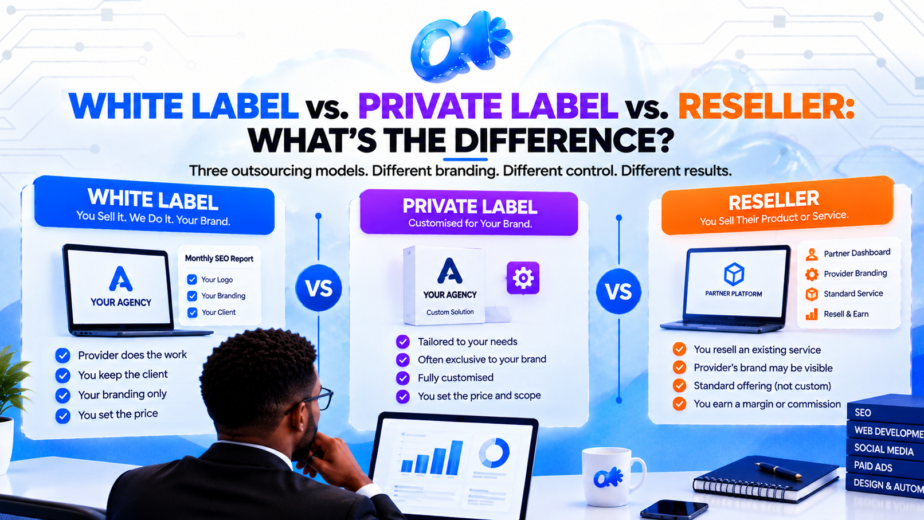
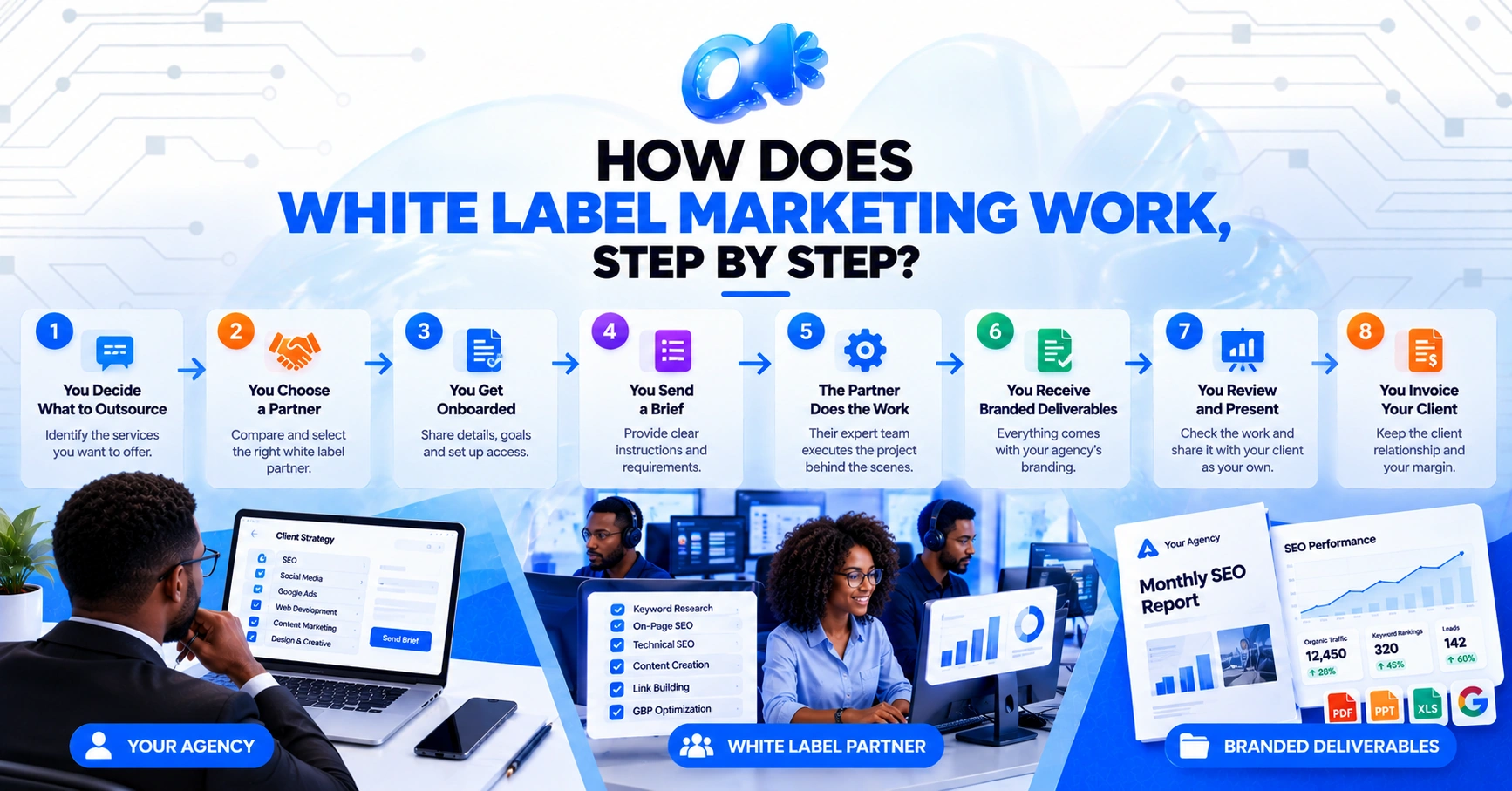
You sell a marketing service to your client. Instead of delivering it yourself, you send a brief to a partner. The partner’s team does the work and returns it with your branding. You review it, present it as your own and invoice your client at your own price. The gap between what you charge and what you pay your partner is your margin.
That’s the whole idea. Now let’s slow it down.
Step 1: You Decide What to Outsource
Before any partner enters the picture, you decide which work to hand off. This is a business decision, not a technical one.
The best candidates are tasks that are:
- Repeatable. The same type of work comes up month after month, such as SEO audits, social graphics or landing page builds.
- Time-consuming. They eat hours that could go to sales or strategy.
- Clearly definable. You can describe what “done” looks like.
- Not your core differentiator. They aren’t the thing clients pay you for specifically.
The poorest candidates are strategy, client relationships and anything that defines your agency’s identity. Keep those close.
Most agencies begin with a single service, usually whichever one is causing the most pain in their schedule. We cover these services: White Label SEO + GBP, Website Design & Development, Social Media Management, Paid Advertising – Google & Meta, Creative Design + Figma and Automations + AI Workflows.
Step 2: You Choose a Partner
This is the step that decides how everything else goes. Compare candidates on a few things that matter more than price:
- Who does the work? In-house team, or a chain of subcontractors?
- Is it truly white label? Everything should carry your brand.
- How’s the communication? One point of contact is far easier than a ticket queue.
- What’s the turnaround? Ask for specifics.
- How’s pricing structured? Clear, with no surprises.
- Can you test first? A trial tells you more than a sales call.
We go deeper on this in Top White Label Digital Marketing Agencies to Consider in 2026, including a scorecard you can use on any provider.
Step 3: You Get Onboarded
Once you’ve picked a partner, there’s a short onboarding phase. A good one is light and quick. A bad one is a month of paperwork.
At Wordout Media, onboarding means:
- You’re assigned a dedicated account manager. One person owns your projects and briefs the right specialist. That means one hand-off for you, not four.
- We learn your standards. How you like things done, your brand guidelines, the tone you use with clients, your preferred tools.
- Access and communication are set up. Shared task tracker, communication channels and, if you like, email addresses on your own domain.
- Expectations are agreed. Turnaround times, how revisions are handled and how feedback flows.
If you want to be more discreet, we can work entirely inside your systems. If you want our account manager to appear as part of your team on client calls, that’s something we do regularly.
Step 4: You Buy Capacity (or Agree on a Scope)
How you pay depends on the partner’s model. Common structures:
- Monthly retainers: a fixed package for a fixed fee.
- Per-project pricing: a flat price for a defined deliverable.
- Wholesale rate cards: set prices per deliverable, which you mark up.
- Hour blocks: you buy hours and spend them as needed.
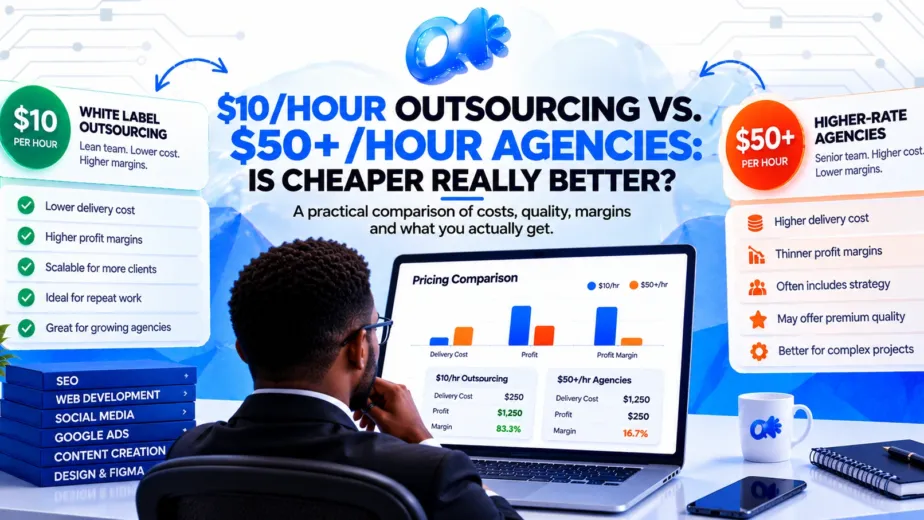
At Wordout Media, we use hour blocks. The rate is $10 an hour and the same on every block:
- Starter: $200 for 20 hours
- Growth: $400 for 40 hours
- Scale: $800 for 80 hours
The hours aren’t tied to a specific service. You can spend them on SEO one month and a website build the next. They don’t expire either: if you buy 40 and use 25, the other 15 are waiting when you come back. A shared task tracker shows exactly what each hour went to.
Step 5: You Write the Brief
This is the step agencies most often rush, and the one that most affects results.
A brief is your instruction to the partner. It can be short for simple tasks and detailed for large ones. A strong brief includes:
- The goal. What should this achieve for the client?
- The client context. What do they do, who are their customers, what have they tried before?
- The deliverable. What exactly do you need, in what format and by when?
- Brand and style guidance. Tone, colors, fonts, examples of work you like.
- Access and assets. Logins, files, images, existing content.
- Constraints. Anything to avoid, deadlines, approvals required.
Compare two briefs for the same task.
Weak: “Build a landing page for a plumber.”
Strong: “Build a single-page landing page for a residential plumber in Austin, focused on emergency call-outs. The goal is phone calls. Use the attached logo and brand colors. Include a click-to-call button, three testimonials (attached), a service area section and a short FAQ. The tone is friendly and direct. Competitor examples are linked below. Needed by Thursday.”
The second takes five minutes longer to write and can save days of rework.
Step 6: The Partner Assigns and Produces the Work
Here’s the part you don’t see, and the part that varies most between providers.
At a well-run white label partner, the account manager reads your brief, asks clarifying questions if anything’s missing and passes the work to the right specialist. A designer takes the graphics. A developer takes the web build. An SEO specialist takes the audit.
At a poorly run one, your work may be passed to a freelancer you’ve never met, who passes it to another. That’s why we keep our team of fifteen in-house, with no subcontractor chains.
Turnaround depends on the task. For us, most design, ad setup and video editing tasks come back the same day to 48 hours. Larger builds, such as full websites and multi-page SEO projects, get a scoped timeline before work begins, and we hold to it. We work EST hours, so a brief sent in your morning is usually moving before lunch.
Step 7: The Work Comes Back Under Your Brand
This is the “white label” part. The deliverable arrives ready to hand to your client:
- Reports carry your logo.
- Design files, documents and presentations carry your branding.
- Websites are built in your name, with nothing pointing back to the partner.
- Communications can come from your domain if you want them to.
The client has no reason to know a partner was involved, and in a properly run arrangement they won’t.
Step 8: You Review
You are the quality gate. Even with a trustworthy partner, review matters because the client holds you responsible, not your partner.
A simple review checklist helps:
- Does it match the brief?
- Does it meet our standard?
- Are the facts, names and numbers correct?
- Is the branding right?
- Would we be comfortable putting our name on this?
If something needs changing, give clear, specific feedback. “The headline feels off” is hard to act on. “Make the headline shorter and lead with the 24-hour response” is easy.
Early on, expect to give more feedback. As your partner learns your standards, revisions drop, and that’s one of the real benefits of working with a dedicated account manager rather than a revolving cast.
Step 9: You Deliver and Communicate With the Client
Now you present the work to your client in your own voice. You explain what was done, why and what comes next. This is where your strategic value shows, because the client isn’t paying for hours. They’re paying for judgment and results.
Don’t hide behind the work. Explain it. If the partner’s report includes useful findings, translate them into the client’s language and priorities.
Step 10: You Invoice Your Client
You bill at your own rate, on your own terms. The client pays you, and your partner has no involvement in that relationship.
The difference between what you charge and what you pay is your margin. For example:
- You charge a client $2,000 for a website.
- The build takes 40 hours, which costs $400 at $10 an hour.
- You spend 4 hours on briefing and review, costing you perhaps $140 in time.
- Your gross profit is roughly $1,460, or 73%.
(These figures are illustrative.) If you’d like to run your own numbers, our Agency Profit Margin Calculator compares internal delivery with outsourced delivery in a couple of minutes, and our guide on how to calculate agency profit margin explains the formula.
Step 11: You Repeat and Refine
White label marketing isn’t a one-off transaction. The value builds over time:
- Briefs get faster as your partner learns your clients.
- Revisions drop as standards become familiar.
- You can add services as you gain confidence.
- You can scale up or down as demand changes.
After a few months, the relationship usually feels less like using a vendor and more like having an extension of your team.
The Whole Process at a Glance
| Step | Who | What happens |
|---|---|---|
| 1. Decide what to outsource | You | Pick repeatable, time-consuming tasks |
| 2. Choose a partner | You | Compare on team, branding, communication, turnaround, price |
| 3. Onboarding | Both | Account manager, standards, access, expectations |
| 4. Buy capacity | You | Hour block, retainer or project scope |
| 5. Write the brief | You | Goals, context, deliverable, assets |
| 6. Produce the work | Partner | Account manager assigns specialists |
| 7. Branded delivery | Partner | Everything under your brand |
| 8. Review | You | Check against brief and standards |
| 9. Present to client | You | Explain the work in your own voice |
| 10. Invoice | You | Bill at your own rate |
| 11. Repeat and refine | Both | Faster, smoother, wider |
Where the Process Usually Breaks Down
Knowing the steps is one thing. Knowing where they fail is more useful.
Thin briefs. The most common cause of poor results. A vague brief produces vague work.
Skipping the review. Mistakes reach the client under your name.
Unclear feedback. Revision cycles drag on when feedback isn’t specific.
Handing over the hardest client first. Test on a lower-stakes account before trusting the relationship with a demanding one.
Slow access. If logins and files take a week to arrive, the work starts a week late.
Mismatched time zones. A partner who’s offline while your client is working creates delays. Look for overlap.
No documentation. Keep records of logins, decisions and deliverables.
Treating the partner like a vendor. Share context, and you’ll get better work back.
How Does White Label Marketing Work for Different Services?
The overall flow is the same, but the details change by service.
SEO
You brief on goals, site and competitors. The partner delivers audits, keyword plans and optimizations, plus reports. Results build over months. See What Does “White Label SEO” Actually Mean? for more.
Website design and development
You brief on pages, brand and functionality. The partner designs and builds, usually in WordPress or Elementor. You review staged versions before launch.
Social media
You brief on brand voice, audiences and goals. The partner produces content calendars, graphics, Reels, carousels and captions on a regular rhythm.
Paid advertising
You brief on goals, budget and audiences. The partner builds campaigns, writes copy, creates assets and optimizes over time.
Design
You brief on purpose and brand. The partner delivers files, usually in a short turnaround.
Automation
You brief on the process to be automated. The partner builds workflows in tools such as n8n and GoHighLevel.
What Does White Label Marketing Cost, and Is It Worth It?
Pricing varies, but the principle is the same everywhere: you’re paying less than you’d charge your client, and the difference is your margin.
The question of whether it’s worth it depends on three things:
- Your current delivery cost. If your internal cost per productive hour is much higher than your partner’s rate, the potential saving is large.
- Your management time. The more time you spend briefing and reviewing, the lower your real margin.
- Whether you’d use the freed time well. Saved hours only add profit if they go into paid work or cost reduction.
We compare cheap and expensive models in $10/Hour Outsourcing vs. $50+/Hour Agencies: Is Cheaper Really Better?.
How to Try It Without Risk
If you’re curious but cautious, test before you commit.
- Pick one task. Something repeatable and low-stakes.
- Write a proper brief.
- Send it as a trial. We offer an 8-hour free trial, with no contract, no card and no sales call required first. A landing page, a batch of social creative, a technical SEO audit or a Google Ads build all work well.
- Judge the result. Quality, speed, communication and how much of your own time it took.
- Expand if it works. Add tasks, clients and services gradually.
Frequently Asked Questions
How does white label marketing work in simple terms?
You sell the service and own the client relationship. A partner does the work behind the scenes and returns it under your branding. You review it, present it and invoice your client.
Do my clients know I’m using a white label partner?
Not if the arrangement is done properly. Deliverables and reports carry only your brand, and communication goes through you.
Who’s my point of contact with my partner?
At Wordout Media, a dedicated account manager owns your projects and briefs the right specialist, so you deal with one person.
How long does delivery take?
For most design, ad setup and video editing tasks, same day to 48 hours. Larger builds get a scoped timeline before work starts.
What do I need to provide?
A clear brief, brand guidelines, access to relevant accounts and any assets such as logos or existing content. The more context you give, the less rework you’ll need.
How is billing handled?
You bill your client yourself at your own rate. With us, you buy hours at $10 each in blocks of 20, 40 or 80 ($200, $400 or $800).
What if I’m not happy with the work?
Give specific feedback and request revisions. How a partner handles this early on tells you a lot about the relationship.
Can I try it before committing?
Yes. Our 8-hour free trial lets you send real work with no contract and no card.
So, how does white label marketing work? It works as a clear division of labor with a simple loop: brief, produce, review, deliver, invoice, repeat. You keep the client, the strategy and the pricing. Your partner takes on the production.
The mechanics are straightforward. What separates smooth arrangements from painful ones is the quality of the brief, the reliability of the partner and your willingness to review before anything reaches the client.
Book a Call With a Dedicated Account Manager
The easiest way to understand the process is to walk through it with the person who’d run it for you.
Book a call with a dedicated account manager and talk through your clients, your services and what a first project would look like. When you’re ready to test it, ask about your 8-hour free trial.
Prefer to read first? Browse our FAQs or see our services.