If you run a marketing agency, the idea of handing production work to a partner who stays invisible to your client probably feels modern. It sounds like something that appeared with remote work, cloud software and freelance marketplaces.
It isn’t. The logic behind it is much older than the internet, and understanding that logic explains a lot about why the model works, where it fails and where it is heading. This guide traces the history of white label marketing from its roots in product manufacturing, through the rise of outsourcing as a mainstream business strategy, to the agency delivery partnerships we see today, and then looks at the trends shaping the next few years, including AI.
One honest note before we begin. There’s no authoritative, dated timeline of “when white label marketing agencies began.” Where we cite dates, they come from published sources on product white labeling and outsourcing, and we link to them. Where we connect those histories to the agency world, that’s our analysis as a white label partner, and we’ll label it as such. We’re Wordout Media, so we have a stake in the story. We’ve tried to tell it fairly.
Part One: Where “White Label” Actually Comes From
The term is older than digital marketing and has nothing to do with it. A white-label product is one made by a company, the producer, and rebranded by other companies, the marketers, so that it appears to be their own. According to the entry on white-label products, the name comes from a blank label on the packaging, which a marketer can fill with its own branding.
That simple idea shows up in many industries.
Retail and consumer goods
Supermarket store brands are the classic example. Many of them are made by suppliers that sell similar products to several retailers, with only the labels changed. Electronics followed the same pattern: the same DVD player could be sold under different brand names by different UK retailers, for instance.
Banking and finance
Smaller banks and credit unions often outsource card or check processing to larger institutions, which issue cards under the smaller bank’s brand for a fee. The customer sees one brand. A different organization runs the machinery behind it.
Software and services
Software companies built products that other businesses could resell under their own brand, with customizable appearance, multi-customer management and automated billing. This is the direct ancestor of what agencies now call white label services.
The pattern is the same everywhere. One party is good at producing. Another is good at selling, trust and customer relationships. The label connects them.
Part Two: The Business Logic That Made It Possible
White labeling only works if a bigger idea is already accepted: that it’s sensible to let someone else do part of your work. That idea is outsourcing, and its history matters here.
According to the overview of outsourcing, which summarizes sources including The Economist, here are the milestones that matter for our story:
- From World War II onward, outsourcing was making its presence felt, according to The Economist.
- 1967: Morton Meyerson of Electronic Data Systems proposed the business model later known as outsourcing.
- By 1981 at the latest: the term itself was in use.
- 1989: Kodak outsourced most of its IT systems, an early high-profile example. In the same year, management thinker Peter Drucker wrote a Wall Street Journal piece titled “Sell the Mailroom,” which helped explain the idea to a wider audience.
- The 1990s: the slogan “Do what you do best and outsource the rest” became a widely recognized strategy.
- Late 1990s: telecommunications and Internet expansion made it practical to offshore IT-enabled services.
The reasons companies gave have barely changed. They outsource to cut or convert costs, to focus on core strengths, to gain access to specialist skills, to move faster, to turn fixed costs into variable ones and to reduce risk. If those sound familiar, they’re the same reasons agencies give for working with a white label partner today.
This is the first important point of the history: white label marketing isn’t a strange new tactic. It’s outsourcing applied to a service business, with the added feature of a hidden label.
Part Three: The Backlash and the Maturing of Outsourcing
Outsourcing wasn’t a smooth, universally loved story, and that matters because the same tensions show up in agency partnerships.
According to the same overview, offshoring grew rapidly in the early 2000s, and business process outsourcing became a large global market, estimated at around $140 billion worldwide in 2016. But outsourcing also became a political issue, particularly in the United States around the 2004 presidential election. A 2005 Deloitte survey reportedly found that a quarter of the companies that had outsourced tasks reversed their strategy. After the 2008 financial crisis, opposition intensified, and a reshoring movement began in 2010.
By 2016, however, Deloitte reportedly found that companies were no longer reluctant to outsource and increasingly viewed it as something more than cost-cutting.
What does that tell us?
Lesson one: Outsourcing done badly gets reversed. Companies that handed off work without clear standards, communication or accountability often took it back.
Lesson two: Outsourcing done well becomes permanent. The firms that stayed with it treated partners as extensions of the team, not as disposable suppliers.
Lesson three: The motivation shifted over time from “cheaper” to “better and more flexible.” That shift is exactly what separates mature white label partnerships from simple price-shopping.
Part Four: How the Idea Reached Marketing Agencies
Here we move from documented history to analysis. We don’t have a dated, sourced timeline for the first white label SEO or web design provider, and we won’t invent one. What we can describe, based on how the industry developed, is a set of conditions that made agency white labeling practical. Treat these as our reading of the trend rather than established history.
1. Marketing became a service business made of discrete tasks
Search optimization, website builds, paid media, social content and design are all work that can be briefed, produced and delivered in defined units. That makes them easy to hand off in a way that, say, a long consulting relationship is not.
2. Digital work stopped needing physical presence
Once nearly all production happened on a screen, the person doing the work no longer had to sit in the same office, or even the same country, as the person selling it. The telecommunications and Internet growth that enabled IT offshoring in the late 1990s eventually enabled this too.
3. Software made collaboration cheap
Shared project trackers, cloud design tools, communication platforms and remote access tools meant a partner could work inside an agency’s systems, under an agency’s brand, without friction.
4. Clients began expecting full-service marketing from one agency
Clients didn’t want a separate vendor for SEO, another for ads and another for websites. They wanted one trusted partner. Small agencies that couldn’t staff every discipline needed another way to say yes. White label partners provided one.
5. Remote work normalized distributed teams
After years in which distributed work became widely accepted, hiring a team you would never meet in person no longer felt strange. An invisible partner became less of an unusual idea.
6. Agency owners learned the economics
Once agency owners started calculating delivery cost per productive hour, comparing it with outsourced rates and measuring the margin difference, the model became hard to ignore. We explain that math in How to Calculate Your Agency’s Profit Margin.
Together, these conditions turned white labeling from a niche arrangement into something many agencies now treat as normal.
Part Five: From Reseller Programs to Delivery Partnerships
Within white label marketing itself, the model has gone through a recognizable evolution in how providers present themselves. Again, this is our analysis, not a dated record.
Stage 1: Resale of packaged services. Providers offered standardized packages that agencies resold, often with the provider’s platform or branding visible somewhere. The focus was on the product.
Stage 2: Fully branded delivery. Providers began delivering custom work with every report and file carrying the agency’s brand. The focus moved to the client experience.
Stage 3: Flexible capacity. Rather than selling fixed packages, some providers began selling blocks of time that agencies could spend across services. The focus moved to flexibility. This is the model we use at Wordout Media: $10 an hour in blocks of 20, 40 or 80 hours.
Stage 4: Embedded partnership. The most mature arrangements assign a dedicated account manager, learn the agency’s standards and operate almost as an internal team. The focus is relationship and consistency.
We cover the terminology that surrounds these models, and why providers often use the labels loosely, in White Label vs. Private Label vs. Reseller: What’s the Difference?
Part Six: What the Model Looks Like in 2026
Today’s white label marketing arrangement tends to have a recognizable shape.
- In-house teams rather than subcontractor chains. Agencies learned to ask who actually does the work. At Wordout Media, all fifteen people are in-house.
- A single point of contact. One dedicated account manager rather than a ticket queue.
- Transparent, flexible pricing. Hour blocks, clear rates and no surprise fees.
- Trials before commitment. An 8-hour free trial with no contract and no card lets agencies test before they commit.
- Time-zone alignment. We work EST hours, serving agencies in the US, Canada and Europe.
- Service breadth. SEO and Google Business Profile, web, social, paid ads, design and automation, available under one account.
- Visibility. A shared task tracker shows what each hour produced.
You can see the full workflow in How Does White Label Marketing Work, Step by Step?
Part Seven: The Trends Shaping What Comes Next
History is useful because it points forward. Here are the trends we think matter most for agencies over the next few years.
1. AI is changing the production side
Automation and AI tools are increasingly capable of handling repetitive production work. The overview of outsourcing history already notes that robotic process automation and AI are seen as potential threats to traditional business process outsourcing models. For agencies, the more interesting question isn’t whether AI replaces experts but what happens when experts work with AI. We explore that in our article on how AI is changing website production. The short version: AI can speed up execution, while people still decide what to build and whether it’s good.
2. Strategy and quality control become the differentiators
When production becomes faster and cheaper for everyone, producing something is no longer a competitive advantage. Judgment, positioning and quality become more important. That favors agencies that keep strategy in-house and delegate execution deliberately.
3. Pricing pressure and margin awareness
As more agencies calculate delivery cost carefully, expect increased pressure on both ends: clients comparing prices and agencies comparing partners. Margin literacy becomes a baseline skill. Our Agency Profit Margin Calculator exists for exactly this reason.
4. A shift from hours to outcomes
Over time, more agencies are moving from selling hours to selling outcomes, which makes delivery cost and efficiency more important behind the scenes.
5. Higher expectations of partners
Agencies increasingly expect partners to behave like teammates: proactive, consistent, quick to respond and honest about limits.
6. More scrutiny of quality and ethics
As the model becomes standard, clients and search engines pay more attention to practices that look manipulative. Google’s published spam policies, for example, define link spam as creating links “primarily for the purpose of manipulating search rankings,” and they list scaled content abuse and other practices that can lead to demotion. Partners that rely on shortcuts expose agencies to real risk.
What the History Teaches Agency Owners
Pulling it together, here are the practical lessons.
1. This is not a fad. The logic of letting specialists produce and sellers sell has existed for generations and across many industries.
2. Outsourcing fails when it’s careless. The companies that reversed outsourcing often lacked standards, oversight or a clear reason. Agencies that outsource well write clear briefs, review work and choose partners carefully.
3. The best reason isn’t “cheaper.” Cost matters, but the durable benefits are flexibility, access to skills and time freed for higher-value work.
4. Keep the label, keep the relationship. The core of white labeling is that you keep the client. Protect that by staying visible in strategy, communication and quality control.
5. Choose partners for their method, not their marketing. Ask who does the work, how they handle quality and whether you can test them first.
6. Expect the model to keep evolving. AI, new tools and changing client expectations will keep reshaping what is worth outsourcing and what should stay human.
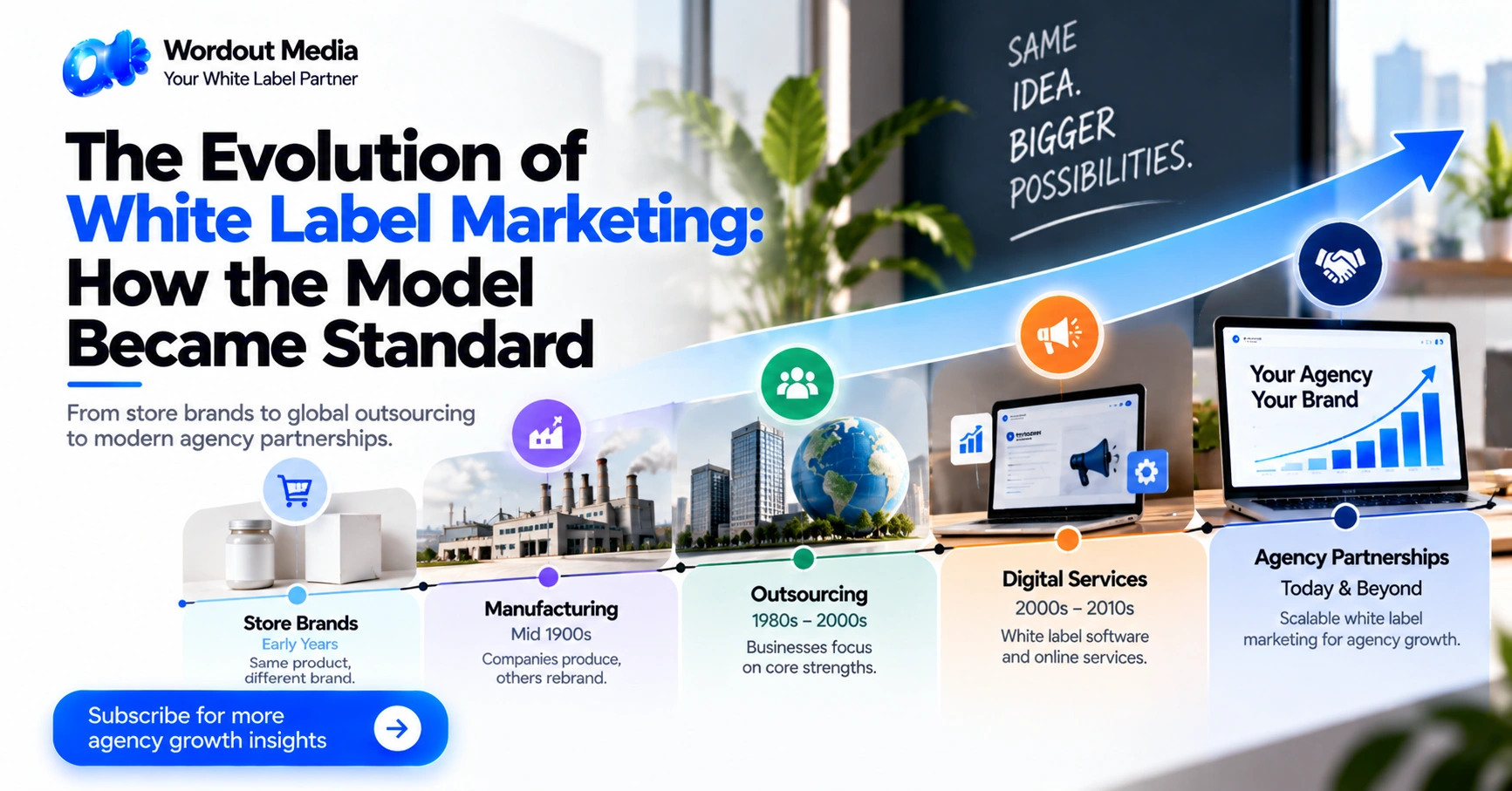
A Timeline at a Glance
| Period | What happened | Why it matters to agencies |
|---|---|---|
| World War II onward | Outsourcing begins to make its presence felt | Establishes the idea of using outside capacity |
| 1967 | EDS proposes the model later called outsourcing | A formal business model emerges |
| By 1981 | The term outsourcing is in use | The practice gets a name |
| 1989 | Kodak outsources IT; Drucker’s “Sell the Mailroom” | Outsourcing reaches the mainstream conversation |
| 1990s | “Do what you do best and outsource the rest” | Focus on core strengths becomes standard advice |
| Late 1990s | Internet and telecom enable offshoring of IT-enabled services | Remote delivery becomes practical |
| 2000s | Offshoring and BPO grow quickly; backlash follows | Lessons about quality, oversight and reputation |
| 2010s | Companies treat outsourcing as more than cost-cutting | Partnership thinking replaces price-only thinking |
| Today | Agency white label partnerships, flexible hour blocks, AI-assisted production | Execution can be shared; strategy stays with you |
Dates up to the 2010s come from the cited outsourcing overview. The final row reflects our own analysis of current agency practice.
How Wordout Media Fits Into This Story
We’re one example of where the model has arrived, and we’d rather describe it plainly than oversell it.
- A fifteen-person in-house team. No subcontractor chains.
- One dedicated account manager who learns your standards and briefs the right specialist.
- 100% white labeled. Every deliverable carries your branding. Your clients only ever see your agency.
- Flexible capacity. $10 an hour, sold in blocks of 20 hours ($200), 40 hours ($400) and 80 hours ($800). The rate is the same on every block, and unused hours don’t expire.
- Six services: White Label SEO + GBP, Website Design & Development, Social Media Management, Paid Advertising – Google & Meta, Creative Design + Figma and Automations + AI Workflows.
- A trial. 8 hours free, no contract, no card, no sales call required first.
And the limits: outsourcing doesn’t remove your workload. You still brief, review and own the client relationship. If your priority is strategic consulting rather than execution, or you need very large, round-the-clock capacity, a different provider may suit you better.
Frequently Asked Questions on White Label Marketing
What is the history of white label marketing?
Dimensions
The term comes from white-label products, where one company makes something and others rebrand it. The idea grew alongside outsourcing, which became a mainstream business strategy from the 1960s through the 1990s. Digital marketing agencies adopted the model as marketing became a service business made of discrete, remotely deliverable tasks.
Where does the term “white label” come from?
According to published sources on white-label products, it comes from a blank label on packaging that a marketer can fill with its own branding.
Is white label marketing the same as outsourcing?
White label marketing is a form of outsourcing in which the provider’s work is delivered under your brand. Standard outsourcing doesn’t necessarily hide the provider.
Why did white label marketing become popular?
Digital work became easy to deliver remotely, collaboration software got cheaper, clients wanted full-service agencies and agency owners learned to calculate delivery margins. Those conditions made partnerships practical and attractive.
Will AI replace white label marketing partners?
AI is changing how production work is done, but strategy, judgment and quality control remain human responsibilities. Many partners are using AI to speed up execution while keeping experts in charge of direction.
Is white label marketing ethical?
Yes, when the work is good, accountability stays with you, client data is protected and results are described honestly. Outsourcing production is normal across industries.
What should I look for in a white label partner today?
An in-house team, genuine white labeling, clear pricing, reasonable turnaround, a single point of contact and the ability to test before committing.
The history of white label marketing is really a story about specialization. Some people are good at making things. Others are good at selling them and earning trust. For generations, businesses have found ways to combine the two, from blank-label products on supermarket shelves to the outsourcing wave of the 1980s and 1990s to today’s agency partnerships.
What has changed is the speed, the tools and the expectations. What hasn’t changed is the principle that makes it work: keep the client relationship and the judgment, and share the production with people who do it well.
When you’re ready to test a partner on real work, claim your 8-hour free trial. You can also browse our FAQs or see all our services.