It depends, and you’ve probably already heard that. But “it depends” isn’t useful unless someone tells you what. This guide does that. It explains the main pricing models for white label SEO in 2026, shows the published price ranges that providers and researchers report, works through what each does to your margin, lists the hidden costs that turn a cheap quote into an expensive one and gives you a way to compare quotes fairly.
We’re Wordout Media. Our rate is a flat $10 an hour, which sits far below most of the figures you’ll see published, and we’ll deal with that head-on rather than hope you don’t notice. We’ll also tell you where published ranges come from, who published them and why you should treat them as a map, not a rulebook.
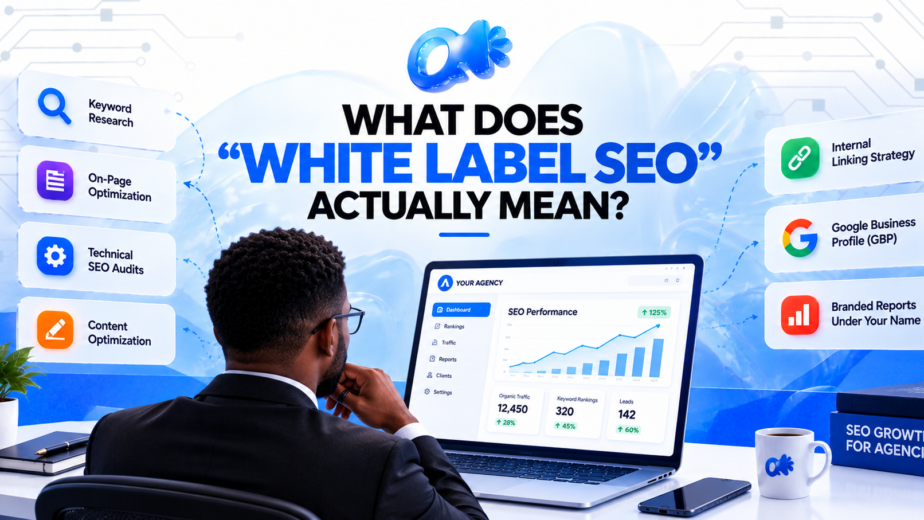
If you want the fundamentals first, read What Does “White Label SEO” Actually Mean?
A Note on Sources, Before We Quote Any Numbers
Every figure in the next section comes from a published source that we link to. Both are provider-published, which means they come from companies that sell white label services and have a commercial interest in how pricing is presented. That doesn’t make them wrong. It does mean they’re best read as indicative.
- Nico Digital’s White-Label SEO Pricing Benchmark 2026, published in June 2026. It states that it draws on public rate cards from white label providers in the US, UK, Australia and India collected in June 2026, published industry surveys as a cross-check and the publisher’s internal benchmarks. It reports ranges, widened where public data was thin, in US dollars, and notes that it doesn’t state hourly rates.
- Clicks Geek’s White Label SEO Pricing guide, dated March 2026, by the company’s COO.
Please treat both as snapshots. Prices move, ranges overlap and your own quote will reflect your scope.
The Four Common White Label SEO Pricing Models
1. Monthly retainers
You pay a fixed monthly fee for a defined package of ongoing work.
Published ranges (wholesale, per Nico Digital):
| Scope | Offshore | Onshore (US/UK) |
|---|---|---|
| Local SEO (single location) | $300 to $900 | $900 to $2,200 |
| Mid-market SEO (lead-gen, multi-location) | $900 to $2,500 | $2,500 to $6,000 |
| E-commerce / enterprise-lite | $2,500 to $6,000+ | $6,000 to $15,000+ |
Published ranges (per Clicks Geek): entry-level local at about $500 to $1,000 a month, mid-tier at $1,500 to $3,500 and enterprise at $5,000 and above.
Pros: Predictable cost and revenue, simple to resell. Cons: You may pay for capacity you don’t use; scope creep can eat the margin. Suits: Agencies with steady, similar clients.
2. Per-deliverable pricing
You pay a set price for each defined output.
Published wholesale ranges (Nico Digital):
| Deliverable | Range |
|---|---|
| Technical SEO audit (one time) | $500 to $2,500 |
| Long-form SEO article (1,500 to 2,500 words, edited) | $120 to $450 |
| Editorial link placement (DR 40+, white-hat) | $150 to $450 |
| Google Business Profile management (monthly) | $100 to $400 |
| Keyword and competitor research pack | $200 to $800 |
Pros: Clear scope for each item; easy to quote. Cons: Costs rise quickly if you need many items; quality varies by item. Suits: Agencies with uneven or project-based demand.
3. Hourly pricing
You pay for time.
Published range (Clicks Geek): $75 to $200 per hour, depending on whether the team is offshore or domestic. Nico Digital doesn’t report hourly rates.
Pros: Transparent and flexible; you pay for what you use. Cons: Hours can balloon without clear scope; rewards slowness unless there’s oversight. Suits: Ad hoc work and agencies that review closely.
4. Hour blocks
A variation of hourly pricing in which you buy blocks of hours up front and spend them across tasks. This is the model we use.
Our pricing: $10 an hour, sold as Starter ($200 for 20 hours), Growth ($400 for 40 hours) and Scale ($800 for 80 hours). The rate is the same on every block, and hours don’t expire.
Pros: Flexible across services, predictable per-hour cost, no lock-in. Cons: You buy time, not outcomes, so briefing quality matters; you need a shared way to track what each hour produced (we provide a task tracker). Suits: Agencies with uneven demand that value flexibility.
How Retail Pricing Relates to Wholesale
The wholesale cost is what you pay your partner. Retail is what you charge your client. The gap between them is your gross margin before your own time.
According to the Nico Digital benchmark, retail retainers typically run about two to three times offshore wholesale. It suggests holding retail at a minimum of 2x wholesale and treats anything below 1.5x as usually unsustainable. It also reports typical agency gross margins on white-labeled SEO retainers of roughly 45% to 65%, with a median around 55%, before account management. Clicks Geek suggests agencies typically mark up white label SEO by 50% to 100%.
Typical retail retainer ranges from Nico Digital: about $900 to $2,500 for single-location local SEO, $2,000 to $6,000 for mid-market SEO and $6,000 to $15,000+ for e-commerce or enterprise-lite SEO.
These are provider-published figures, so use them as orientation. The more important numbers are your own: what you charge, what delivery costs and what you keep. We explain the formulas in How to Calculate Your Agency’s Profit Margin.
Why Prices Vary So Much
The same label, “white label SEO,” covers very different arrangements. These factors explain most of the spread.
1. Where the team is based. Nico Digital’s regional index shows delivery costs differing significantly across regions, with onshore US and UK teams costing a multiple of offshore ones.
2. Seniority. Strategic input from senior specialists costs more than execution by junior staff.
3. What’s included. Some retainers bundle reporting, account management and strategy. Others sell execution only.
4. Scope. Single-location local SEO is far lighter than multi-location or e-commerce work.
5. Link building. Editorial links that take real outreach cost far more than directory submissions. Be cautious: very cheap link packages can be a sign of practices that search engines treat as spam.
6. Overheads. Providers with offices, large sales teams and heavy marketing build those costs into their rates.
7. Business model. Fixed packages, hour blocks and per-deliverable prices spread cost differently.
8. Positioning. Some providers price as a premium service; others compete on efficiency.
Where Our $10 an Hour Fits, and Why We’re Not Hiding the Gap
You’ll notice our rate is well below the hourly range quoted by Clicks Geek and doesn’t map neatly onto per-deliverable wholesale prices. A technical SEO audit, for example, has a published wholesale range of $500 to $2,500, while ours, scoped at an illustrative 12 hours for a small business site, would come to around $120.
That gap deserves an explanation, not a shrug.
What explains it:
- A lean, in-house team of fifteen. No sales armies, no subcontractor chains and low overhead.
- Execution focus. You supply strategy and client relationships. We carry out production. Some higher-priced providers bundle consulting and account management into their rates.
- Hour-based scoping. Our quotes reflect hours of work, not a premium for a branded deliverable.
- Efficiency and repeat business. The model works because agencies come back, not because each job carries a large margin.
What doesn’t follow from it:
- A low rate doesn’t automatically mean lower quality, and a high rate doesn’t automatically mean higher quality. Both need proof.
- Our hour estimates are illustrative. Real scope depends on the site, the starting point and the work.
- You still brief and review. Our price isn’t “free”; it shifts effort, and your review time is part of your real cost.
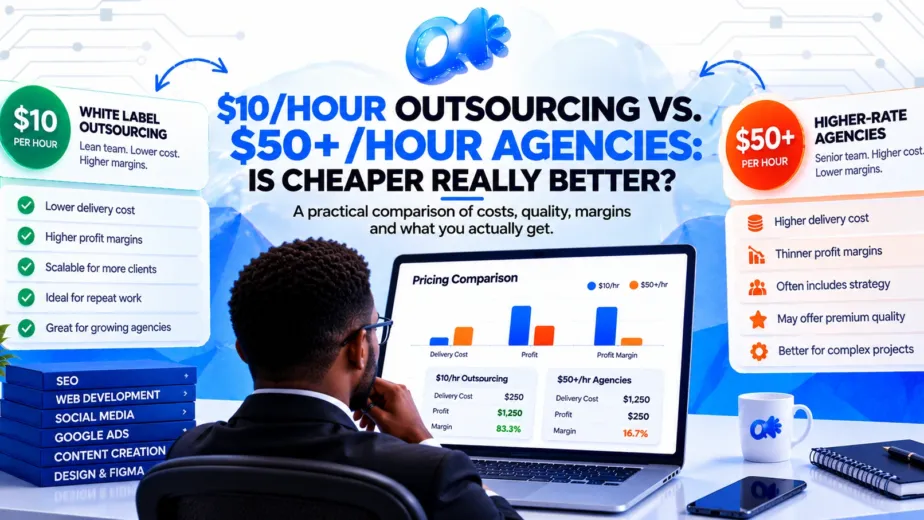
That’s why we offer an 8-hour free trial. Don’t take our word for the quality. Test it and compare the result with any provider charging ten times more. For a deeper discussion of cheaper versus pricier models, see $10/Hour Outsourcing vs. $50+/Hour Agencies: Is Cheaper Really Better?
The Hidden Costs Behind Any White Label SEO Quote
The headline price is rarely the whole price. Check for these.
Setup and onboarding fees
Clicks Geek reports one-time setup fees of $500 to $2,500 as a common add-on in the market. Ask whether any apply.
Reporting and technology fees
The same source mentions white-label reporting and technology fees of $100 to $300 per client per month as a common extra.
Content add-ons
Extra posts or pages billed separately, with published figures of $200 to $400 per post.
Minimum commitments
Minimum monthly spend or contract length that locks you in.
Revision charges
How many rounds are included, and what happens after.
Rush fees
Charges for faster turnaround.
Your own management time
Briefing, reviewing and communicating. This is the hidden cost almost no quote includes, and it’s often the largest. A partner who needs ten hours of your time per month to deliver twenty hours of work costs far more than the invoice suggests.
The cost of problems
Poor work, missed deadlines and damaged client relationships. These don’t appear on invoices but cost real money.
What White Label SEO Pricing Means for Your Margin
Let’s put numbers through an example. These figures are illustrative.
You sell a monthly local SEO retainer for $1,200. The work takes 25 hours. Your review time is 3 hours at $40.
| Delivery model | Hourly cost | Delivery cost | Your time | Total cost | Profit | Margin |
|---|---|---|---|---|---|---|
| Internal employee | $44 | $1,100 | $120 | $1,220 | −$20 | −1.7% |
| Onshore partner | $75 | $1,875 | $120 | $1,995 | −$795 | −66% |
| Mid-range partner | $35 | $875 | $120 | $995 | $205 | 17.1% |
| Hour-block partner | $10 | $250 | $120 | $370 | $830 | 69.2% |
The onshore example shows the lesson in blunt form: at $75 an hour, a $1,200 retainer for 25 hours can’t work. You’d need to charge far more, which narrows your market. At the other end, the hour-block option leaves a healthy margin even after your own time.
Notice what this means for pricing power. When delivery costs less, you can protect margin, price more competitively or invest more hours in each client. Our guide How to Price Digital Marketing Services for Maximum Profit shows the formulas, and the Agency Profit Margin Calculator lets you test your own numbers.
Government Data on the Cost of Employees
If you’re comparing outsourcing with hiring, it helps to anchor on real data. The U.S. Bureau of Labor Statistics’ Employer Costs for Employee Compensation release for June 2026 reports that total employer compensation costs for private industry workers averaged $46.89 per hour worked. Wages and salaries were 70.0% of that ($32.82), and benefits were 30.0% ($14.07).
That’s an average across all private industry, not marketing agencies or SEO roles, so it isn’t your number. It shows that the true hourly cost of an employee sits well above the wage. And because not every paid hour is productive, the cost per productive hour is higher still. We cover this comparison in White Label vs. In-House Marketing Team: Which Is Right for Your Agency?
How to Compare White Label SEO Quotes Fairly
Collecting quotes is easy. Comparing them is where agencies go wrong. Use this table.
| Question | Why it matters |
|---|---|
| What exactly is included? | A cheaper quote may cover less. |
| How many hours or deliverables does it represent? | Compare effort, not just price. |
| Who does the work? | In-house team or subcontractors? |
| What are the setup, reporting and minimum fees? | Hidden costs change the real price. |
| How many revisions are included? | Unlimited vs capped changes. |
| What’s the turnaround? | Delays cost client trust. |
| Is it fully white labeled? | Branding should be entirely yours. |
| What’s the contract length? | Lock-ins reduce flexibility. |
| How will I see what I paid for? | Task tracking and reporting. |
| Can I test first? | Evidence beats promises. |
Then calculate your total cost of ownership: partner fees + setup + extras + your own time + the estimated cost of rework. Compare that across providers, and compare it with your retail price to see the margin each option leaves.
Red Flags in SEO Pricing
- “Guaranteed rankings.” Nobody controls Google.
- A price with no scope. “SEO for $499” says nothing.
- Very cheap link packages as the core service. Google’s spam policies define link spam as creating links “primarily for the purpose of manipulating search rankings.”
- Long lock-ins before any proof. Good providers earn the contract.
- Prices that change with no explanation. Ask how rate changes are handled.
- No visibility into hours or tasks. If you can’t see what you’re paying for, you can’t manage it.
- Refusing to name who does the work.
How to Protect Your Margin Whatever You Pay
- Know your target margin and work backward to what you can afford to pay.
- Scope your own retainers tightly. List deliverables, cap revisions and charge for extras.
- Track hours on every account, even if clients never see them.
- Test before you commit. One task, one client, then expand.
- Review quarterly. Costs, scope and prices change.
- Don’t pass all your savings to the client. Your margin is what funds your own growth.
Our Pricing, Stated Plainly
For clarity, here is exactly what we charge.
- Rate: $10 an hour.
- Starter: $200 for 20 hours. Best for testing us out or covering an overflow month.
- Growth: $400 for 40 hours. Best for one to two active client accounts.
- Scale: $800 for 80 hours. Best for multiple accounts and ongoing delivery.
- No volume pricing games. The rate is the same on every block.
- Hours don’t expire. If you buy 40 and use 25, the other 15 are waiting when you come back.
- Flexible across services. Spend them on SEO, web, social, ads, design or automation, whichever is urgent that month.
- Visibility. A shared task tracker shows exactly what each hour went to.
- Trial. 8 hours free, no contract, no card, no sales call required first.
For SEO, our White Label SEO + GBP service covers keyword research, on-page optimization, technical audits, blog content optimization, internal linking and Google Business Profile optimization. For a line-by-line scope and estimate on your own project, see Get a Custom White Label SEO Quote for Your Agency.
Frequently Asked Questions
How much does white label SEO cost in 2026?
Published ranges vary widely. Provider-published benchmarks report wholesale monthly retainers from roughly $300 to $900 for offshore single-location local SEO up to $15,000+ for onshore e-commerce or enterprise-lite SEO. Our rate is $10 an hour, sold in blocks of 20, 40 or 80 hours.
What are the main white label SEO pricing models?
Monthly retainers, per-deliverable pricing, hourly rates and hour blocks.
How much should I mark up white label SEO?
Published guidance varies. One provider suggests typical markups of 50% to 100%, and another benchmark suggests retail at a minimum of about 2x wholesale. Set your own target by working backward from the margin you need.
Why is white label SEO pricing so inconsistent?
Because the label covers very different arrangements: different team locations, seniority levels, scopes, link-building approaches and business models.
Are there hidden fees in white label SEO?
Common ones include setup fees, reporting fees, content add-ons, minimum commitments, revision charges and rush fees. Always ask for the full cost.
Is $10 an hour too cheap to be good?
Price alone doesn’t indicate quality in either direction. Our rate reflects a lean in-house team, an execution focus and low overhead. Test the work with our free trial and judge for yourself.
Can white label SEO providers guarantee rankings?
No. Be wary of any provider that does.
Does my own time count as a cost?
Yes. Briefing and reviewing work is a real cost, and including it gives you an honest margin figure.
White label SEO pricing in 2026 spans a huge range because the label covers very different things. Published benchmarks show retainers from a few hundred dollars to well over ten thousand, per-deliverable prices from $100 to $2,500 and hourly rates that vary by region and team model.
What matters isn’t the cheapest or most expensive quote but the one that gives you a defensible margin, honest scope and work you’d put your own name on. Compare total cost, include your own time, test before you commit and keep your retail pricing tied to your target margin.
Get Our Flat $10/Hr Rate, No Volume Pricing Games
One rate. Every block. Hours that don’t expire.
Get our flat $10/hr rate with no volume pricing games: Starter at $200 for 20 hours, Growth at $400 for 40 hours or Scale at $800 for 80 hours. Want to test the work first? Claim your 8-hour free trial with no contract and no card.
You can also read our FAQs or browse our services.