Stay with me for a second, because this analogy actually helps.
Imagine a small pizza shop that takes orders by phone and app. The owner is brilliant at it. She knows her regulars by name, she’s got a great sense of what the neighborhood wants and she’s built a brand people trust. But on a Friday night, with forty orders stacked up, she can’t make every pizza herself and also answer the phone and also keep customers happy. So she partners with a kitchen that handles production when it gets busy. The customer still orders from her. The box still has her name on it. She still gets the thank-you messages and the one-star reviews.
That kitchen is a fulfillment partner. The word comes from the world of physical goods, where “fulfillment” means everything that happens between “customer ordered” and “customer received.” Somebody takes the order. Somebody else packs it, ships it and makes sure it arrives.
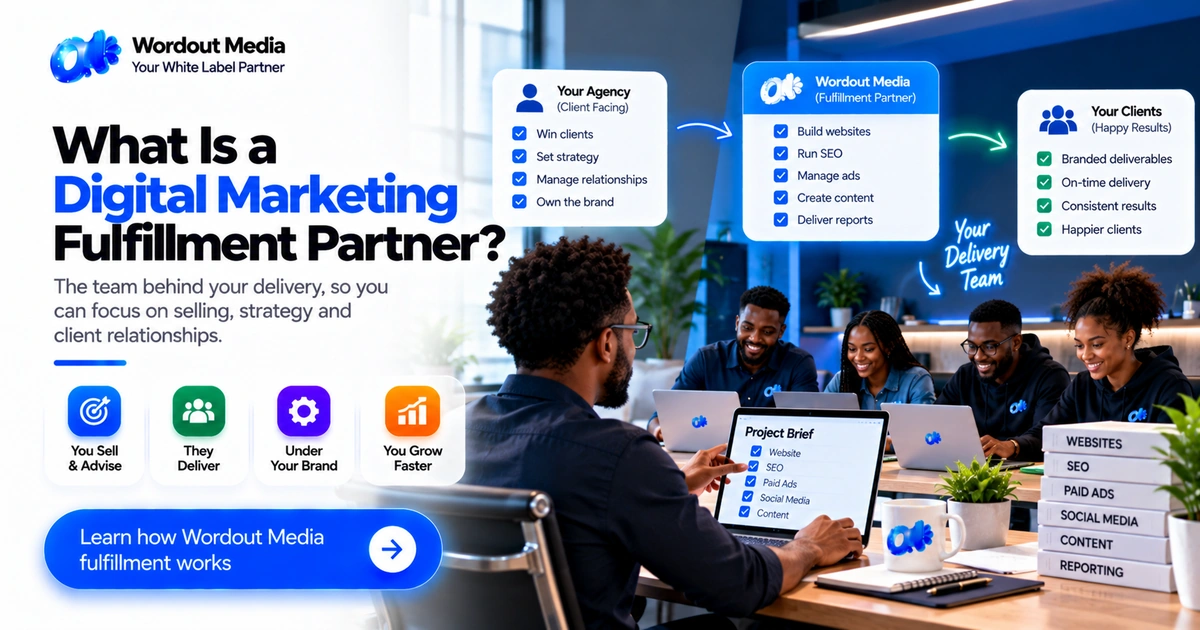
Now swap pizzas for websites, SEO audits, ad campaigns and social calendars, and you’ve got the idea. A digital marketing fulfillment partner is a team that delivers the marketing work an agency has sold. You sell, advise and own the relationship. They produce and hand it back, ready for you to pass on.
If that sounds a lot like white label, it’s because the two overlap. We’ll untangle how in a moment. First, let’s make the definition more precise, because the term gets used loosely.
A Plain-English Definition
A digital marketing fulfillment partner is an outside team that carries out client work on behalf of your agency, typically under your brand and your direction, so you can deliver more than your own staff could handle.
Three things make a fulfillment partner different from “just another vendor”:
- They deliver finished work, not advice. A consultant tells you what to do. A fulfillment partner does it.
- They work inside your commitments. You’ve promised a client a deliverable by Thursday. The partner’s job is to help you keep that promise, not to run its own agenda.
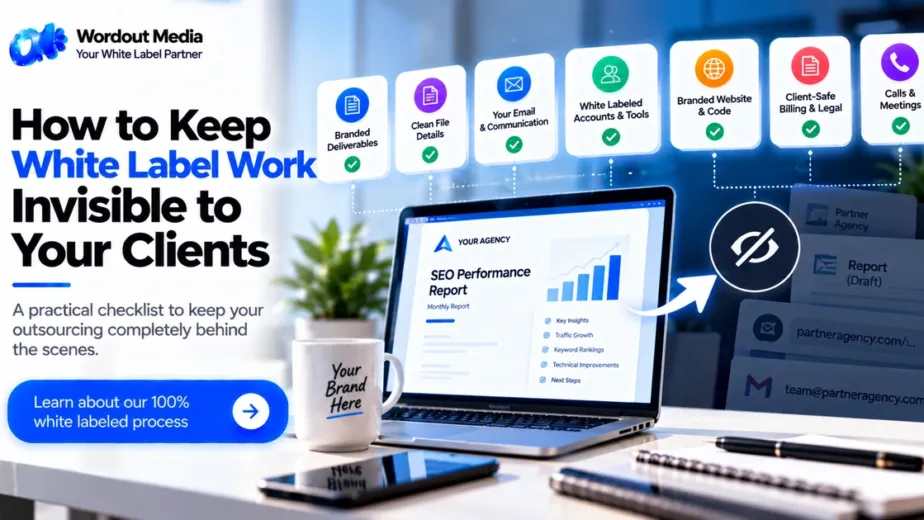
- They’re built to be invisible when you want them to be. The work arrives ready to hand to your client, with your branding on it.
You might see the same idea described as outsourced delivery, white label production, back-end delivery or an extension of your team. The labels vary. The idea is steady: you own the front of the house, and someone else helps run the kitchen.
Why the Term Is Showing Up Now
Honestly, it’s showing up because agencies keep running into the same wall.
Selling marketing is one skill. Delivering it is another. Plenty of agency owners are great at the first and drowning in the second. They win a client, feel good for about a day and then realize someone has to actually build the site, write the briefs, set up the ads and send the reports, and that someone is usually them, on a weekend.
The wider business world has been dealing with the same tension for decades. According to the Overview of outsourcing, the reasons companies outsource are consistent: cost savings, focus on core strengths, access to specialist skills, speed, flexibility and the ability to convert fixed costs into variable ones. Marketing agencies simply have a particularly clean version of the problem, because most of what they sell is work done by people, in units that can be briefed and handed off.
“Fulfillment partner” is the language of agencies who’ve decided to treat delivery as something to design, not something to survive.
Fulfillment Partner vs Everything Else
People often ask how this differs from the other ways of getting help. Here’s the honest comparison.
Fulfillment partner vs freelancer
A freelancer is one person with one set of skills and a finite number of hours. They can be wonderful. But if they get sick, get busy or get a better offer, your delivery pauses. A fulfillment partner is a team, so capacity and skills don’t depend on a single person. The trade-off: a good freelancer may feel more personal, and sometimes costs less for a one-off task.
Fulfillment partner vs full-service agency
A full-service agency sells its own strategy and often wants its own client relationship. A fulfillment partner is built to support yours. If you hire another agency to do your client work, you risk the client meeting them. With a fulfillment partner, that’s not the plan.
Fulfillment partner vs in-house staff
Employees are a commitment: salary, benefits, management and training, whether the month is busy or quiet. A partner turns that into a variable cost. We compared the two in detail in White Label vs. In-House Marketing Team. For steady, high-volume work, hiring can make sense. For uneven demand, a partner is often easier to live with.
Fulfillment partner vs reseller
A reseller sells a ready-made product, often with the provider’s brand still visible somewhere. A fulfillment partner does custom work for your clients’ needs. We walked through the terminology in White Label vs. Private Label vs. Reseller.
Fulfillment partner vs white label agency
Here’s where the words blur. “White label” describes the branding arrangement: the work carries your name. “Fulfillment” describes the role: the partner delivers what you sold. Most good white label agencies are fulfillment partners, and most fulfillment partners work white label. If you’d like the full background on white labeling, start with What Is a White Label Digital Marketing Agency?
In short: white label tells you how the work is branded. Fulfillment tells you what the partner is for.
What a Fulfillment Partner Actually Does All Day
It helps to picture a normal week, because it makes the idea less abstract.
On Monday morning, a brief arrives from an agency: “New client, a local dental practice. We need a technical audit and a Google Business Profile cleanup. Here are the logins, the competitors and the client’s goals.” The account manager reads it, spots that the practice has two locations the brief doesn’t mention and asks one clarifying question. By lunch, a specialist is working.
On Tuesday, a different agency sends a batch of social graphics to produce for the month. A third needs a landing page edited and published by end of day. A designer picks up the graphics, a developer handles the page.
On Wednesday, the audit lands in the first agency’s inbox, branded with their logo, with a short summary the owner can read aloud on a client call. They send back two small notes. A revised version arrives that afternoon.
Nothing dramatic happened. That’s the point. A good fulfillment partner makes delivery feel boringly reliable.
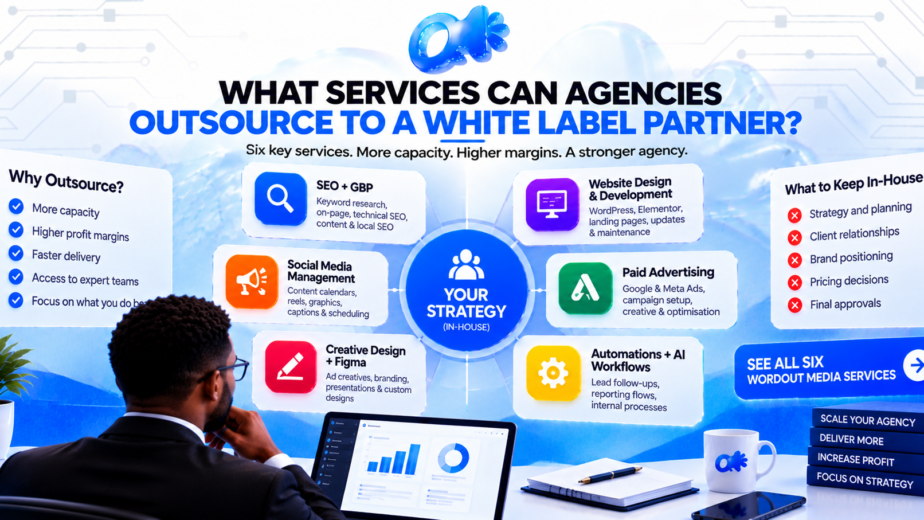
The work typically falls into a handful of areas, which at Wordout Media look like this:
- SEO and Google Business Profile. Keyword research, on-page optimization, technical audits, content optimization, internal linking and local profile work. See White Label SEO + GBP.
- Websites. Business sites, landing pages and WordPress or Elementor builds. See Website Design & Development.
- Social media. Content calendars, Reels, carousels, graphics and captions. See Social Media Management.
- Paid advertising. Google and Meta campaigns, copy, audiences and optimization. See Paid Advertising – Google & Meta.
- Design. Graphics, ad creative, mockups and presentations. See Creative Design + Figma.
- Automation. Lead follow-up, reporting and workflow builds in tools such as n8n and GoHighLevel. See Automations + AI Workflows.
What a Fulfillment Partner Doesn’t Do
This part matters just as much, and it’s where expectations go wrong.
A fulfillment partner doesn’t replace your thinking. They don’t know your client’s business the way you do, they can’t build the relationship you’ve built and they shouldn’t be making your strategic decisions. If you ask for “SEO” with no goals, no context and no review, you’ll get something generic, and that’s not their fault.
A good partner also doesn’t guarantee outcomes they can’t control. Nobody controls Google’s rankings, and nobody controls whether a client approves changes on time. Be wary of anyone who says otherwise.
And a fulfillment partner doesn’t make your workload vanish. You still brief the work, review what comes back and talk to the client. What changes is the production load, which is usually the heaviest part, not the thinking part.
How the Relationship Works, Step by Step
If you’re considering one, here’s what the arrangement usually looks like in practice. For a longer walkthrough, see How Does White Label Marketing Work, Step by Step?
1. You choose what to hand off. Usually something repeatable and time-consuming that isn’t your core craft.
2. You get set up. At Wordout Media, you’re assigned a dedicated account manager who learns your standards, your tools and how you like to communicate. One person owns your projects and briefs the right specialist, so there’s one hand-off rather than four.
3. You write a brief. Goals, context, deliverables, brand notes and access. A good brief is the cheapest quality control you’ll ever have.
4. The partner produces. Most design, ad setup and video editing tasks come back same day to 48 hours. Bigger builds, like full websites or multi-page SEO projects, get a scoped timeline up front.
5. You receive branded work. Everything carries your logo. Clients see only your agency.
6. You review and respond. You’re the quality gate. Specific feedback gets specific fixes.
7. You deliver to the client and invoice. On your terms and at your price.
8. You repeat, and it gets smoother. The first month has more questions than the sixth.
The Honest Benefits
Let’s talk about what you actually get, without the brochure language.
More capacity without more payroll. You can say yes to the client who shows up in a busy month.
A wider menu. You can offer services you don’t have the staff to deliver. A web studio can sell SEO. A social agency can sell ads.
Better margins, usually. If your partner’s hourly cost is lower than your own cost per productive hour, delivery gets cheaper. We show the math in How to Calculate Your Agency’s Profit Margin, and you can test your own numbers with the Agency Profit Margin Calculator.
Flexibility. Quiet month? You buy fewer hours. Busy month? You buy more.
Time back. This is the one people underrate. When you’re not buried in production, you can sell, think and look after clients. We wrote about the trap of constant busyness in Why Being Constantly Busy Is Killing Your Agency’s Profit.
The Honest Risks
A fair explanation includes the downsides, so here they are.
Quality is still your responsibility. If something poor reaches your client, your name is on it. Review everything, at least until trust is earned.
A vague brief produces vague work. Most disappointments trace back to unclear instructions.
Hidden subcontracting. Some providers pass work to freelancers or other agencies, leaving you several steps from the person doing it. Ask directly. Our team of fifteen is in-house, and we keep it that way for this reason.
Time zones. A partner who’s asleep while your client is awake creates delays. We work EST hours and serve agencies across the US, Canada and Europe.
Dependence. If everything runs through one partner and they vanish, you’re exposed. Keep documentation of what’s been built and where it lives.
Confidentiality. You’re sharing client access. Make sure the provider is comfortable with NDAs and careful about logins.
None of these is a reason to avoid the model. They’re reasons to choose carefully and to start small.
How Fulfillment Partners Charge
Pricing varies widely, and it’s worth understanding the common shapes.
- Monthly retainers. A fixed package for a fixed fee.
- Per-project pricing. One price for one deliverable.
- Wholesale rate cards. Set prices per item that you mark up.
- Hour blocks. You buy hours and spend them where you need them.
Our own model is hour blocks at $10 an hour: Starter is $200 for 20 hours, Growth is $400 for 40 hours and Scale is $800 for 80 hours. The rate is the same on every block, hours don’t expire and you can spend them across any of the six services. A shared task tracker shows exactly where each hour went. We explain how to pick a block in Starter, Growth or Scale: Which Hour Block Is Right for You?, and how cheaper and pricier providers compare in $10/Hour Outsourcing vs. $50+/Hour Agencies.
A Short Checklist for Judging Any Fulfillment Partner
If you’re comparing options, these are the questions that matter most.
- Who does the work? Employees or subcontractors?
- Is it truly white labeled? Reports, files and communication should carry only your brand.
- Who’s my contact? One person is better than a queue.
- What’s the turnaround? Ask for specifics for small tasks and large ones.
- How is pricing structured? Look for clarity and no surprise fees.
- Can I see what I paid for? Task-level visibility keeps everyone honest.
- Can I test first? A trial tells you more than a sales call.
- What happens if something goes wrong? Ask how mistakes are handled.
- How do they treat confidentiality? NDAs, access and data.
- Do they tell me when I’m wrong or when they can’t help? Honest partners are worth more than agreeable ones.
We go deeper on this for SEO specifically in How to Choose the Right White Label SEO Partner.
How Wordout Media Approaches Fulfillment
Since you’ve read this far, here’s how we do it, in plain terms.
We’re a team of fifteen, all in-house. There are no subcontractor chains and no handing your client’s work to someone we’ve never met. You get one account manager who knows how you like things done. Everything we deliver carries your branding, so your clients only ever see your agency.
We turn most small tasks around in a day to two. Bigger builds get a scoped timeline first, and we stick to it. We work EST hours, which means a brief you send in your morning is usually moving before lunch.
You can test us first. The 8-hour free trial means you send real work, such as a landing page, a batch of social creative, a technical SEO audit or a Google Ads build, and judge the output and the working relationship before spending anything. There’s no contract, no card and no sales call required first.
And the limits, because we’d rather say them now: if you want a done-for-you package with almost no briefing, hour blocks ask more of you. If you need very large, round-the-clock capacity, a bigger provider may suit you better. If your contracts require employee-only delivery, an outsourced model may not work. If those apply, we’ll tell you.
Who This Is For
Fulfillment partners tend to suit:
- Small and mid-size agencies with more demand than capacity.
- Web studios that want to add monthly SEO, social or ads.
- Freelancers who are turning into agencies.
- Consultancies that sell strategy and need reliable execution.
- Agencies with spiky demand that don’t want to carry payroll through quiet months.
They’re a poorer fit for agencies whose whole identity is hands-on craft in one discipline, or for those with no real client work yet.
Frequently Asked Questions
What is a digital marketing fulfillment partner?
A team that carries out the marketing work an agency has sold, usually under the agency’s brand and direction, so the agency can deliver more than its own staff could handle.
Is a fulfillment partner the same as a white label agency?
They overlap. White label describes the branding arrangement (your name on the work). Fulfillment describes the role (delivering what you sold). Most good white label agencies act as fulfillment partners.
What kinds of work can be fulfilled?
SEO and Google Business Profile work, websites, social media, paid advertising, design and automation are common. Reporting, video editing and content production are often included too.
Will my clients know I use a partner?
Not if the arrangement is done properly. Everything ships under your branding.
How much does fulfillment cost?
It depends on the model. Ours is $10 an hour in blocks of 20, 40 or 80 hours ($200, $400, $800), with hours that never expire.
What do I still have to do?
Write briefs, review the work, manage the client relationship and own strategy and pricing. A partner takes the production load, not your judgment.
How do I know a partner is any good?
Ask who does the work, check how they handle confidentiality and test them on a real task first.
How fast can a partner start?
Much faster than a hire. Most small tasks at Wordout Media come back same day to 48 hours.
A digital marketing fulfillment partner isn’t a magic fix, and it isn’t a threat to your agency’s identity. It’s a practical answer to a simple problem: selling and delivering are different jobs, and most agencies are better at one of them.
If you hand off the right work, write decent briefs and keep your hands on the strategy and the relationship, the arrangement can feel like a bigger team without the overhead. If you hand off everything carelessly, it can feel like a gamble. The difference is mostly in how you set it up.
Learn How Wordout Media Fulfillment Works
Curious what this would look like for your agency?
Learn how Wordout Media fulfillment works and talk to a dedicated account manager about your clients and your workload. If you’d rather see it for yourself first, claim your 8-hour free trial: no contract, no card. You can also read our FAQs or browse all our services.