Think about the last time you got on a call with a vendor. You probably spent the first ten minutes explaining your business, the next ten listening to a pitch and the last five agreeing to “send over some information.” Then the follow-up email arrived, you were busy, and the whole thing quietly faded.
Nobody did anything wrong. The call just had no shape. Neither side knew what question it was supposed to answer.
If you’re thinking about whether to book a call with a white label agency, we’d like yours to go differently. A good first call has one job: to help you decide, honestly, whether outsourcing part of your delivery makes sense, and if it does, what the smallest sensible first step looks like. It shouldn’t feel like being sold to, and it shouldn’t leave you with homework you don’t understand.
This guide covers who you’d actually speak to, what to prepare, which questions to ask us (and any agency), what a useful call can settle, what usually happens afterward and when a call isn’t the right first step at all. We’ll be straight about that last one, because sometimes it isn’t.
Why People Book a Call With a White Label Agency
People book a call with a white label agency for a handful of recurring reasons, and recognising yours helps you prepare.
- They’re stuck on scope. They know they need help but can’t tell whether it’s twenty hours of work or two hundred.
- They have a specific worry. Usually quality, confidentiality or whether clients will notice.
- They want a human. A website can answer questions, but it can’t ask you one back.
- They have an unusual project. Multiple locations, an urgent launch or a client with special rules.
- They’re comparing providers and want to hear how each one actually talks about the work.
A call is a good place to settle those things. It isn’t the only place, and it shouldn’t be a hurdle you must clear before seeing any work.
Who You’d Be Talking To
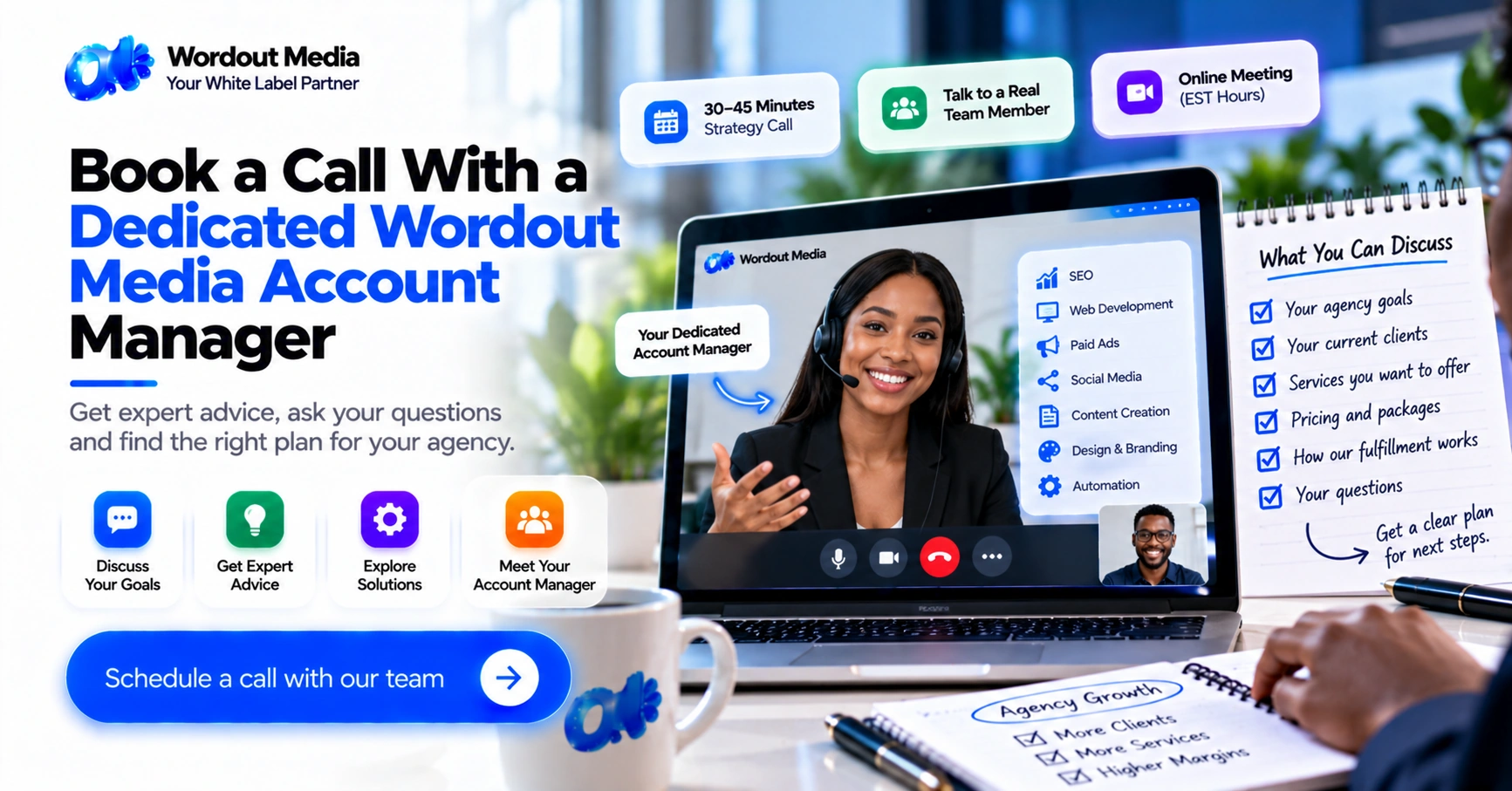
At Wordout Media, every agency partner gets one dedicated account manager. That person is your point of contact for the whole relationship: they learn your standards, take your briefs, brief the right specialists on our fifteen-person in-house team, and keep track of what’s moving.
The call is with our team, and the aim is to connect you with that kind of person early, so you’re talking to someone who’d actually be working with you rather than a stranger who disappears after the sale. We work EST hours, which suits agencies across the US, Canada and Europe.
If you want a primer before the conversation, What Is a White Label Digital Marketing Agency? covers the basics, and How Does White Label Marketing Work, Step by Step? walks through the day-to-day.
What a Dedicated Account Manager Actually Does
The phrase “dedicated account manager” gets thrown around a lot, so let’s be concrete about what it means in a white label setting.
They’re your single hand-off. Instead of explaining the same project to a designer, a developer and an SEO specialist separately, you explain it once. Your account manager translates it into tasks for the right people.
They protect your standards. Over time they learn how you like reports laid out, how you word things for clients and what you consider “done.” That memory is a large part of the value.
They keep the work visible. A shared task tracker shows what each hour went to, and your account manager keeps it up to date and answers questions about it.
They flag problems early. If a brief is missing logins, or a request will take more hours than expected, you hear about it before the deadline, not after.
They can appear as part of your team. If you’d like them on a client call, they can join as a member of your agency. Everything we deliver carries your branding, and your clients only ever see your agency. For the full picture, see How to Keep White Label Work Invisible to Your Clients.
What they don’t do: make your strategic decisions, set your prices or own your client relationships. Those stay with you. The account manager is there to make delivery smoother, not to replace your judgment.
Is a Call the Right First Step?
Honestly, not always. Here’s how we’d think about it.
A call makes sense if:
- You have a specific project or client you’d like help with.
- You want to talk through scope, hours or timelines before committing.
- You’re comparing a few options and have questions that a website can’t answer.
- Your situation is unusual, such as multiple locations, a tight deadline or a client with special requirements.
The free trial may be a better first step if:
- You’d rather see the work than hear about it.
- You already know what task you’d like to try.
We offer an 8-hour free trial with no contract, no card and no sales call required first. Many agencies prefer to test with a real task and talk afterward. Others like to talk first. Either order is fine, and plenty of people do both. You can read how the trial works in Claim Your Free 8-Hour Trial With Wordout Media.
How to Prepare (Twenty Minutes Well Spent)
You don’t need a polished presentation. A short list of notes is plenty. The more concrete you are, the more useful the call becomes.
1. Know what you’re trying to solve
Complete this sentence: “I’m looking for help because ______.” For example:
- “I keep turning down web projects because I don’t have developers.”
- “My SEO clients are growing but my margin isn’t.”
- “I do all the production myself and I’m tired.”
- “I’d like to add paid ads to my menu without hiring a media buyer.”
That single sentence shapes the whole conversation.
2. List your current clients and their needs
A rough list is fine: how many active clients, which services each needs and roughly what you charge. You don’t have to share client names. Even “three local SEO retainers and one website rebuild” is enough to estimate hours.
3. Estimate your hours
If you’ve tracked time, bring those numbers. If not, make an honest guess. Our guide to choosing between Starter, Growth and Scale includes illustrative hour estimates for common tasks and a five-step method for working out your monthly need.
4. Know your numbers
What do you charge, what does delivery currently cost you, and what margin would you like to keep? If you haven’t worked this out, the Agency Profit Margin Calculator does the math, and How to Calculate Your Agency’s Profit Margin explains the formulas.
5. Gather examples of your standards
Anything that shows how you like work to look: a sample report, a brand guide, a past deliverable you’re proud of. It helps your account manager understand your bar.
6. List your concerns
Write them down honestly. Quality? Confidentiality? Communication? Time zones? Whether your clients will find out? A good call deals with these directly. If you’re unsure what to worry about, Why Do Agencies Outsource SEO, PPC and Web Design? covers the common ones.
7. Decide what “success” looks like
In 30 days, what would make you think this was worth it? A finished landing page? A client report delivered without you staying up late? A clearer sense of your margin? Naming it now keeps the first project focused.
A Sample Agenda You Can Steal
If you want the call to stay useful, propose a simple agenda at the start. Something like this works well, and it’s easy to adjust:
- Two minutes on you. What your agency does, who you serve and how big the team is.
- Three minutes on the problem. The sentence you wrote earlier.
- Five minutes on a specific project. One client, one deliverable, one deadline.
- Five minutes on working style. Briefs, reviews, communication and who attends client calls.
- Three minutes on numbers. Hours, blocks and how the pricing would apply.
- Two minutes on next steps. What you’ll do, what we’ll do and by when.
Whether you choose to book a call with a white label agency like ours or another, an agenda keeps both sides honest about time and makes the follow-up obvious.
Questions to Ask Us (and Any Agency)
You should leave a call knowing more than you did going in. These questions are worth asking anyone you’re considering, including us.
About who does the work
- Is the work done by your own employees, or do you use subcontractors?
- Who would I speak to day to day?
- What happens if my account manager is unavailable?
About quality and process
- How do you handle briefs and revisions?
- What’s the typical turnaround for small tasks and larger ones?
- How will I see what’s been done and how many hours it took?
About branding and confidentiality
- Is everything fully white labeled?
- Will clients ever see your name, logos or tools?
- Are you comfortable signing an NDA?
About pricing
- What is the rate, and does it change with volume?
- Do hours expire?
- Are there setup, reporting or minimum fees?
About fit
- What kinds of agencies do you work best with?
- Where are you not a good fit?
- What would you advise me to try first?
That last pair of questions is the most revealing. A partner who can say where they don’t fit is usually one who knows their own limits. For deeper detail on evaluating providers, see How to Choose the Right White Label SEO Partner.
What We Can Tell You Before the Call
To save time, here are answers to the things people ask most.
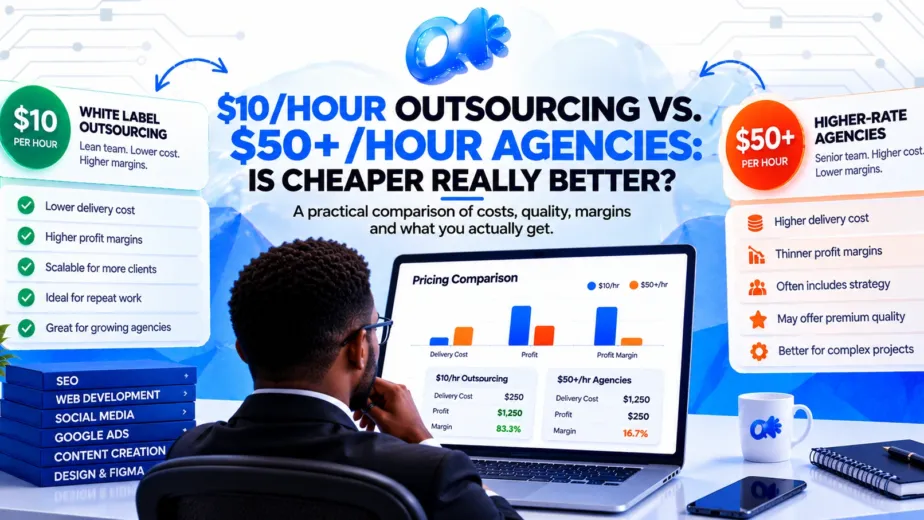
- Rate: $10 an hour.
- Blocks: Starter is $200 for 20 hours, Growth is $400 for 40 hours, Scale is $800 for 80 hours.
- No volume pricing games. The rate is the same on every block.
- Hours don’t expire.
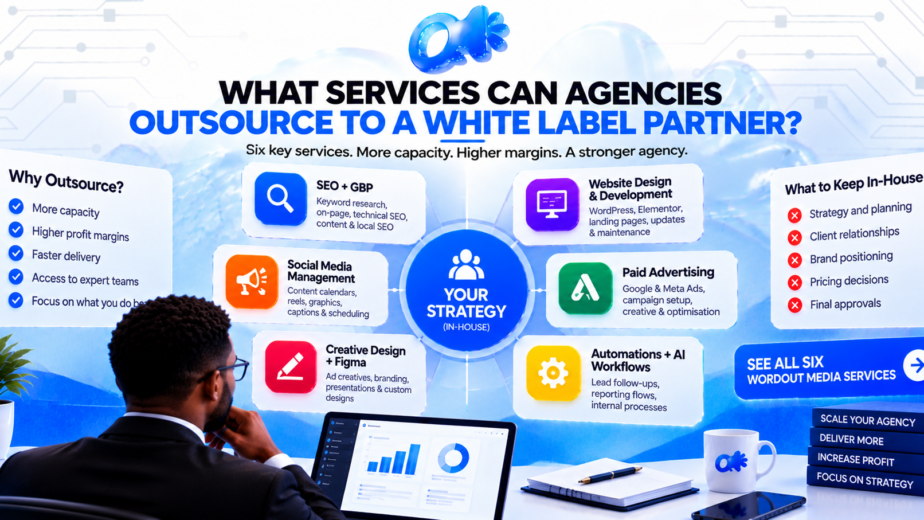
- Services: White Label SEO + GBP, Website Design & Development, Social Media Management, Paid Advertising – Google & Meta, Creative Design + Figma and Automations + AI Workflows.
- Team: fifteen people, all in-house.
- Turnaround: most design, ad setup and video editing tasks come back same day to 48 hours. Larger builds like full websites and multi-page SEO projects get a scoped timeline first.
- Branding: 100% white labeled. Reports and deliverables carry your logo.
- Visibility: a shared task tracker shows where every hour went.
- Trial: 8 hours free, no contract, no card.
If those are already clear, your call can skip straight to your specifics.
What a Useful Call Can Settle
A good first conversation can usually get you answers to four things:
- Fit. Does what you need match what we do? If it doesn’t, we’d rather say so.
- Scope. What would a sensible first project look like?
- Hours. Roughly how many, and which block makes sense? Or whether the free trial should come first.
- Process. How briefs, reviews and communication would work for your agency specifically.
You shouldn’t need to decide anything on the call itself. Plenty of agencies take a few days, test with the trial and come back.
What Happens After
Here’s a typical path. It’s a general outline, and details depend on your situation.
Step 1: Agree on a first task. Something real, bounded and reviewable, like a technical SEO audit, a landing page or a month of social graphics.
Step 2: Share a brief. Goals, context, access, examples and deadline. A good brief is the cheapest quality control there is.
Step 3: Try it. Use the 8-hour free trial, or buy a Starter block if you’re ready.
Step 4: Review. You check the work and give specific feedback. Specific feedback gets specific fixes.
Step 5: Decide. If it’s working, you move a real client task across and scale up gradually.
For an illustration of how a first month might unfold, see the scenario in our guide to hour blocks.
Mistakes to Avoid on Any Sales Call
Going in with no goal. If you can’t say what you want, no one can help you get it.
Hiding your real constraints. Budget, deadlines and worries are all useful information. Share them.
Asking only about price. Price matters, but how work gets done matters more.
Not asking who does the work. Hidden subcontracting is the most common surprise.
Skipping the test. A call can tell you how a partner talks. Only real work shows how they deliver.
Agreeing to a long commitment on the spot. Good partners are happy to be tested first.
Starting with your hardest client. Build trust on a lower-stakes account.
Where We Might Not Be the Right Fit
Since honesty is the point of this post, here are situations where we’d probably say so on the call:
- You want a fixed, done-for-you package with almost no briefing. Hour blocks ask more of you.
- You need very large, round-the-clock capacity. A bigger provider may suit you better.
- Your client contracts require employee-only or in-country delivery.
- Your work is mostly senior strategic consulting. We’re an execution partner.
If any of these apply, it’s far better to know before spending time on either side.
Frequently Asked Questions
How do I book a call with Wordout Media?
Contact us to get in touch and say you’d like to schedule a call with our team.
Who will I speak to?
Our team will connect you with the kind of dedicated account manager you’d work with day to day, so the conversation reflects how the relationship would actually run.
Do I need to prepare anything?
It helps to know what you’re trying to solve, roughly what your clients need and your target margin. A short list of notes is plenty.
Is there a cost for the call?
Reach out through the contact page and ask about the process. The free trial itself is 8 hours with no contract, no card and no sales call required first.
Should I take the free trial before or after the call?
Either works. Some agencies like to talk first, and others prefer to test first. Many do both.
Will my clients know you’re involved?
No. Everything is 100% white labeled, and clients only ever see your agency.
What does a dedicated account manager do?
They’re your single hand-off: they take your briefs, brief our specialists, keep your standards in mind, track hours and flag problems early.
Can your account manager join my client calls?
Yes, if you’d like. They can join as part of your team.
What if I’m not sure which services I need?
Say so. Describing your clients and goals is enough, and we can suggest where to start.
If you’ve been wondering whether to book a call with a white label agency, the best preparation is simple: know what you’re trying to solve, bring a rough picture of your clients and hours, write down your worries and ask who actually does the work. A call like that can turn “I should probably outsource something” into a specific, low-risk first step. And if you’d rather skip the talking and see the work, the free trial is always there.
Schedule a Call With Our Team
Ready to talk it through? Schedule a call with our team and tell us about your agency, your clients and what you’d like to hand off. Prefer to test first? Claim your 8-hour free trial: no contract, no card. You can also read our FAQs, learn about us or browse our services.