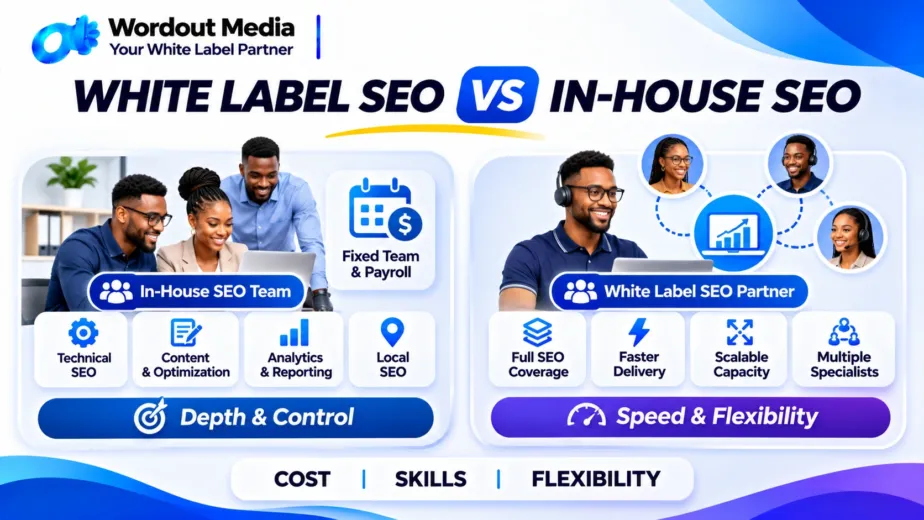
Ask five people in marketing what an “SEO reseller” is and you’ll get at least three answers. One will describe an agency selling someone else’s SEO under its own name. Another will describe a software company with a partner program. A third will talk about affiliates who send leads and collect a commission. They’re all using the same word for different arrangements.
That ambiguity is why it’s worth slowing down. If you’re searching for an SEO reseller program, the details of how it works decide whether it makes you money or makes you regret it. This guide explains what an SEO reseller program is, the different forms it takes, how resellers earn money, how reselling differs from white label fulfillment, what can go wrong and how to choose well. We’ll be upfront that Wordout Media sits on the fulfillment side of that line, so we’ll try to be fair about where reselling is a good fit and where it isn’t.
What Is an SEO Reseller
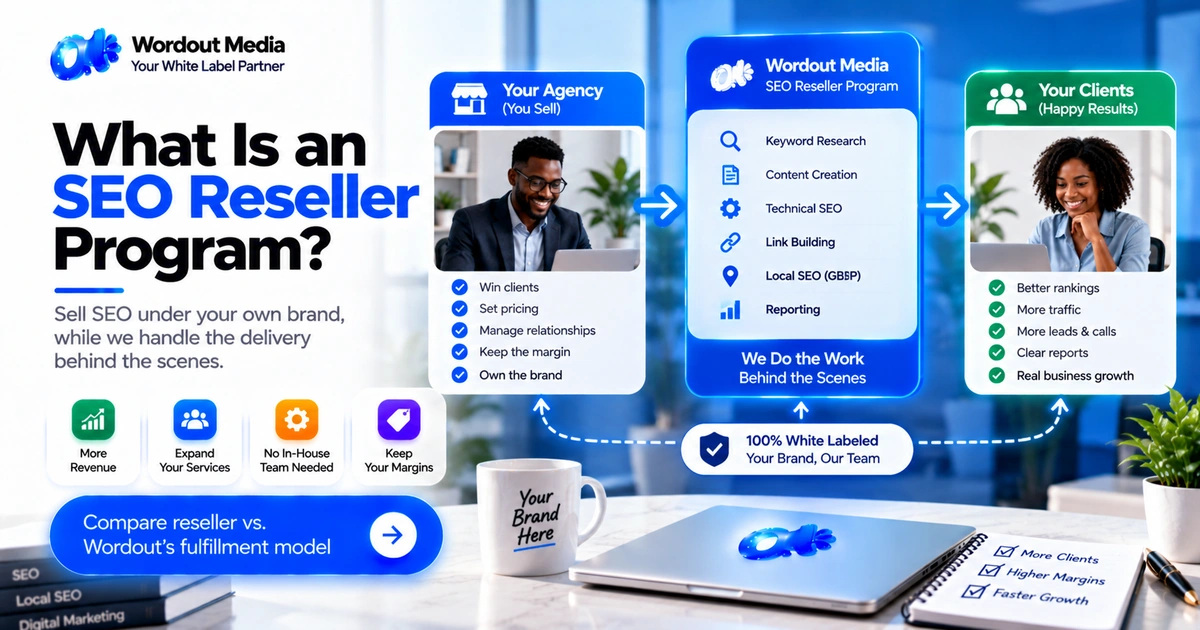
An SEO reseller is a business that sells SEO services to its own customers but doesn’t deliver all or part of the work itself. It buys the service from a provider, and sells it on at a higher price. An SEO reseller program is the structured arrangement a provider offers to make that possible: pricing, packages, reporting, support and sometimes branded materials.
Resellers are common in many industries. A reseller, in general, buys goods or services and sells them on, and the margin between buy price and sell price is how it earns. The idea is old. What’s new is how often it shows up in digital marketing, where services are delivered by people and can be packaged into monthly plans.
How an SEO Reseller Program Usually Works
The mechanics are fairly simple.
- You sign up with a provider. Sometimes this is a quick form, sometimes an application or a call.
- You get access to packages and pricing. Often a menu of plans at wholesale rates.
- You sell to your own clients, setting your own retail price.
- You pass client details to the provider, such as the site, goals and access.
- The provider delivers the work, often with reports.
- You deliver the results, usually with your own reporting and communication.
- You keep the difference between what you charge and what you pay.
Where programs differ is in the details: who the client sees, how much you can customize, how much you have to manage and what happens when something goes wrong.
The Main Types of SEO Reseller Programs
1. White label reseller programs
The provider’s work carries your branding, and the client doesn’t see the provider. This is the arrangement most agencies mean. Wikipedia’s overview of white-label products describes the general concept: one company makes a product or service that other companies rebrand as their own.
2. Branded or co-branded reseller programs
The provider’s name stays visible, sometimes with your logo alongside. You may be selling more of an introduction than a hidden service.
3. Package or productized reseller programs
The provider offers fixed packages, such as “Local SEO Starter,” at set prices. You sell them largely as they are. This is simple but less flexible.
4. Software or platform reseller programs
You resell access to an SEO tool or dashboard, sometimes with services layered on top.
5. Referral or affiliate programs
You introduce clients and receive a commission, but you don’t manage delivery. This is closer to referral than reselling.
Most agencies looking at “SEO reseller programs” are comparing the first and third types. Keep the differences in mind when reading provider claims.
How SEO Resellers Make Money
The core economics are margin. If you pay $600 a month for a package and sell it for $1,200, your gross margin before your own time is $600, or 50%.
Providers and benchmarks publish a range of figures for typical margins and markups. For example, Nico Digital’s White-Label SEO Pricing Benchmark 2026, a provider-published report, suggests retail pricing of at least about twice wholesale, and reports typical gross margins on white-labeled SEO retainers of roughly 45% to 65% before account management. Treat that as a rough guide, because it comes from a company that sells these services.
What matters more than any benchmark is your own math. Two quick points:
- Margin and markup are different. A 100% markup is a 50% margin. We explain the formulas in How to Calculate Your Agency’s Profit Margin and What Is Agency Profit Margin?.
- Your time is a cost. Selling, briefing, reviewing and answering client questions all take hours. A reseller arrangement that looks profitable on paper can disappoint once your own time is counted.
For more on setting your retail price, see How to Price Digital Marketing Services for Maximum Profit.
Reseller vs. White Label Fulfillment: What’s the Difference?
Here’s where the vocabulary gets muddy, so let’s separate two things that often travel together.
Reselling describes the commercial relationship. You buy from a provider and sell to your client at a markup. You hold the client relationship and the pricing.
Fulfillment describes the delivery relationship. A team does the actual work you’ve sold, ideally to your standards, in your branding and in step with your commitments.
In practice, there’s a spectrum.
| Typical reseller program | Fulfillment partner (our model) | |
|---|---|---|
| What you buy | Pre-defined packages | Hours of work you direct |
| Customization | Often limited to the package | Work is shaped to your client and standards |
| Pricing style | Monthly fee per package | Hourly blocks, $10 an hour |
| Flexibility across services | Usually SEO-focused | SEO, web, social, ads, design and automation from one balance |
| Your role | Sell and relay | Sell, brief and review |
| Visibility into work | Varies, often summary reports | Shared task tracker showing where each hour went |
| Commitment | Often monthly or longer | Hours don’t expire; trial has no contract |
| Best for | Simple, repeatable SEO sales | Agencies who want custom work and flexibility |
This is a generalization, not a verdict on any particular provider. Some reseller programs are flexible and transparent, and some “fulfillment” arrangements are rigid. Read what’s actually on offer. For the full terminology comparison, see White Label vs. Private Label vs. Reseller and What Is a Digital Marketing Fulfillment Partner?
The Benefits of an SEO Reseller Program
You can offer SEO without building a team. A web studio or social agency can add a service line without hiring specialists.
Faster to launch. Packages and pricing already exist, so you can start selling quickly.
Predictable costs. Fixed packages make budgeting simpler.
A recurring revenue line. SEO is naturally monthly, which supports retainers.
Lower risk than hiring. If it doesn’t take off, you haven’t carried payroll.
The Risks and Drawbacks
A fair guide has to include these.
Quality you don’t control. If you can’t see how the work is done, you can’t easily judge it. Poor work still goes out under your name.
Black-box delivery. Some programs give you summary reports but little detail on what was actually done.
Risky tactics. SEO is full of shortcuts. Google’s spam policies describe link spam as links created “primarily for the purpose of manipulating search rankings,” and sites that engage in spam can see lower rankings or removal from results. A reseller who doesn’t ask how the work is done may be exposing clients to that risk.
Limited customization. A fixed package may not fit what a client needs.
Lock-in. Long minimum terms before you’ve seen results.
Margin squeeze. If your provider’s wholesale prices are high, there’s little room left.
Hidden subcontracting. Your reseller may itself be reselling to someone else, leaving you several steps from the people doing the work.
Dependence. If the provider changes terms or disappears, you need a plan.
Reputational risk. Your clients blame you, not your provider.
None of these is a reason to avoid reselling. They’re the questions to ask before you sign.
Questions to Ask Any SEO Reseller Program
- Who does the work? Employees or subcontractors?
- What exactly is included each month? Get it in writing.
- What tactics do you use, especially for links? Look for clear, white-hat explanations. Avoid vague answers.
- Is it truly white labeled? Reports, files and communication should carry only your brand.
- What does reporting look like? Can you see tasks, not just a summary?
- What are all the fees? Setup, reporting, minimums, revisions, rush.
- What’s the contract length and exit process?
- How fast is turnaround?
- Who’s my contact?
- Can I test before committing?
- What happens when something goes wrong?
- Where do you not fit?
For a fuller evaluation framework, read How to Choose the Right White Label SEO Partner.
Is an SEO Reseller Program Right for You?
It’s likely a good fit if:
- You have clients who need basic, repeatable SEO.
- You want a simple, packaged offering.
- You have little time to brief or review work.
- You’ve checked the provider’s quality and tactics.
You might prefer a more flexible fulfillment model if:
- Your clients’ needs vary and don’t fit packages.
- You want to spend hours across several services.
- You want visibility into what each hour produced.
- You prefer paying for what you use rather than a fixed monthly plan.
- You’d like a dedicated account manager who learns your standards.
Neither is “better.” They suit different agencies.
An Illustrative Comparison
Here’s a hypothetical to make the difference concrete. These numbers are illustrative.
An agency sells a monthly local SEO retainer at $1,200.
Reseller package: The provider charges $600 a month for a standard local SEO package. The agency spends 3 hours reviewing at $40 ($120). Profit: $1,200 − $600 − $120 = $480, or 40% margin.
Hour-block fulfillment: The work takes about 22 hours at $10 an hour ($220), plus the same 3 hours of review ($120). Profit: $1,200 − $220 − $120 = $860, or about 71.7% margin.
Does that mean fulfillment always wins? No. The hour-block figure depends on the work actually taking 22 hours, on you briefing well and on the quality meeting your standard. A reseller package might include strategy, reporting or tools that you’d otherwise supply yourself. Compare what’s inside each option, not just the totals. You can model your own version using the Agency Profit Margin Calculator.
How Wordout Media’s Fulfillment Model Works
Since you asked to compare, here’s ours in plain terms.
- You buy hours, not packages. $10 an hour: Starter is $200 for 20 hours, Growth is $400 for 40 hours and Scale is $800 for 80 hours. The rate is the same on every block, and hours don’t expire.
- You choose where the hours go. White Label SEO + GBP is one of six services. You can also spend hours on websites, social, paid ads, design and automation.
- A team of fifteen, all in-house. No subcontractor chains.
- A dedicated account manager. One person who learns your standards.
- 100% white labeled. Everything carries your branding.
- Visibility. A shared task tracker shows where every hour went.
- Trial first. 8 hours free, no contract, no card, no sales call required first.
Where we may not fit: If you want a fixed package with almost no briefing, hour blocks ask more of you. If you need very large, round-the-clock capacity, a bigger provider may suit you better. If you want a single fixed monthly fee for a defined SEO product, a package-based reseller program may be simpler.
How to Start Without Betting the Agency
Whichever route you choose, a sensible path is:
- Define one client and one scope. Don’t launch to everyone at once.
- Run a test. Use a trial or the smallest paid unit.
- Check the work yourself. Review the output and, for SEO, ask what was done and why.
- Document what you’d change.
- Scale gradually.
Frequently Asked Questions
What is an SEO reseller program?
It’s an arrangement in which a provider supplies SEO services that an agency sells to its own clients at a markup, usually with packages, pricing and reporting set up to make that easy.
What is an SEO reseller?
A business that sells SEO services it doesn’t fully deliver itself, buying from a provider and selling on to its customers.
Is an SEO reseller the same as white label?
They overlap. Reselling describes the buy-and-sell relationship. White label describes the branding arrangement, in which the work appears under your name. Many reseller programs are white labeled, but not all.
How do SEO resellers make money?
By charging clients more than they pay the provider. The gap is the margin, from which you subtract your own time.
How much should I mark up SEO?
Published guidance varies. One provider benchmark suggests retail of at least about twice wholesale, and another source suggests markups of 50% to 100%. Work backward from the margin you need.
Are SEO reseller programs safe?
They can be, if you check who does the work and which tactics they use. Risky link practices can harm clients, and Google’s spam policies explain what to avoid.
What’s the difference between reseller and fulfillment?
A reseller program is usually about packages you buy and resell. A fulfillment model is about a team that carries out the work you direct, often priced by hours.
Can I try a fulfillment partner first?
At Wordout Media, yes. The 8-hour free trial has no contract and no card.
An SEO reseller program is a legitimate and widely used way to add SEO to an agency’s menu. It can work well for simple, repeatable services. But the label hides large differences in transparency, flexibility and quality, so the useful question isn’t “should I resell SEO?” It’s “what exactly am I buying, who is doing it and how do I know it’s good?”
Ask those questions of every provider, including us. Then test with real work before you commit.
Compare Reseller vs. Wordout’s Fulfillment Model
Want to see how an hour-based fulfillment model would work for your clients?
Compare reseller vs. Wordout’s fulfillment model on our White Label SEO + GBP page, then claim your 8-hour free trial and send us a real task to judge for yourself. No contract, no card. You can also read our FAQs or browse our services.