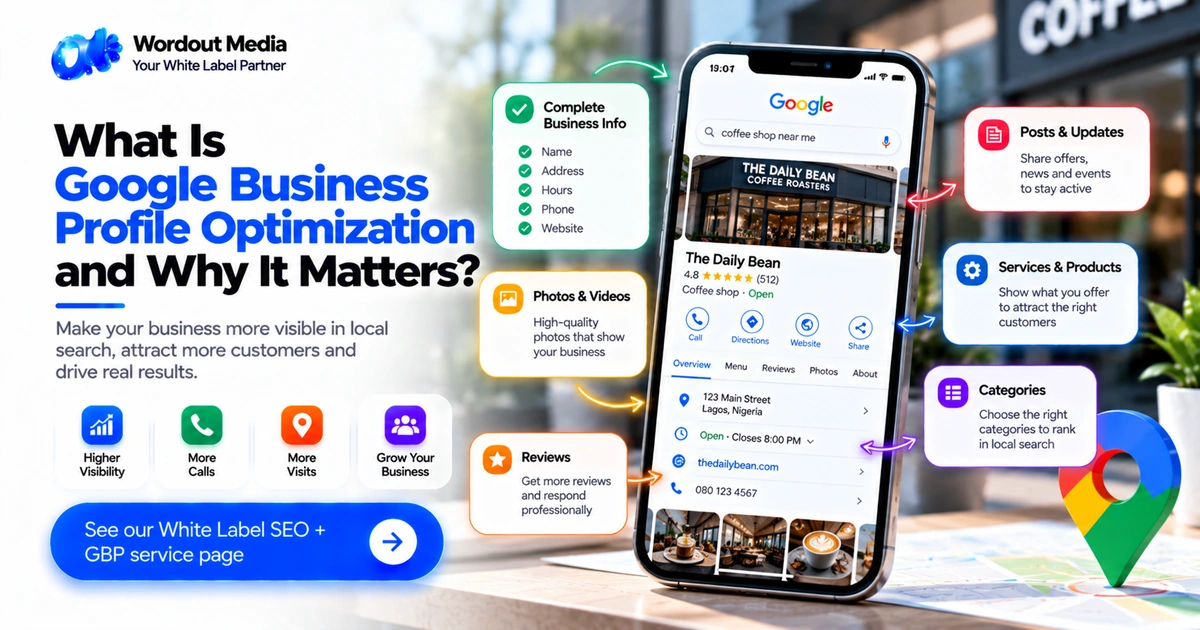
Search for “plumber near me” or “dentist open now” and look at what shows up. Before anyone reads a website, they see a name, a star rating, a few photos, opening hours, a phone number and a button that says Directions. For plenty of local businesses, that little card is the first impression, and sometimes the only one. The person might call straight from it and never visit the site at all.
If you run an agency with local clients, this is one of the most practical services you can offer. It’s repeatable, the results are easy to explain, and clients understand it immediately because they’ve all searched for a business on their phone. If you’re a business owner, it’s one of the few marketing tasks where an afternoon of careful work can make a visible difference.
We’re Wordout Media, and Google Business Profile work is part of our White Label SEO + GBP service, so this is a topic we handle regularly. In this guide we’ll explain what GBP optimization is, why it matters, what goes into it, a step-by-step checklist, the mistakes we see most often, how to measure it and how agencies hand it off without losing control.
What Is a Google Business Profile?
A Google Business Profile is the free business listing that Google uses to show information about a business in Search and Maps. You may know it by its older name, Google My Business. It’s where a business sets out the details people look for: name, category, address or service area, hours, phone number, website, photos, services and more, and where customers leave reviews.
An owner claims and manages the profile, and Google asks them to verify it, so that edits come from someone with a real connection to the business. Search Engine Journal’s guide to optimizing Google My Business notes that Google doesn’t show the listing or edits until the business is verified.
Two quick clarifications help avoid confusion:
- A Business Profile isn’t a website. It’s a listing that points to one. Your site and your profile do different jobs and work best together.
- You don’t fully control it. Google also pulls information from other sources, and customers can suggest edits, so profiles need monitoring, not a one-time setup.
What Is GBP Optimization?
GBP optimization is the ongoing work of making a business’s profile as accurate, complete and useful as possible so that Google can understand it and customers can act on it.
That covers three things:
- Accuracy. The information is correct and consistent everywhere.
- Completeness. Every relevant field and feature is used well.
- Activity. The profile is kept fresh with photos, posts, responses and updates.
It’s not a trick for gaming Google. It’s closer to housekeeping done carefully, and Google’s own descriptions of local results emphasise how complete and accurate information makes a business easier to match with searches. The Search Engine Journal guide quotes the principle that local results favor the most relevant listings, and says complete, accurate information makes a business easier to show in search.
Why It Matters
It’s where local searches often start
For businesses that serve a local area, the profile appears in front of people who are actively looking. They’re not browsing, they’re deciding. That intent is valuable.
It shapes first impressions
Photos, ratings and review responses tell a stranger quickly whether a business seems active and trustworthy. A listing with wrong hours or no photos looks neglected, even if the business is excellent.
It supports calls, directions and website visits
The profile gives people direct ways to act: call, get directions, visit the website, send a message. Profile insights can show how many people take those actions, which helps you explain value to clients.
It’s usually inexpensive compared with other channels
You aren’t buying ads. The cost is mostly time and care, which is why it fits so well into hour-based outsourcing.
It complements, not replaces, the rest of local SEO
Your site content, local pages, citations and reviews all feed into how a business is seen locally. For the wider picture, see What Is White Label SEO?
A word of caution: no one can promise a particular ranking. Google decides what appears, and results vary by search, location and competition. What optimization does is remove avoidable obstacles and give the profile its best chance.
How Google Decides What to Show (In General Terms)
Google has described local results as depending broadly on relevance, distance and prominence. We’d rather not overstate how these work, because the details change, but the general ideas help:
- Relevance: how well the profile matches what someone searched for.
- Distance: how far the business is from the searcher or the location they named.
- Prominence: how well known the business seems, which can reflect things like reviews and its presence across the web.
This is why consistency matters, why reviews matter and why categories and descriptions need care. You can’t change distance for a given searcher, but you can improve the rest.
The Core Elements of an Optimized Profile
Business name
Use the real-world name customers know, exactly as it appears on signage and your website. Adding extra keywords to a business name is the sort of thing that can get a profile suspended, so don’t.
Primary and additional categories
Your primary category is one of the most important choices. Pick the one that most accurately describes the core of the business, then add secondary categories only where they’re genuinely true. Be specific: “Italian restaurant” often serves better than just “Restaurant.”
Address or service area
A business with a storefront shows its address. A service-area business, such as a mobile plumber, can hide its address and define the areas it serves. Choose the setup that matches how the business really works.
Phone number and website
Use a consistent main phone number and a link to the most relevant page, which is often the homepage or a local landing page.
Hours
Keep regular hours accurate, and set special hours for holidays and events. Wrong hours are among the most frustrating things a customer can find.
Business description
Write plainly and honestly about what the business does, who it serves and where. Natural use of relevant terms is fine. Stuffing the description with keywords reads badly and can cause problems.
Services and products
List the services offered, with short descriptions. Where eligible, a product catalog can be added.
Attributes
Features like “wheelchair accessible,” “women-led” or “free Wi-Fi” help customers decide. Add the ones that apply and are true.
Photos and video
Logo, cover image, exterior, interior, team, products and work examples all help. According to Search Engine Journal’s guide, Google has said businesses with photos get more direction requests and website clicks than those without, though that isn’t a claim about ranking. Use real, current, good-quality images.
Reviews
Reviews influence both visibility and trust. Ask satisfied customers to leave one, make it easy with a direct link and respond to every review you can, positive or negative.
Posts and updates
Posts about offers, events or news keep the profile active. They won’t transform results alone, but they show customers the business is open and alive.
Messaging and Q&A
Where available, enable messaging and respond promptly. Keep an eye on questions customers ask and answer them accurately.
A Step-by-Step GBP Optimization Checklist
Use this list for a new profile or an audit of an existing one.
Setup and access
- ☐ Search for an existing listing before creating a new one
- ☐ Claim and verify the profile
- ☐ Confirm who has owner and manager access, and remove anyone who shouldn’t
Core information
- ☐ Business name matches real-world branding
- ☐ Primary category is accurate and specific
- ☐ Secondary categories are relevant and true
- ☐ Address or service area is correct
- ☐ Phone number and website are correct and consistent
- ☐ Hours and special hours are up to date
Content
- ☐ Description is clear, honest and natural
- ☐ Services listed with short descriptions
- ☐ Relevant attributes selected
- ☐ Logo and cover photo uploaded
- ☐ A set of recent, real photos added
Engagement
- ☐ Review link created and shared with customers
- ☐ Existing reviews answered
- ☐ Messaging enabled and monitored
- ☐ Questions answered
Ongoing
- ☐ Posts published regularly
- ☐ New photos added over time
- ☐ Profile checked monthly for suggested edits or changes
- ☐ Insights reviewed and recorded
Consistency
- ☐ Name, address and phone match the website and other listings
- ☐ Website has a clear local page or contact page
Common Mistakes
Keyword-stuffing the business name. It’s tempting and can get a profile suspended.
Wrong or conflicting categories. Too many loosely relevant categories dilute the message.
Duplicate listings. Multiple profiles for the same business confuse customers and Google.
Outdated hours. Especially around holidays.
Ignoring reviews. Unanswered complaints send a message.
Buying or faking reviews. This is against Google’s rules and risks serious penalties. Ask real customers, always.
Using stock photos only. Real photos build trust.
Setting it and forgetting it. Profiles need regular attention.
Inconsistent details across the web. Different phone numbers or addresses on different sites create doubt.
No access plan. Many businesses don’t know who owns their profile, and lose access when an employee or past agency leaves. Always keep the business owner as an owner.
How to Handle Reviews Well
Reviews deserve their own section because they’re where profiles succeed or stumble.
Ask at the right time. Right after a good experience, when it’s fresh.
Make it easy. Share a direct link by text, email or on a receipt.
Never pay for or gate reviews. Don’t offer rewards for positive reviews only, and don’t filter who gets asked.
Respond to everything you can. Thank people briefly and specifically.
Handle negative reviews calmly. Acknowledge the problem, don’t argue, and offer to resolve it offline. Future customers read how you respond, not just the complaint.
Don’t copy and paste. A reply that sounds human beats a template.
Measuring Whether It’s Working
Profile Insights let you see how customers find and use a listing. Useful things to track monthly include:
- How many people viewed the profile
- Calls, direction requests, website clicks and messages
- Search terms that led people to the profile
- Number and average rating of reviews
- Photo views
Record the numbers in a simple spreadsheet or report so you can show clients a trend. Be cautious about drawing conclusions from a single month. Seasonality, competitors and unrelated changes all affect results. Also avoid promising growth targets you can’t control. What you can say honestly is: “We’ve made the profile accurate and complete, we’re keeping it active and here are the numbers.”
Where GBP Fits in a Local SEO Plan
A profile does its best work alongside other things:
- A well-built website with clear service and location pages. See Website Design & Development.
- Consistent listings elsewhere on the web.
- Reviews earned steadily over time.
- Helpful content that answers local questions. Google’s own SEO Starter Guide stresses creating helpful content for people and making sites easy to understand.
- Technical health so pages load and can be found.
Our guide to what white label SEO involves shows how these pieces fit together for agencies.
Why Agencies Outsource GBP Work
If you serve local clients, GBP work has a few features that make it a natural thing to hand off.
It’s repeatable. The checklist is similar for each client, with local details changed.
It’s time-consuming across many clients. Audits, updates, photo uploads, posts and reporting add up.
It’s easy to review. You can see the finished profile and check the details.
It supports retainers. Monthly GBP management is a clear, recurring service.
It needs consistency. A partner who does it every week stays practiced.
If you’re curious about the economics, margin math is in How to Calculate Your Agency’s Profit Margin, and a quick calculation shows how outsourced hours change what you keep.
How Wordout Media Handles GBP
Our White Label SEO + GBP service includes Google Business Profile optimization alongside keyword research, on-page optimization, technical audits, blog content optimization and internal linking. In practice, for an agency partner that means:
- We work under your brand, in your systems, using your email addresses if you want them.
- Reports and deliverables carry your logo.
- A dedicated account manager takes your brief, and a specialist from our in-house team of fifteen does the work.
- A shared task tracker shows where every hour went, at $10 an hour with hours that never expire.
- You review everything before it reaches your client.
Two honest notes. First, we can’t control Google. We can make a profile accurate, complete and active, but we can’t guarantee placement. Second, access matters: your client should remain an owner of their own profile, and we’d work with the access arrangement you set.
Frequently Asked Questions
What is Google Business Profile optimization?
It’s the ongoing work of making a business’s Google listing accurate, complete and active, covering things like categories, hours, photos, services, reviews and posts.
What is GBP optimization?
GBP is short for Google Business Profile, so GBP optimization means the same thing.
Is Google Business Profile the same as Google My Business?
Google My Business is the older name. Business Profile is the current name for the listing.
Does GBP optimization guarantee higher rankings?
No. Nobody can guarantee rankings. Optimization improves accuracy and completeness, which gives a profile its best chance.
How long does it take to see results?
It varies. Some updates show quickly, while reviews and prominence build over time. Track trends over several months, not days.
How often should a profile be updated?
Check it at least monthly. Update hours for holidays, add photos regularly and respond to reviews as they arrive.
Can I buy reviews?
No. Fake or incentivized reviews violate Google’s rules and can lead to penalties. Ask real customers.
Can agencies outsource Google Business Profile management?
Yes. It’s a common white label service. Make sure your client remains an owner of their own profile.
What does your service include?
Our White Label SEO + GBP service covers keyword research, on-page optimization, technical audits, blog content optimization, internal linking and Google Business Profile optimization.
Google Business Profile optimization is less glamorous than many marketing tactics, and that’s partly why it works. It rewards careful, honest, consistent housekeeping: accurate facts, specific categories, real photos, answered reviews and regular updates. None of it is complicated, but it takes attention, and attention is exactly what busy business owners and stretched agencies run short of.
Do it well and a local business gets a listing that looks alive, is easy to trust and gives customers a quick path to act. Do it badly, or not at all, and the first impression is left to chance.
See Our White Label SEO + GBP Service Page
If you’d like help with GBP work for your clients, take a look at what’s included.
See our White Label SEO + GBP service page for the full scope, then claim your 8-hour free trial and send us a real profile to audit. No contract, no card, no sales call required first. You can also read our FAQs or browse all services.