Most agencies that decide to outsource don’t get stuck on whether to start. They get stuck on how much to buy. Too little, and you run out mid-project and stall a client. Too much, and you worry you’ve tied up money you may not use. Without a clear way to estimate, people guess, and guesses cost money.
This guide is built to remove that guesswork. It explains exactly how Wordout Media’s three hour blocks work, shows who each is best for, walks through worked examples of how many hours common client work takes, gives you a simple formula to estimate your own needs, covers what happens to unused hours, and ends with a decision guide you can complete in five minutes. If you’re searching how to buy outsourcing hours as an agency, this is the one page that lays out the numbers.
We’ll be straightforward about the limits too, because the right block isn’t always the biggest one, and sometimes the right answer is to start with a free trial and buy nothing yet.
The Three Hour Blocks at a Glance
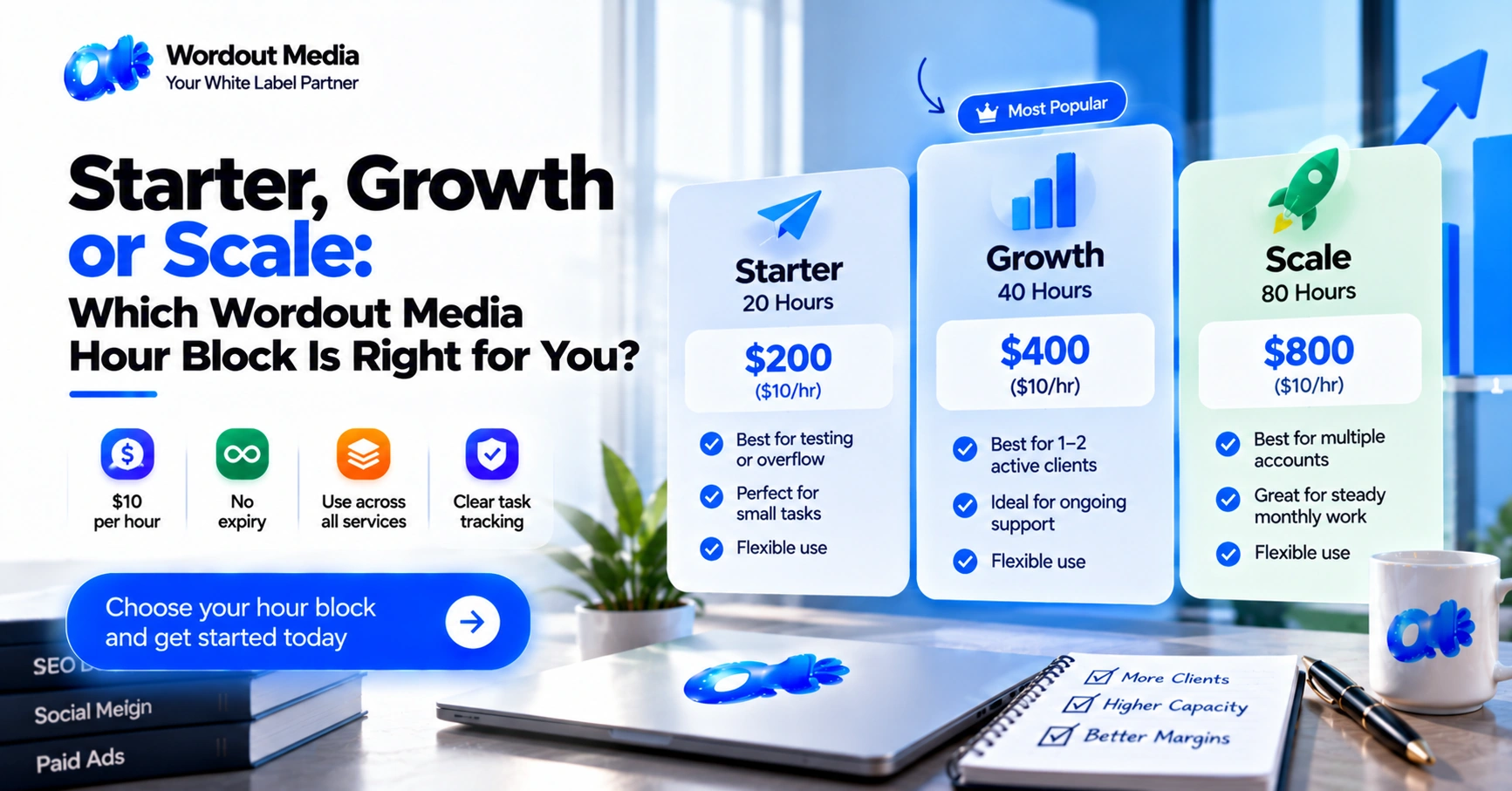
Our pricing is deliberately simple. The rate is $10 an hour on every block.
| Starter | Growth | Scale | |
|---|---|---|---|
| Hours | 20 | 40 | 80 |
| Price | $200 | $400 | $800 |
| Rate | $10/hr | $10/hr | $10/hr |
| Best for | Testing us out, or covering an overflow month | One to two active client accounts | Multiple accounts, ongoing delivery |
| Expire? | No | No | No |
A few points apply to all three:
- No volume pricing games. The rate doesn’t change as you buy more. You’re not paying more per hour on a small block or being rewarded for committing to a large one.
- Hours don’t expire. If you buy 40 hours and use 25, the other 15 are waiting whenever you come back.
- Hours work across services. You can spend them on SEO, web, social, ads, design or automation, whatever is urgent that month. You’re not buying a retainer tied to one service.
- You can see where every hour goes. Every agency gets a shared task tracker showing exactly what each hour was spent on.
Starter: 20 Hours for $200
Best for: Testing us out, or covering an overflow month.
Who it suits
- Agencies trying a white label partner for the first time after (or instead of) the free trial.
- Agencies with a one-off busy month and no reason to build permanent capacity.
- Freelancers who occasionally need extra hands.
- Agencies that want to add one new service for a single client before expanding.
What 20 hours can realistically cover
These are illustrative estimates. Actual hours depend on scope, and larger tasks get a scoped timeline before we start.
- A technical SEO audit for a small site, plus a short summary of priority fixes.
- A single landing page build.
- A month of social graphics for one client.
- A first Google Ads campaign setup.
- A small automation, such as a lead follow-up sequence.
Starter strengths and limits
Strengths: Low commitment, quick to start and a meaningful test of the working relationship.
Limits: If you have more than one active account, 20 hours can disappear in a week. Starter isn’t designed for ongoing multi-client delivery.
Growth: 40 Hours for $400
Best for: One to two active client accounts.
Who it suits
- Agencies serving one or two clients that need ongoing support.
- Agencies that have finished a trial or a Starter block and are ready for steady use.
- Agencies adding a monthly SEO or social retainer for an existing client.
What 40 hours can realistically cover
Again, illustrative:
- A monthly SEO retainer for one or two local clients (for instance, around 20 hours each for on-page work, content optimization, Google Business Profile management and reporting).
- A small business website, from design through build.
- Social content for two clients for a month.
- A set of ad creatives plus campaign management for one client.
Growth strengths and limits
Strengths: Enough capacity for steady work on a couple of accounts, without the commitment of a larger block.
Limits: If a large website build lands in the same month as a retainer, you may need a second block. That’s fine, since hours stack and don’t expire.
Scale: 80 Hours for $800
Best for: Multiple accounts and ongoing delivery.
Who it suits
- Agencies serving several clients across more than one service.
- Agencies that want predictable capacity and a single account manager across their whole book.
- Agencies replacing or avoiding a hire, using outsourced hours as flexible production capacity.
What 80 hours can realistically cover
Illustrative:
- Monthly SEO for three or four clients.
- A multi-page website build alongside ongoing social for a client.
- Ongoing ad management and creative for several accounts.
- A mix of SEO, web and design across five or six small accounts.
Scale strengths and limits
Strengths: Capacity for real, ongoing delivery across multiple clients, with the same $10 rate you’d pay on a Starter block.
Limits: Larger volume requires good briefing and a review routine on your side. Eighty hours of work generates plenty of review.
How Many Hours Do Common Agency Tasks Take?
The hardest part of choosing a block is knowing how long work takes. The ranges below are illustrative planning estimates for small to medium clients, not quotes. Scope, starting point and complexity change them, and larger projects are scoped before work begins.
| Task | Typical hours (illustrative) |
|---|---|
| Technical SEO audit (small site) | 10 to 15 |
| Local SEO setup (research, Google Business Profile, core pages) | 15 to 25 |
| Monthly ongoing SEO, one local client | 18 to 25 |
| Landing page | 8 to 14 |
| Five-page business website | 30 to 50 |
| A month of social graphics and captions, one client | 12 to 20 |
| Google Ads campaign setup | 6 to 10 |
| Monthly ad management, one account | 8 to 15 |
| Ad creative set (several formats) | 5 to 10 |
| Figma mockup or design set | 6 to 15 |
| Simple automation workflow | 6 to 12 |
For a scoped estimate on your own project, we’ll give you a line-by-line breakdown. For SEO specifically, see Get a Custom White Label SEO Quote for Your Agency.
A Simple Formula for Estimating Your Monthly Hours
Use this five-step method to work out how many hours you’d need.
Step 1: List your clients and the work each needs in a typical month.
Step 2: Assign hours using the table above (or your own records).
Step 3: Add up the total.
Step 4: Add a 15% buffer for revisions, questions and surprises.
Step 5: Decide how much you want to outsource. You might hand over 100% of production or only the overflow.
Worked example 1: The solo consultant
A freelance strategist has two local SEO clients and wants to hand off most of the execution.
- Client A monthly SEO: 20 hours
- Client B monthly SEO: 20 hours
- Total: 40 hours
- Buffer (15%): 6 hours
- Estimated need: 46 hours.
Choice: One Growth block (40 hours) plus a few hours from a Starter, or a Growth block now and another when needed. Since hours don’t expire, buying Growth twice costs the same per hour as buying Scale once.
Worked example 2: The small web and social agency
An agency has one new website to build, ongoing social for two clients and a few ad tasks.
- Five-page website: 40 hours
- Social, two clients: 30 hours
- Ad setup and creative: 12 hours
- Total: 82 hours
- Buffer (15%): 12 hours
- Estimated need: 94 hours.
Choice: One Scale block (80 hours) plus a Starter (20 hours), for about 100 hours.
Worked example 3: The agency testing a partner
An agency wants to try us before committing and has one real task.
- Technical SEO audit: 12 hours
Choice: Start with the 8-hour free trial. If the audit needs more than 8 hours, a Starter block covers the remainder.
Do Bigger Blocks Cost Less per Hour?
No, and we’d like to be clear about that, because it’s unusual. Many providers discount larger commitments, which creates pressure to buy more than you need. Our rate is $10 an hour on all three blocks. Starter is $10 an hour. Growth is $10 an hour. Scale is $10 an hour.
That means the choice of block is purely about convenience and cash flow, not savings. You can buy small blocks as needed without paying a premium, or buy a larger one for fewer purchases.
What Happens to Unused Hours?
Nothing. They stay in your account.
If you buy Growth (40 hours) and use 25 this month, the remaining 15 carry forward. Come back in two months with a new client, and they’re still there. This removes the biggest fear of buying outsourcing capacity: paying for hours you’ll lose.
Compare it with a fixed monthly retainer, where unused capacity usually disappears at the end of the month. With hour blocks, uneven demand becomes a non-issue.
Cash Flow and Margin: What Each Block Does for You
Choosing a block isn’t only about workload. It’s also about money. Let’s put margin numbers on a typical scenario. These figures are illustrative.
You charge a local client $1,200 a month for SEO that takes 22 hours of delivery.
- Delivery cost at $10 an hour: $220
- Your own review time: 3 hours at $40 = $120
- Total cost: $340
- Profit: $860
- Gross margin: about 71.7%
If you serve two such clients, you need 44 hours a month, so Growth plus a little more.
| Clients | Hours per month | Monthly cost at $10/hr | Revenue at $1,200 each | Profit before your review time |
|---|---|---|---|---|
| 1 | 22 | $220 | $1,200 | $980 |
| 2 | 44 | $440 | $2,400 | $1,960 |
| 3 | 66 | $660 | $3,600 | $2,940 |
| 4 | 88 | $880 | $4,800 | $3,920 |
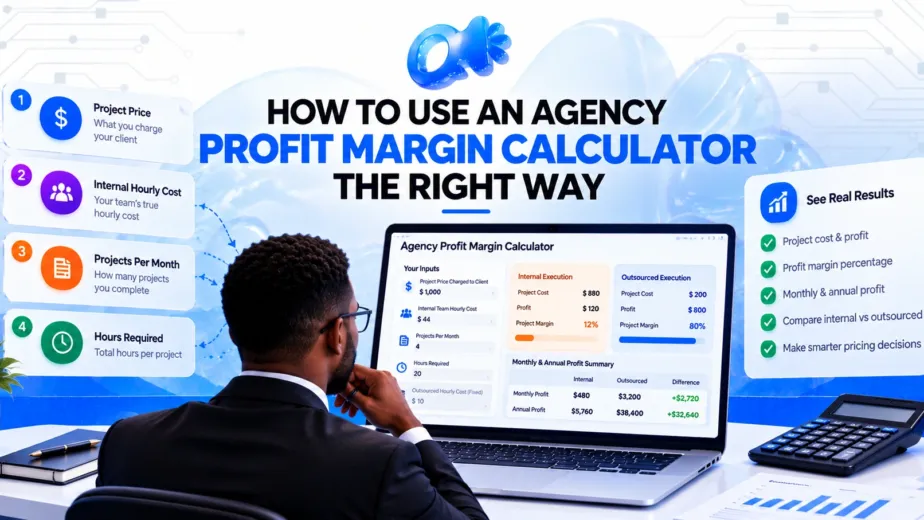
Your own review time, which isn’t in that table, reduces the profit. Adding 3 hours per client at $40 is $120 per client. You can run your own version of this with the Agency Profit Margin Calculator. Our walkthrough, How to Use an Agency Profit Margin Calculator the Right Way, explains each input, and What Is Agency Profit Margin? explains the definitions.
One caution: savings only become profit if the work gets billed. If you buy hours for tasks you can’t invoice, you’ve added cost, not margin. Buy to match billable work.
The Five-Minute Decision Guide
Answer these questions to find your starting block.
1. Have you worked with us before?
- No: Start with the 8-hour free trial before buying anything.
- Yes: Continue.
2. How many active client accounts will you hand us work for?
- 1 or occasional: Starter
- 1 to 2: Growth
- 3 or more: Scale
3. Is your demand steady or spiky?
- Spiky or uncertain: Choose the smaller block and buy again when needed. Hours don’t expire, so nothing is lost.
- Steady: Choose the block that matches your monthly estimate.
4. How much can you review each week?
- Little: Start smaller. Review capacity limits how much you can use well.
- Plenty: A larger block is fine.
5. Is this for a one-off project or ongoing work?
- One-off: Starter or Growth, based on the project estimate.
- Ongoing: Growth or Scale.
Quick results
| Your situation | Suggested block |
|---|---|
| Testing us, no live work yet | Free trial, then Starter |
| Overflow month | Starter |
| One or two retainers | Growth |
| A single website plus one retainer | Growth, then another Growth or Starter if needed |
| Three or more active accounts | Scale |
| Replacing a part-time hire | Scale, and add Starter or Growth as needed |
Why Buying Hours Beats Hiring for Uneven Demand
Part of the appeal of hour blocks is that they turn a fixed cost into a variable one. That’s one of the standard reasons companies outsource at all: according to the overview of outsourcing, the main motivations include cost savings, focus on core strengths, access to specialist skills, speed, flexibility, and converting fixed costs to variable costs so you pay only for the services you need.
For comparison, the U.S. Bureau of Labor Statistics’ Employer Costs for Employee Compensation release for June 2026 reports that total employer compensation costs for private industry workers averaged $46.89 per hour worked, with benefits making up 30.0% of that. That’s an average across all private industry, not a marketing-specific figure, and it applies to every paid hour whether or not the person is busy. An employee is paid during quiet weeks. A block of outsourced hours isn’t consumed until you use it.
That doesn’t make hiring wrong. Steady, high-volume work can justify it. But if your demand is uneven, flexible blocks avoid paying for idle capacity. We walk through the full comparison in White Label vs. In-House Marketing Team.
Mistakes to Avoid When You Buy Outsourcing Hours
Buying the biggest block to “save money.” There’s no volume discount on our blocks, so a big block saves nothing per hour. Buy what you’ll use.
Skipping the trial. You’ll learn more from eight free hours than from any plan page.
Under-briefing. Hours spent on rework from vague briefs are wasted hours. Write clear briefs.
Starting with your hardest client. Build trust on a lower-stakes account first.
Not tracking what you use. Use the shared task tracker to see where hours go and refine your estimates.
Forgetting your own time. Reviewing 80 hours of work takes real time. Plan for it.
Buying hours for work you won’t bill. Match purchases to client work.
What Your Hours Can Be Spent On
All three blocks cover the same six services, and you can mix them from one balance.
- White Label SEO + GBP: keyword research, on-page, technical audits, blog optimization, internal linking and Google Business Profile.
- Website Design & Development: business websites, landing pages, WordPress and Elementor builds.
- Social Media Management: content calendars, Reels, carousels, graphics and captions.
- Paid Advertising – Google & Meta: campaign setup, copy, audiences and optimization.
- Creative Design + Figma: graphics, mockups and ad creative.
- Automations + AI Workflows: workflows built in tools such as n8n and GoHighLevel.
Everything is delivered under your branding. Clients only ever see your agency.
How a Typical First Month Might Look
To make this concrete, here’s a plausible path for a new agency partner. This is a scenario, not a guarantee.
Week 1: You send a real task for the 8-hour free trial, say a technical SEO audit. You review the output and the communication.
Week 2: You’re satisfied and buy a Starter block (20 hours) to cover the rest of the audit work and a landing page for the same client.
Week 3: You use about 18 hours. You track what each hour produced in the shared task tracker and refine your briefs.
Week 4: A second client signs. You buy a Growth block (40 hours). Together with the two spare Starter hours, you have 42 hours for the next month.
Month 2 and beyond: As demand grows, you add another Growth block or move up to Scale. Since the rate never changes, you’re never penalized for starting small.
You can see how the workflow runs day to day in How Does White Label Marketing Work, Step by Step?
Where Hour Blocks May Not Suit You
In the spirit of honesty, here’s when this model might not be the best fit.
- If you want a fixed, done-for-you package with no briefing. Hour blocks ask more of you than a packaged retainer does.
- If you need very large, round-the-clock capacity. A bigger provider may be a better match.
- If your clients require in-country or employee-only delivery. An outsourced model may not satisfy the contract.
- If your work is mostly senior strategic consulting. We’re an execution partner. Strategy stays with you.
Frequently Asked Questions
How do I buy outsourcing hours as an agency?
Contact us and choose a block (Starter, Growth or Scale) and share your first task. We’ll assign a dedicated account manager.
How much does each block cost?
Starter is $200 for 20 hours, Growth is $400 for 40 hours and Scale is $800 for 80 hours. The rate is $10 an hour on all of them.
Do bigger blocks have lower hourly rates?
No. The rate is the same on every block. There are no volume pricing games.
Do unused hours expire?
No. If you buy 40 hours and use 25, the other 15 remain for when you need them.
Can I use hours across different services?
Yes. Hours aren’t tied to a single service. You can spend them on SEO one month and a website build the next.
Can I buy more than one block?
Yes. Blocks stack, and the rate stays the same.
Which block should I start with?
If you haven’t worked with us, start with the 8-hour free trial. If you have, Starter suits testing or overflow, Growth suits one or two accounts and Scale suits multiple accounts.
How will I know what my hours were spent on?
You get a shared task tracker showing exactly what each hour went to.
How fast is turnaround?
Most design, ad setup and video editing tasks come back same day to 48 hours. Larger builds, such as full websites and multi-page SEO projects, get a scoped timeline before we start.
Is there a contract?
The free trial involves no contract and no card. Ask us about terms when you’re ready to buy.
The right way to buy outsourcing hours as an agency is to start from your own workload, not from a price list. List your clients, estimate the hours each needs, add a buffer and choose the block that matches. With the same $10 rate on every block and hours that never expire, you can start small, learn how the partnership works and scale as your agency grows without losing anything.
If you’re unsure, there’s no cost to find out. Take the 8-hour free trial, track what it takes and pick your block with real evidence.
Choose Your Hour Block and Get Started Today
Ready to pick a plan?
Choose your hour block and get started today: Starter at $200 for 20 hours, Growth at $400 for 40 hours or Scale at $800 for 80 hours. Not sure yet? Claim your 8-hour free trial, with no contract and no card.
You can also see the plans on our homepage, read our FAQs or browse our services.