If you’ve ever collected quotes from white label providers, you’ve seen the spread. One charges $10 an hour. Another charges $25. Another quotes $50, $75 or more, sometimes wrapped in a retainer that makes the hourly figure hard to find.
The natural question is whether you’re paying for something real at the higher end, or whether the cheaper options are a trap. It’s a fair question and a hard one, because the honest answer is that price tells you less than you’d think in either direction.
This white label SEO pricing comparison looks at the real economics: what each rate does to your margin, which costs hide behind a low rate and which hide behind a high one, when cheaper is genuinely better and when it isn’t. It also covers other services, because the same logic applies to design, development, ads and social.
We’re Wordout Media. Our rate is $10 an hour, so we’re obviously on one side of this comparison. We’ll try to be as fair to the $50+ end as we’d want someone to be about ours, and we’ll tell you where a more expensive agency might be the right choice. We won’t name or rate specific competitors, because their pricing changes and we can’t verify it from outside. Where we use higher-rate figures, they’re illustrative, not quotes from any real company.
What You’re Actually Comparing
When you compare $10 an hour with $50 an hour, you’re not comparing the same thing at different prices. You’re comparing different business models, and the rate is the visible part.
A $10 an hour model typically relies on a lean structure: a team that works efficiently, low overhead and a business built on volume and repeat work. Our own explanation: predictable rates mean lower costs, and we charge two to three times less than many agencies.
A $50+ an hour model usually carries higher overhead, may employ more senior or locally based staff, may include strategy and account management in the rate and may be pricing to a different kind of client.
Neither is automatically better or worse. The question is which one fits what you’re buying.
The Margin Math
Let’s start with what most agency owners care about most: what each rate does to profit.
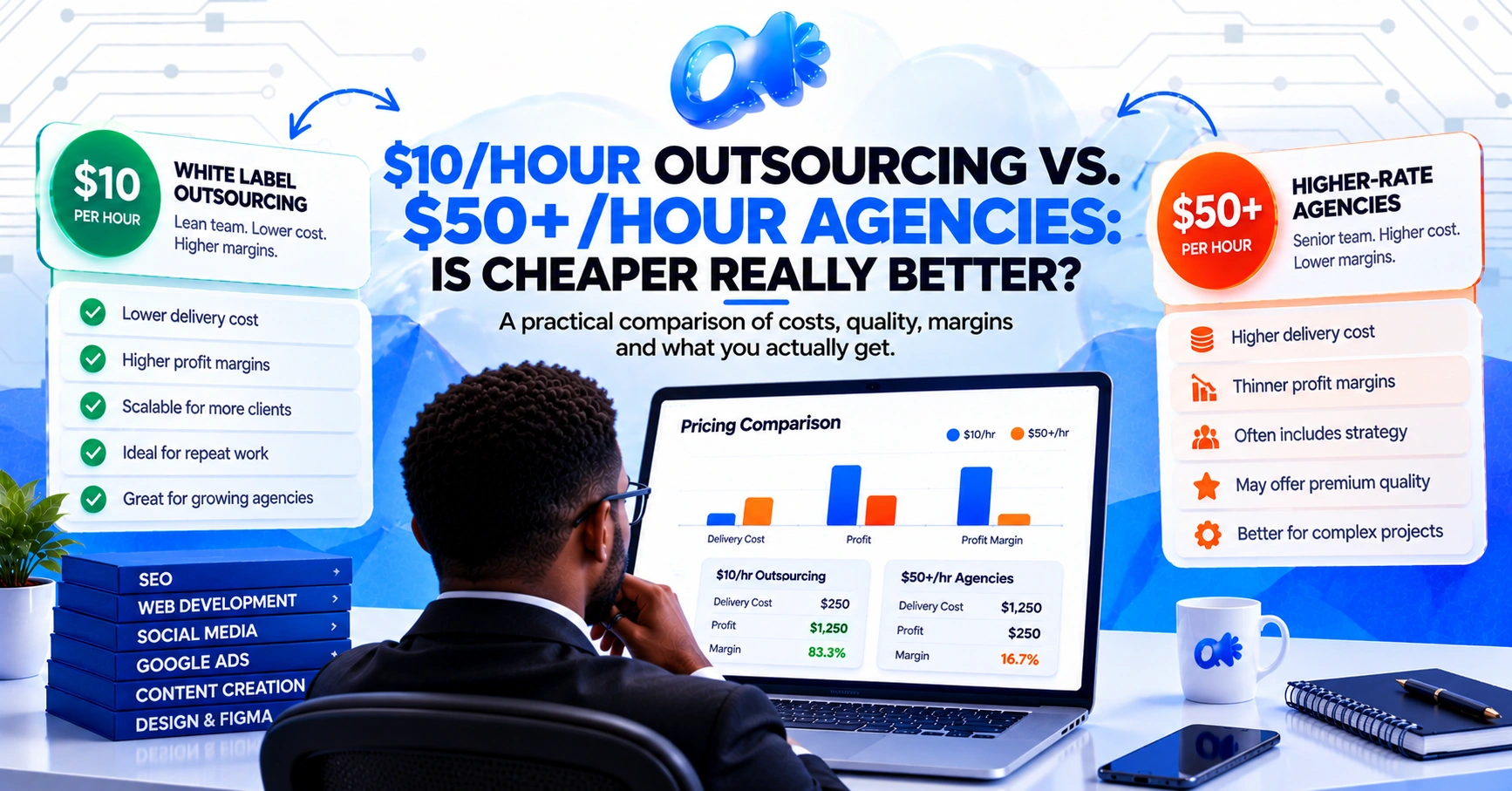
Here’s an illustrative scenario. You sell an SEO retainer for $1,500 a month. The work takes 25 hours a month. We’ll compare rates, ignoring your own management time for the moment.
| Hourly rate | Monthly delivery cost | Profit | Margin |
|---|---|---|---|
| $10 | $250 | $1,250 | 83.3% |
| $25 | $625 | $875 | 58.3% |
| $50 | $1,250 | $250 | 16.7% |
| $75 | $1,875 | −$375 | −25% |
At $75 an hour, this retainer loses money. At $50 an hour, you’re left with a thin 16.7%. At $10, you’ve got a comfortable margin.
Now let’s repeat it over a year with four such clients.
| Hourly rate | Annual profit (4 clients) |
|---|---|
| $10 | $60,000 |
| $25 | $42,000 |
| $50 | $12,000 |
The rate difference between $10 and $50 is $40 an hour, but across a year it moves your profit from $60,000 to $12,000. That’s the case for caring about rate.
But Rate Isn’t Everything: The Costs Behind the Cost
If the story ended there, nobody would pay $50 an hour. Plenty of agencies do, and some of them have good reasons. Here are the factors that can make a cheap rate more expensive than it looks.
Your management time
Every hour you spend briefing, correcting and chasing is a cost. If a cheaper partner needs 10 hours of your time to deliver 25 hours of work, and your time is worth $40 an hour, that’s $400 of hidden cost. A more expensive partner who needs 2 hours of your time adds just $80.
Let’s redo the retainer example with management time included.
| $10/hr partner needing heavy oversight | $50/hr partner needing light oversight | |
|---|---|---|
| Delivery (25 hours) | $250 | $1,250 |
| Your time | 10 hrs × $40 = $400 | 2 hrs × $40 = $80 |
| Total cost | $650 | $1,330 |
| Profit on $1,500 | $850 | $170 |
Even with heavy oversight, the cheaper option still wins on these numbers. But the gap narrowed from $1,000 to about $680, and if the cheaper partner needed 20 hours of your time, it would narrow further. The lesson: a low rate is only valuable if the work needs little correction.
Revision cycles
Each round of revisions costs hours. A partner whose first drafts are close to right saves more than one whose drafts need three rounds.
Missed deadlines
A delayed deliverable can cost you a client’s trust, which is worth far more than any rate difference.
Staff turnover
Cheap operations sometimes churn through staff. Every time your contact changes, you re-explain your standards and your clients.
Hidden fees
Setup fees, minimums, rush charges and “management fees” can turn a low headline rate into a higher real one.
Quality risk
If work is poor, you pay twice: once for the work and once to fix it or lose the client.
The Costs Behind the Expensive Option
The same scrutiny applies upward.
Paying for things you don’t need
A $75 rate might include senior strategy, in-house research tools and extensive reporting. If you only need execution, you’re paying for capacity you won’t use.
Overlap with your own role
If a partner provides strategy and client communication, but you want to keep those yourself, you’re paying for duplication.
Minimums and contracts
Higher-priced providers often have monthly minimums or lock-in terms. That cuts the flexibility that makes outsourcing safe.
A premium that isn’t about quality
Some agencies charge more because of location, branding or the size of their offices, not because the output is better. Rate and quality aren’t reliably linked.
Cheap vs Expensive White Label Agency: What Actually Differs
Rather than assuming, here’s a structured comparison of the factors that really separate low-rate and high-rate models.
| Factor | Lower-rate model | Higher-rate model |
|---|---|---|
| Hourly cost | Low | High |
| Overhead | Usually lean | Usually heavier |
| Seniority of staff | Varies widely | Often more senior, but not always |
| Strategy included | Usually execution-focused | Often includes planning and consulting |
| Flexibility | Often high (hour blocks) | Often lower (retainers, minimums) |
| Onboarding | Often quick | Sometimes more formal |
| Risk if it goes wrong | Lower financial loss, possible quality risk | Higher financial loss |
| Best for | Agencies that want to protect margin and keep strategy in-house | Agencies that want a strategic extension and have the margin for it |
Notice that “quality” isn’t a row. That’s deliberate. Quality varies inside both groups, so the only reliable way to judge it is to test the work.
When Cheaper Is Genuinely Better
A lower rate wins when:
- Your client pricing is fixed or competitive. If you can’t raise prices, delivery cost is the lever you control.
- The work is well defined and repeatable. Standard audits, graphics, landing pages and social content don’t need senior-level involvement.
- You keep strategy in-house. If you provide the thinking, you’re paying for production only.
- Your volume is uneven. Flexible hour blocks beat retainers when demand fluctuates.
- You’re margin-sensitive. Agencies with thin margins gain the most from a lower cost.
- You review the work anyway. If you’re the quality gate, you’re already insulated from many risks.
When a More Expensive Agency Might Be the Better Choice
We’d rather say this plainly than hide it.
- You need senior strategic input. If you want a partner who’ll shape the plan, not just carry it out, a higher rate may be justified.
- The work is highly specialized. Complex technical SEO for a large enterprise site, for example, may justify specialist rates.
- You’re serving clients with strict requirements. Compliance, location or staffing rules can limit your choices.
- You have no capacity to review. If you can’t oversee work, a provider with stronger built-in quality control might be worth paying for.
- You’ve found one that delivers consistently. A reliable partner at a higher rate can be cheaper in practice than an unreliable one at a lower rate.
- Your client pays a premium. If you charge top rates, you can afford a top-rate partner and keep a healthy margin.
The Right Metric: Cost Per Useful Outcome
Hourly rate is a convenient number, but it isn’t the one that matters. The right measure is the total cost per outcome you can bill for.
Total cost includes:
- The partner’s fees.
- Your management and review time.
- The cost of revisions and rework.
- The cost of delays and lost trust.
Divide by outcomes, such as finished sites, delivered audits or retainers retained.
Imagine two providers delivering 10 audits.
- Provider A charges $10 an hour, takes 8 hours per audit and needs 1 hour of your time at $40. Cost per audit: $80 + $40 = $120.
- Provider B charges $50 an hour, takes 5 hours per audit and needs 0.5 hours of your time. Cost per audit: $250 + $20 = $270.
Provider A still wins, but the gap is $150, not the $40-an-hour gap the rates suggest, and it would flip if Provider A needed three rounds of revisions on half the audits. This is why testing matters more than comparing quotes.
How to Run Your Own Comparison
You don’t need to guess. Here’s a way to compare any two providers using real numbers.
Step 1: Pick one real task. Something typical, like a technical SEO audit or a landing page.
Step 2: Send the same brief to both. Or to one, then compare against your internal cost.
Step 3: Record everything. Provider hours, your hours, revision rounds, delivery time.
Step 4: Calculate total cost. Include your own time at its true cost.
Step 5: Score quality. Would you put your logo on it without changes?
Step 6: Compare cost per outcome. Not just the rate.
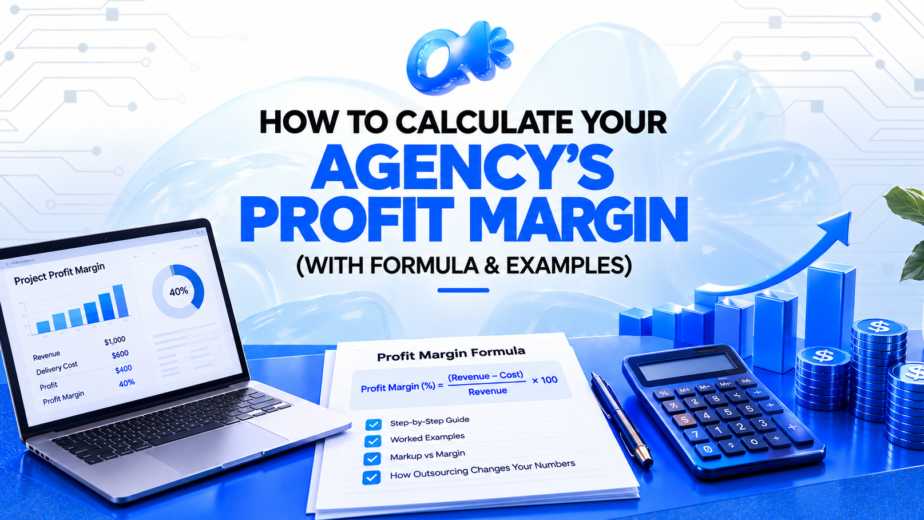
You can do the arithmetic quickly with the Agency Profit Margin Calculator. Our walkthrough, How to Use an Agency Profit Margin Calculator the Right Way, explains what to enter, and How to Calculate Your Agency’s Profit Margin covers the formula.
Why $10 an Hour Isn’t Automatically a Red Flag
A rate that low makes people suspicious, and suspicion is healthy. Here’s what’s behind ours, so you can judge it.
- A small, stable, in-house team. Fifteen people, all employed directly, with no subcontractor chains.
- Execution-focused. You supply strategy and client relationships. We carry out the production.
- Efficient operations. One account manager briefs the right specialist, so there’s no layers of hand-off.
- Volume and repeat work. The model works because agencies come back.
- Simple pricing. $200 for 20 hours, $400 for 40 or $800 for 80, with the same rate on every block. Hours don’t expire.
We’re not claiming that rate alone makes us better, and we’d encourage you to test us. What we’d say is that a low rate isn’t evidence of poor quality by itself, any more than a high rate is evidence of good quality. Both need proof.
Red Flags at Both Ends
At the low end
- No trial, no samples, no way to see work before you pay.
- Vague answers about who does the work.
- Very high turnover or constant contact changes.
- Guarantees about results.
At the high end
- Rates that can’t be explained in terms of what you receive.
- Large minimums and long contracts.
- Reluctance to trial.
- Strategy and service bundled so tightly you can’t buy only what you need.
At either end
- Slow replies before you’ve even signed.
- Pressure to commit quickly.
- Hidden fees.
- Reports with no explanation of what was done.
A Quick Decision Framework
Answer these four questions.
- Do I need strategy or execution? Execution points to the lower end. Strategy might justify the higher.
- How much margin do I need? If your client price is fixed and margins are thin, rate matters a lot.
- How much time can I spend on review? Less time suggests paying for stronger built-in quality, or testing carefully for it at a lower rate.
- How uneven is my demand? Spiky demand suits flexible hour blocks.
If most answers point one way, you have your direction. Then confirm it with a trial.
How to Test Without Risk
Whatever you’re considering, start small.
- Send a real, low-stakes task.
- Judge four things: quality, speed, communication and your own time spent.
- Compare the total cost, not just the quote.
- Expand only if the evidence supports it.
We built our 8-hour free trial for this. Send us a landing page, a batch of social creative, a technical SEO audit or a Google Ads build, and judge the output and the working relationship before you spend anything. No contract, no card and no sales call required first. You can send the same task to another provider and compare the results side by side. We’d welcome that.
Frequently Asked Questions
Is a $10 an hour white label agency too cheap to be good?
Not automatically. Price alone doesn’t indicate quality at either end. Check who does the work, test on a real task and judge the result.
Why do some agencies charge $50 or more per hour?
Reasons include higher overhead, more senior staff, included strategy, local presence or premium positioning. Whether those are worth paying for depends on what you need.
What’s the real cost difference between cheap and expensive white label agencies?
On a 25-hour monthly retainer, $10 an hour costs $250 versus $1,250 at $50 an hour, before adding your own time. The full picture depends on management time, revisions and reliability.
How do I compare white label providers fairly?
Run the same task through each, record all hours including your own, count revisions and compare total cost per outcome rather than hourly rate.
Does a higher rate guarantee better quality?
No. Quality varies within every price band, so test the work.
Which is better for SEO, a cheap or expensive white label provider?
It depends on the scope. Repeatable work such as audits, on-page optimization and Google Business Profile management can be done well at lower rates. Complex, strategic work may justify higher ones.
Are there hidden fees to watch for?
Setup fees, minimums, rush charges and management fees are common. Ask for a complete cost breakdown.
What does your $10 an hour include?
Work from an in-house team through a dedicated account manager, delivered under your branding, with hours usable across SEO, web, social, ads, design and automation, and a shared task tracker. Hours don’t expire.
Is cheaper really better? Sometimes. A low rate protects margin, and for repeatable execution work it can be the obviously right choice. But it isn’t a rule. A cheap partner who needs constant correction can cost more than an expensive one who delivers cleanly, and an expensive partner whose premium pays for things you don’t need is just a worse deal.
The honest approach is to stop comparing rates and start comparing outcomes. Test the work, count your own hours and calculate cost per outcome. The results will usually be clear.
Compare Your Margins With Our Calculator
Before you decide, put your own numbers in.
Compare margins with our Agency Profit Margin Calculator to see how your current delivery cost stacks up against outsourcing at $10 an hour. Then, if you want to test the real thing, claim your 8-hour free trial and judge the work yourself.
You can also read our FAQs, explore our White Label SEO + GBP service or see all our services.