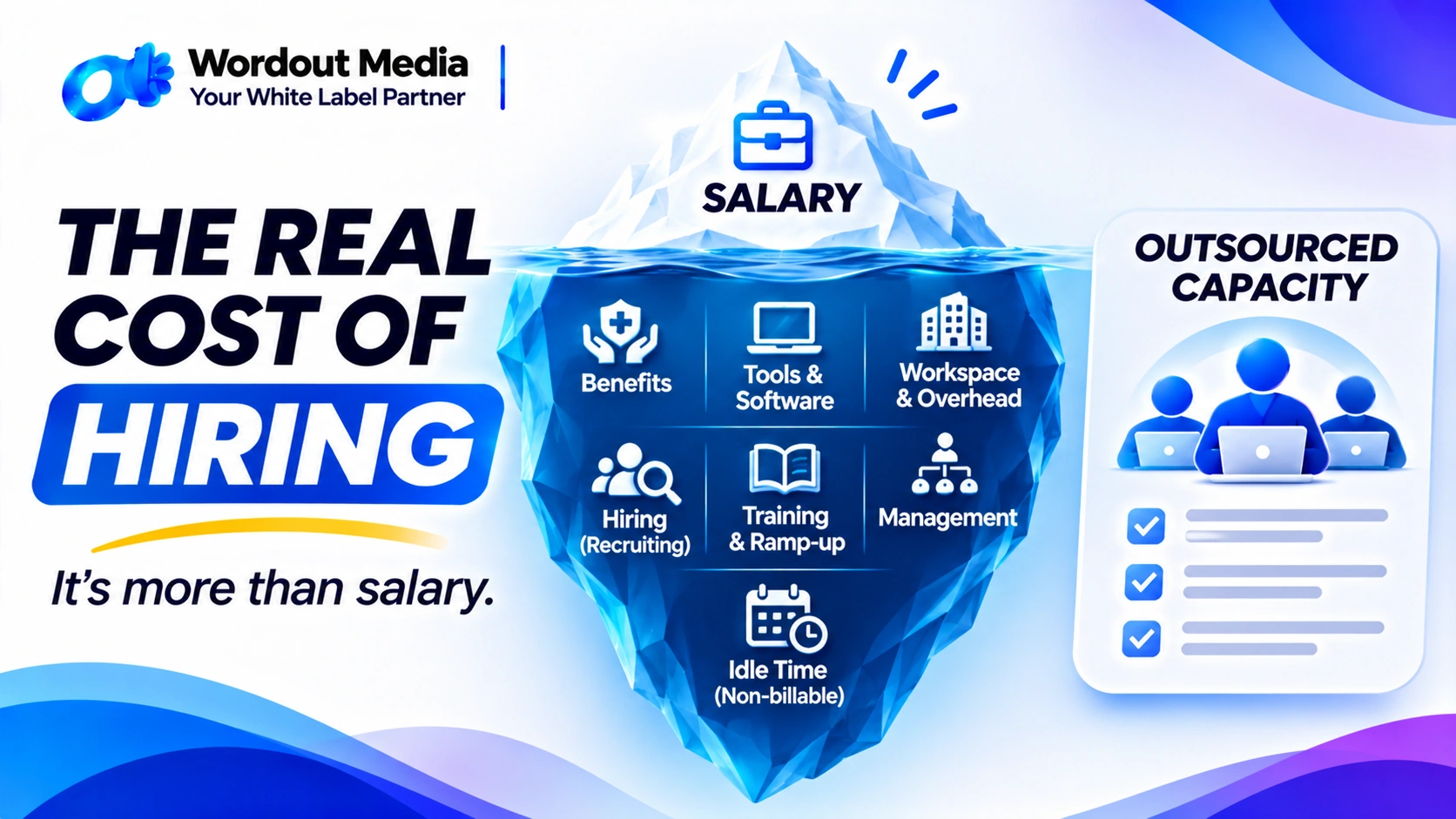
Suppose you decide to hire a marketer. You post the role with a salary, interview a few people and hire someone good. On paper, you’ve agreed a number. In reality, you’ve just started a stream of costs the number doesn’t capture.
The employee needs a laptop and software licences. There are payroll taxes and benefits. Somebody has to manage them. The first couple of months are partly spent learning your clients. Some weeks they’ll be flat out, and some weeks the pipeline will be quiet, and either way the payroll runs.
None of this means hiring is a mistake. It means the cost of hiring an in-house marketing team needs to be understood properly before you compare it with anything else. This guide breaks it down line by line, shows a worked example, covers the hidden costs, explains when hiring is still the right call and shows how outsourcing changes the picture. We’re Wordout Media, an outsourcing partner, so we have a view, but the arithmetic is the arithmetic. You can test it on your own numbers with the Agency Calculator calculator.
To be precise, when we talk about the cost of hiring in house marketing team members, we mean everything the business pays because that person is on the payroll, not just the pay itself. The same logic applies whether you hire one person or a team.
What Real Data Says About Employee Cost
The most useful public benchmark is the U.S. Bureau of Labor Statistics’ Employer Costs for Employee Compensation release. For June 2026, it reported private industry employer compensation costs averaging $46.89 per hour worked: $32.82 in wages (70.0%) and $14.07 in benefits (30.0%), released September 9, 2026.
Two cautions. This is an all-industry average, not a marketing-specific figure, so your numbers will differ. And it measures cost per hour worked, which is closer to productive hours than paid hours, but doesn’t include recruiting, equipment or management time. Treat it as evidence that true cost runs well above wages, not as your number.
The Cost Lines of an In-House Marketer
Here’s a checklist of what actually goes into the cost of one hire.
Direct pay
- Base salary
- Bonuses or commissions
- Overtime, where applicable
Statutory and benefits costs
- Employer payroll taxes
- Health insurance contributions
- Retirement contributions
- Paid leave, holidays and sick days
Tools and equipment
- Computer, monitors and peripherals
- Software licences: design, analytics, SEO tools, project management, stock assets
- Phone and internet allowances
Workspace and overhead
- Office space or remote-work stipend
- Utilities, insurance and administration
- HR, payroll and accounting support
Hiring costs
- Job advertising and recruiter fees
- Interviewing time from you and your team
- Background checks, if applicable
Ramp-up and training
- Weeks of reduced productivity
- Courses, certifications and conferences
- Your time teaching standards and processes
Management
- Supervision, feedback and reviews
- Planning and meetings
Turnover risk
- The cost of replacing someone who leaves, including a gap in coverage
Salary Is Not Cost Per Hour
A paid hour is not a productive hour. Holidays, leave, training, internal meetings, admin and slow periods all reduce the hours that produce billable work.
Here’s a simple way to find your cost per productive hour:
- Add up annual fully loaded cost (pay, benefits, tools, overhead, hiring and training).
- Estimate annual productive (billable or genuinely useful) hours.
- Divide cost by productive hours.
A Worked Example (Illustrative)
These figures are hypothetical, so replace them with your own.
One in-house marketer
| Cost line | Annual amount |
|---|---|
| Base salary | $55,000 |
| Payroll taxes and benefits (about 30%) | $16,500 |
| Software, equipment and workspace | $4,500 |
| Training and ramp-up (year one) | $2,000 |
| Recruiting (spread over the year) | $1,500 |
| Management time (about 3 hours a week at $40) | $6,000 |
| Total | $85,500 |
Productive hours: 2,080 paid hours, minus leave, holidays and training (about 240), minus internal meetings and admin (about 300) gives roughly 1,540 productive hours.
Cost per productive hour: $85,500 ÷ 1,540 = about $55.52.
Compare that with the $26.44 you’d get by dividing salary by 2,080 paid hours. The real number is more than double.
What a Team Costs
Scale it up. A small in-house team of three, such as a marketer, a designer and an SEO specialist, might cost around $250,000 a year fully loaded, on figures like those above, before any salary growth. That’s a commitment of more than $20,000 a month that continues through quiet periods, lost clients and slow quarters.
This is the exact trade-off behind the question of whether to hire or outsource. We compared the two models in White Label vs. In-House Marketing Team, and for SEO specifically in White Label SEO vs. an In-House SEO Team.
The Hidden Costs People Forget
Idle time. If you have 120 hours of work in a month and a person with 130 productive hours, you’re paying for ten hours of nothing. Across a year, and across a team, the waste is significant.
Skill gaps. One person can’t be excellent at SEO, paid ads, design and video. You’ll hire again or live with gaps.
Single points of failure. If your only designer leaves, delivery stops.
Management distraction. Every employee consumes owner or manager attention.
Raises and promotions. Costs go up over time, even if revenue doesn’t.
Severance and turnover. Replacing someone costs recruiting plus a ramp-up period.
Slow response to change. Adding capacity takes months, and reducing it is harder and more painful.
The Outsourced Equivalent (Illustrative)
At Wordout Media, the rate is $10 an hour: Starter is $200 for 20 hours, Growth is $400 for 40 hours and Scale is $800 for 80 hours, with the same rate on every block. Hours don’t expire, and you can spend them across all six services.
Compare the work of one in-house marketer’s 1,540 productive hours:
- In-house: $85,500 a year, or about $55.52 per productive hour.
- Outsourced: 1,540 hours × $10 = $15,400.
That’s a gap of about $70,000 on paper, but a fair comparison needs more:
- You’ll still spend review and briefing time, perhaps 10% to 20% of outsourced hours. At $40 an hour, 150 hours of review adds about $6,000.
- You’ll still sell and manage clients. That doesn’t change.
- An outsourced team won’t have the same deep, daily knowledge of your clients that an employee builds. Briefs matter more.
- You might need more hours than an employee works, if the partner is less familiar with your clients at first.
- A partner’s capacity is flexible. An employee’s isn’t.
Even after those adjustments, the cost difference is large for work that fits an outsourcing model. That’s why we say: outsource execution, keep judgment. Our guide to how agencies scale without hiring covers the strategy.
We’d be misleading you if we said outsourcing is always cheaper. If you have steady, high-volume work in one discipline that keeps a full-time person busy all year, the economics shift. If the work is central to your identity or needs deep daily involvement, hiring may be better.
Three Agency Scenarios (Illustrative)
Numbers depend on your situation, so here are three invented agencies and how the cost of hiring an in-house marketing team plays out for each.
Scenario A: the two-person agency with six clients. Delivery work fills about 90 hours a month, spread across SEO, social and design. One generalist hire has roughly 128 productive hours a month, so they’d be busy about 70% of the time, and still wouldn’t be strong in every discipline. The agency would pay for about 38 unused hours every month, and would still need outside help for the skills the hire lacks.
Scenario B: the growing web studio. It wants to add monthly SEO for eight clients, needing roughly 140 hours a month. That’s a full-time role plus extra, and the demand looks stable. Here hiring becomes a serious option, though a hybrid with a partner for peaks and specialist tasks would still reduce risk.
Scenario C: the seasonal consultancy. Most of its work lands in four busy months. A full-time employee would sit underused for the rest of the year. Flexible capacity is much cheaper here.
The pattern is simple: the steadier and fuller the workload, the better hiring looks. The lumpier it is, the stronger the case for variable cost.
Questions to Ask Before You Post the Job
- Can I describe 120+ hours of work a month for this role, every month, for the next year?
- What happens to the cost if I lose my biggest client?
- Which skills will this person lack, and how will I cover them?
- Who will manage and train them, and what does that time cost?
- What’s my plan if they leave in the first year?
- Have I calculated cost per productive hour instead of cost per paid hour?
- Have I tested the alternative on one real task?
If you can answer all seven confidently, hiring may be right. If several give you pause, test flexible capacity first. You can try ours with the 8-hour free trial.
The Opportunity Cost Nobody Counts
There’s one more cost on the in-house side that no spreadsheet shows: your attention. Every employee needs direction, feedback and problem solving. If you’re already stretched, adding a person adds a new demand on the scarcest resource in the business, which is the owner’s time.
Outsourcing doesn’t remove that demand entirely. You still brief and review. But it tends to concentrate it into clearer, shorter interactions than managing a person day to day. That difference has real value, even if it doesn’t appear in the cost of hiring an in-house marketing team calculation.
Using the Numbers in Your Pricing
Once you know your true cost per productive hour, you can price work properly. If your in-house cost is $55 an hour and a client’s retainer needs 25 hours, delivery costs $1,375 before management time. At a 55% target margin, that retainer needs to be priced above $3,000. If outsourced delivery costs $250 for the same work, the price you can choose is very different.
That’s why the cost of hiring an in-house marketing team isn’t only a hiring question. It shapes what you can charge, which clients you can serve and how much margin you keep. How to Price Digital Marketing Services shows the formula, and White Label SEO Pricing in 2026 compares published ranges. ## When Hiring Is the Right Answer
- Steady, high-volume work that fills a full-time role.
- Core craft that defines your brand.
- Roles needing deep client immersion, like a head of strategy.
- Contracts that require employee-only delivery.
- A desire to build institutional knowledge inside the company.
Many agencies end up with a hybrid: a small core team they trust deeply, plus flexible outsourced capacity for peaks and for services they don’t specialize in.
How to Run Your Own Comparison
- List your costs using the checklist above.
- Calculate cost per productive hour.
- Estimate your monthly workload in hours.
- Add review and management time for both models.
- Compare cost at your actual volume, including quiet months.
- Calculate margin on a real client using both options.
- Test the outsourced option on one task before deciding.
The Agency Profit Margin Calculator does steps 5 and 6 quickly. How to Use an Agency Profit Margin Calculator the Right Way explains each input, and How to Calculate Your Agency’s Profit Margin covers the formulas.
Where We Might Not Be the Right Fit
- If your work is steady and fills a full-time role, hiring may beat any outsourced model.
- If you need very large, round-the-clock capacity, a bigger provider may suit you better.
- If your clients require employee-only or in-country delivery.
- If you want a fully hands-off package with no briefing.
Frequently Asked Questions
What is the real cost of hiring an in-house marketing team?
Salary plus payroll taxes, benefits, tools, workspace, recruiting, training, management time and idle time. In general, true cost runs well above salary alone.
How much do benefits add to employee cost?
The U.S. Bureau of Labor Statistics reported benefits at 30.0% of private industry employer compensation costs in June 2026. That’s an all-industry average.
What is cost per productive hour?
Fully loaded annual cost divided by the hours that produce useful work, after leave, holidays, training, meetings and admin.
Is outsourcing cheaper than hiring?
Often, especially at low and medium volumes and when demand is uneven. At steady, high volume, hiring can be competitive. Calculate your own numbers.
What does a marketing team cost per year?
It depends on roles, location and pay. In our illustrative example, a small team of three came to roughly $250,000 a year fully loaded.
Do I still need to spend time managing outsourced work?
Yes. Briefing and reviewing take time, and it belongs in your calculation.
How can I compare costs for my own agency?
Use the Agency Profit Margin Calculator on our homepage with your real numbers.
What if my demand drops?
Outsourced hours don’t expire, so you simply stop buying. Payroll for employees continues.
Before you commit, remember that the cost of hiring in house marketing team members is a ten-year decision made with one-year information.
The cost of hiring an in-house marketing team is rarely what the salary suggests. Once you add benefits, tools, overhead, management, ramp-up and idle time, and divide by productive hours, the true hourly cost can be double the number you started with.
Hiring is still right for some work. But if you’ve never run the full comparison, run it. You might find that flexible capacity is cheaper, safer or simply a better fit for how your demand actually behaves.
Compare Costs With Our Profit Margin Calculator
Put your own numbers in.
Compare costs with our Profit Margin Calculator on our homepage and see how in-house and outsourced delivery compare on a real project. When you want to test the outsourced side on real work, claim your 8-hour free trial: no contract, no card, no sales call required first. You can also read our FAQs or browse our services.