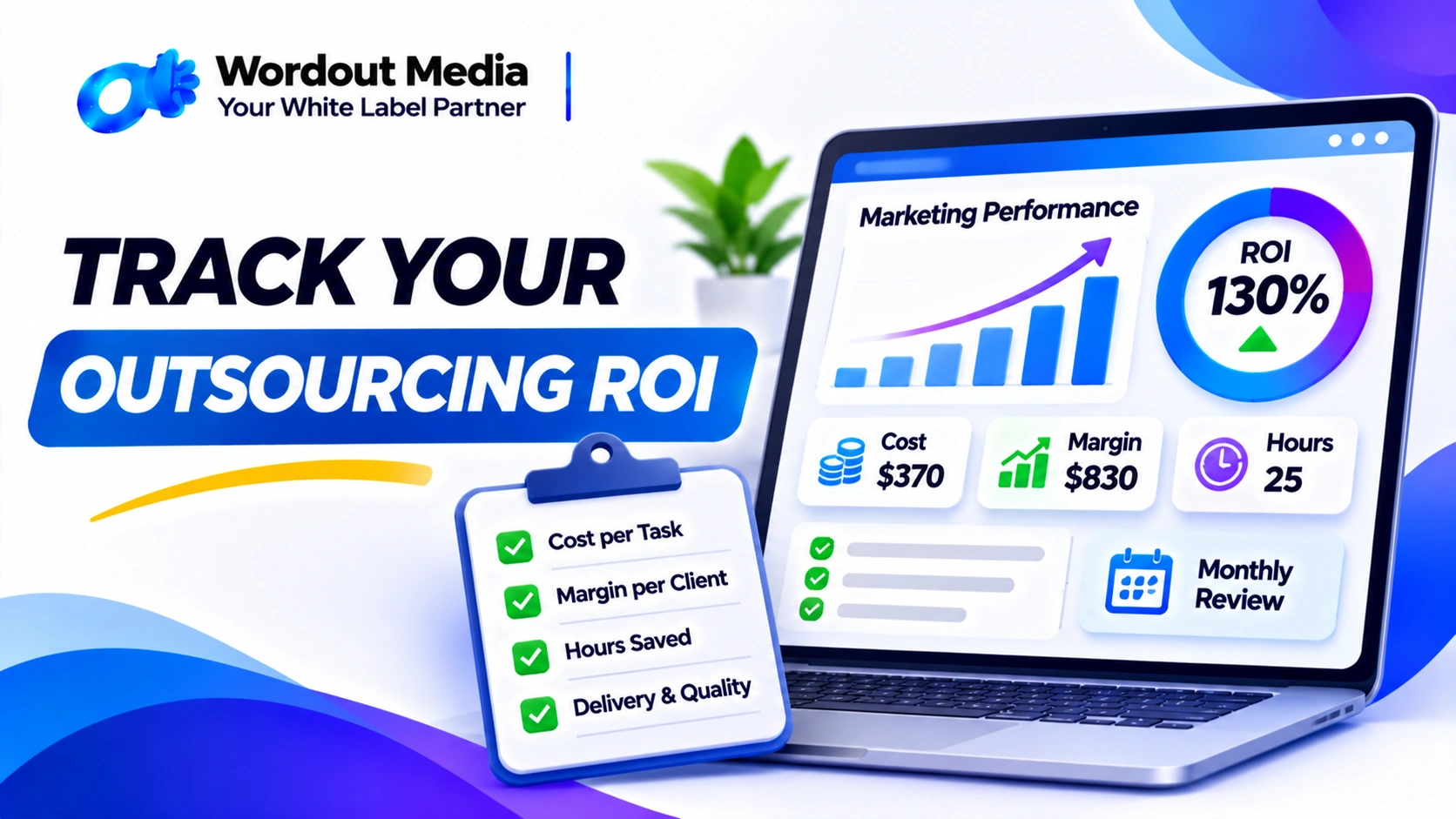
A few months after an agency starts outsourcing, the owner usually asks the same question: is this actually working? The honest answer is often “I think so,” which is a feeling, not a number. The work seems to be getting done. Things feel calmer. But nobody has measured the cost per task, the margin on the clients, the revision rate or how much time was really saved.
That matters, because “I think so” doesn’t survive a bad month. This guide shows how to track ROI on outsourced marketing properly. We’ll separate the two meanings of “ROI,” give you formulas, list the metrics worth watching, show a monthly review routine with a worked example and explain how a task-level tracker makes it practical. We’ll also be clear about what you can’t measure precisely.
In short, to track roi outsourced marketing work well, you need records, a baseline and a monthly habit. The rest of this guide shows how.
How do you track ROI on outsourced marketing work?
Record what you spend (partner fees plus your own review time), what the work earns or saves (client revenue, margin gained, hours freed) and how well it performs (turnaround, revision rate, on-time delivery). Then apply: ROI = (Benefit − Cost) ÷ Cost. Review it monthly per client and per service, using a task-level record of hours.
Two Questions Hiding in One
“ROI on outsourced marketing” means two different things, and mixing them causes confusion.
1. Agency ROI: Is outsourcing worth it to us? Does using a partner improve our margin, capacity and quality compared with the alternative?
2. Client ROI: Is the marketing worth it to the client? Does the SEO, ads or social work produce results that justify what the client pays?
This guide focuses mainly on the first, because that’s what you control as an agency and what a partner affects directly. We touch on the second near the end, since it determines whether your clients stay.
The ROI Formula
The standard formula is:
ROI = (Benefit − Cost) ÷ Cost
Expressed as a percentage, multiply by 100.
For outsourcing, define each term carefully.
Cost:
- Partner fees (hours × rate)
- Your own briefing and review time, valued at your hourly cost
- Tools or access costs specific to the arrangement
- Rework or fixes you paid for twice
Benefit can be measured in more than one way:
- Margin gained: the difference between what you’d have spent delivering the work another way and what you spent now
- Revenue enabled: work you could take on only because you had the capacity
- Time freed, valued at what that time earns when used for sales or strategy
Pick the benefit definition that matches your reason for outsourcing, and use it consistently.
A Worked Example (Illustrative)
Say your agency delivers a $1,200 a month SEO retainer that takes about 25 hours to produce. These figures are hypothetical.
Baseline (in-house):
- Delivery cost: 25 hours × $44 = $1,100
- Your review time: 3 hours × $40 = $120
- Total cost: $1,220
- Profit: −$20
Outsourced at $10 an hour:
- Partner fees: 25 × $10 = $250
- Your review time: 3 × $40 = $120
- Total cost: $370
- Profit: $830
Benefit (margin gained vs baseline): $1,220 − $370 = $850 per month. ROI on outsourcing cost: ($850 − $370) ÷ $370 ≈ 130% per month.
Notice what the example depends on: the baseline cost, the hours and your review time. Change any of them and the answer moves, which is why measuring them matters. You can test variations with the Agency Profit Margin Calculator.
The Metrics Worth Tracking
You don’t need fifty. These eight tell you most of what matters.
1. Cost per deliverable
Total outsourced cost divided by deliverables produced (audits, pages, graphics, campaigns). It shows which work is cheap or expensive to produce.
2. Margin per client
Revenue minus all delivery cost (partner fees plus your review time). Check each client, because averages hide problem accounts. See How to Calculate Your Agency’s Profit Margin.
3. Hours used versus estimated
Compare your estimate with actual hours per task. Large gaps point to unclear briefs or underestimated work.
4. Your review and management time
The hidden cost. If outsourced work needs more of your hours than expected, ROI falls.
5. Revision rate
How many rounds each deliverable needs. A high rate suggests a briefing problem, a quality problem or both.
6. Turnaround time
How long from brief to delivery. At Wordout Media, most design, ad setup and video tasks come back same day to 48 hours, and larger builds are scoped with a timeline. Track what you actually experience.
7. On-time delivery rate
The share of tasks delivered by the agreed date.
8. Capacity gained
Extra clients, projects or hours you could take on because of outsourcing, and what they earned.
Why a Task-Level Tracker Matters
You can’t compute any of the above without a record of what happened. That’s the problem a task tracker solves.
Every agency partner at Wordout Media gets a shared task tracker that logs each task, who did it, how long it took and what was delivered, updated as work happens, not at month-end. It means you can:
- See where every hour went
- Compare estimated and actual hours
- Calculate cost per deliverable
- Spot tasks that consume more than expected
- Check your remaining balance at any time
You also keep your own record of review time, since that’s on your side. If you use ClickUp or Asana, which we can join as a member of your team, you can tag tasks by client and service to make reporting easier. For tooling ideas, see Best Tools & Platforms for Managing White Label Client Work.
A Simple Monthly ROI Review
Set aside 30 minutes at the end of each month.
- Export hours by client and service from the tracker.
- Calculate partner cost (hours × $10 in our case).
- Add your review time.
- Record client revenue for each account.
- Work out margin per client.
- Compare estimate to actual hours on major tasks.
- Note revision rounds and delivery dates.
- Write down one finding and one action. For example, “Social graphics for Client A took 40% more hours than estimated. Brief template needs examples of approved posts.”
Keep the figures in a simple spreadsheet. Over a quarter, trends will show up that no single month reveals.
Setting a Baseline
ROI needs something to compare against. Choose a baseline before you start:
- Previous in-house cost per hour or per deliverable, if you were doing the work yourself
- A quote from another provider for the same work
- What you would have paid to hire, using the true cost approach in The Real Cost of Hiring an In-House Marketing Team
Without a baseline, you’re measuring activity, not return.
ROI Examples by Service (Illustrative)
Different services produce different kinds of benefit, so here is how you might think about each. All numbers are invented.
SEO retainer. You charge $1,200 and the work takes 25 outsourced hours ($250) plus 3 hours of your review ($120). Profit is $830. Track hours per task, revision rate and margin, and report client outcomes such as enquiries separately.
Website build. You charge $4,000 and the build takes 70 outsourced hours ($700) plus 10 hours of your review and client management ($400). Profit is $2,900. Track estimated versus actual hours and revision rounds, because overruns are the main risk.
Social media retainer. You charge $1,000 and the month takes 18 outsourced hours ($180) plus 3 hours of review ($120). Profit is $700. Track hours per asset and approval turnaround.
Paid ads management. You charge $900 and the month takes 12 outsourced hours ($120) plus 2 hours of review ($80). Profit is $700. Track management time against ad spend, and keep client ad spend out of your own cost figures.
Automation setup. You charge $900 and the build takes 16 outsourced hours ($160) plus 2 hours of review ($80). Profit is $660. Track build hours and post-launch fixes.
When you track roi outsourced marketing across services like this, you’ll quickly see which lines are healthiest and which need repricing or tighter scope.
A Simple ROI Spreadsheet Layout
You don’t need software. A single spreadsheet with one row per task or per client per month works well.
| Column | What to record |
|---|---|
| Month | Reporting period |
| Client | Account name |
| Service | SEO, social, ads, web, design, automation |
| Task | What was delivered |
| Estimated hours | Your estimate before work began |
| Actual hours | From the task tracker |
| Partner cost | Actual hours × hourly rate |
| Your review hours | Your own time, logged honestly |
| Review cost | Your hours × your hourly cost |
| Revision rounds | Number of feedback cycles |
| Delivered on time? | Yes or no |
| Client revenue | What you billed for this work |
| Margin | Revenue − partner cost − review cost |
Add a summary tab with totals by client and by service, and a simple chart of margin over time. Within a quarter you’ll know more about your delivery economics than most agencies ever learn.
How to Present Outsourcing ROI to Your Team or Partners
If you have staff, they may worry that outsourcing replaces them. Sharing the numbers, and being clear about what the partner does and doesn’t do, builds trust. Position it honestly: partners take repetitive production so your team can focus on strategy, client relationships and higher-value work.
If you have business partners or investors, show them a one-page summary: total outsourced spend, margin before and after, capacity gained, quality indicators and a plan for the next quarter. Reliable numbers beat enthusiasm.
What to Do If the ROI Isn’t There
Sometimes the numbers disappoint. Before you walk away, diagnose the cause.
- Is the brief the problem? Vague instructions create rework.
- Are you outsourcing the wrong tasks? Judgment-heavy work rarely suits it.
- Is your review time higher than expected? Standardize checklists and templates.
- Are estimates unrealistic? Compare against the task tracker and adjust.
- Is the partner a poor fit? Be honest, and try someone else, or stop.
- Is your volume too low or too steady? Hiring might be cheaper.
An honest “no” from your own data is a good outcome. It saves you from carrying a model that doesn’t suit your agency. ## What You Can’t Measure Precisely
Honesty matters here.
Attribution is imperfect. Marketing results depend on many factors, including the client’s offer, seasonality and competitors. A partner’s work is one input.
Some benefits are indirect. Reduced stress, better sleep and more time for sales don’t show on an invoice, though they’re real.
Quality is partly subjective. Revision rate and client feedback help, but judgment still applies.
Short windows mislead. One bad month tells you little, and SEO in particular takes time. Judge process and deliverables early, outcomes over a longer period.
No partner can guarantee results. Rankings, ad performance and client behavior are outside anyone’s control.
Tracking Client ROI (the Second Question)
Your clients also want to know their marketing is worth it. Your reporting should answer, in order:
- What business outcomes happened? Calls, leads, bookings, sales.
- What did it cost? Your fee and any ad spend, kept separate.
- What was the trend? Compared with previous periods.
- What did we learn and change?
Cost per lead and revenue per dollar of ad spend are common client-facing measures, but only use figures you can support. For how to present it, see What Should a White Label Client Report Include? and How to Build a White Label Reporting System Clients Trust.
Warning Signs That ROI Is Slipping
- Review time is creeping up.
- Revision rounds are increasing.
- Hours per task keep exceeding estimates.
- Deadlines are slipping.
- You’re double-checking everything.
- Margins are shrinking even though costs look low.
- Clients are noticing quality problems.
Most of these trace back to briefs, not partners. Improving the brief is the cheapest fix. See the template in Start Outsourcing Your SEO Projects This Week.
How to Improve ROI Once You’re Measuring
- Write better briefs, with examples and clear definitions of done.
- Batch feedback to reduce revision loops.
- Standardize repeatable tasks with templates and checklists.
- Re-estimate with real data.
- Move low-value work out and keep high-value work.
- Price using actual cost, not guesses. See How to Price Digital Marketing Services.
- Keep a small reserve of hours. Since hours don’t expire, you can respond to surprises without panic.
Where We Might Not Be the Right Fit
- If you don’t want to track or review anything. A partner can’t create ROI for you without your input.
- If your volume is steady and large enough that hiring would be cheaper.
- If you want guaranteed client outcomes. No partner can promise those.
Frequently Asked Questions
How do I track ROI on outsourced marketing?
Record total cost (partner fees plus your own time), measure the benefit (margin gained, revenue enabled, time freed) and apply ROI = (Benefit − Cost) ÷ Cost, reviewing monthly by client and service.
What is a good ROI for outsourcing?
It depends on your baseline and goals. What matters is that it’s positive, improving and measured consistently.
Which metrics matter most?
Cost per deliverable, margin per client, hours used versus estimated, your review time, revision rate, turnaround, on-time delivery and capacity gained.
How does a task tracker help?
It records each task, who did it, how long it took and what was delivered, so you can calculate cost and compare it with estimates.
How often should I review?
Monthly, with a deeper quarterly look at trends.
Can I measure ROI in the first month?
You can measure cost, turnaround and quality quickly. Return on client outcomes, especially SEO, takes longer.
Does outsourcing always improve ROI?
No. It depends on briefs, review time, volume and what you do with the time and capacity it creates.
How do I try this without a big commitment?
Use our 8-hour free trial and our shared task tracker on one real task. No contract, no card.
To track ROI on outsourced marketing, don’t start with a dashboard. Start with a record: what each task cost, how long it took, how many revisions it needed and how much of your time it used. Add client revenue and margin, compare against a baseline and review monthly.
Measured this way, outsourcing stops being a leap of faith and becomes a decision you can defend, improve or reverse with evidence.
Use our shared task tracker with a free trial: send us a real task, then check every hour in the tracker, including who did it, how long it took and what was delivered. No contract, no card, no sales call required first. You can also try our Profit Margin Calculator, read our FAQs or browse our services.