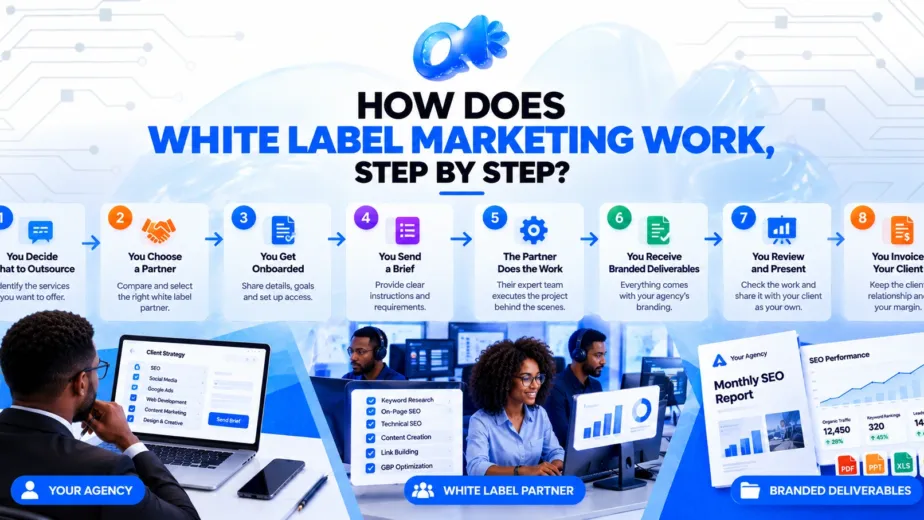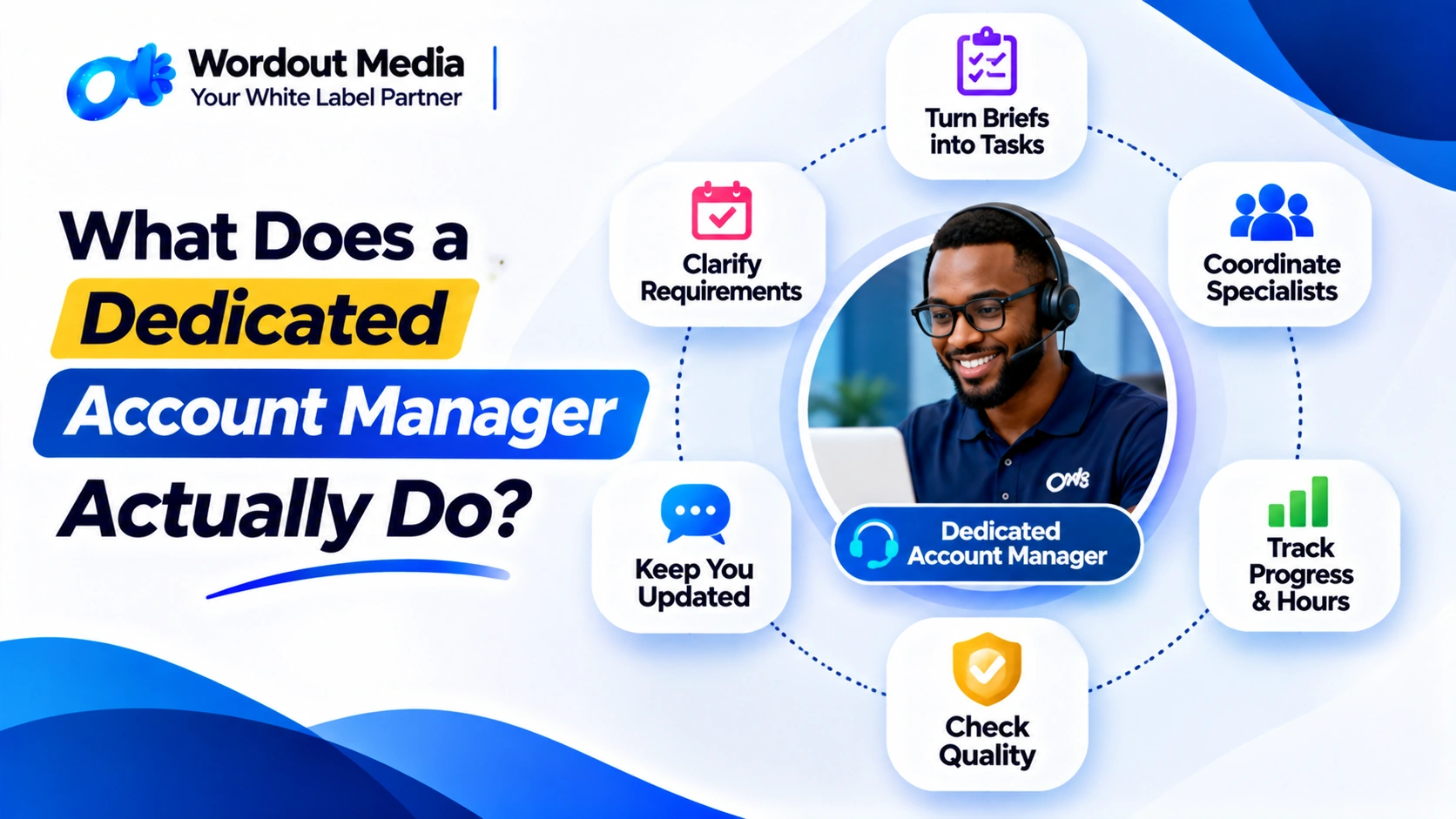
What does an account manager do? An account manager is the person responsible for a client relationship after the sale. At a white label marketing partner, a dedicated account manager takes your briefs, clarifies scope, assigns the work to the right specialists, tracks hours and progress, checks quality before delivery and keeps you informed. They are your single point of contact, so you don’t have to coordinate six people.
Key takeaways
- A dedicated account manager is one named person who learns your standards and keeps that knowledge.
- Their core jobs are translation (briefs into tasks), coordination, tracking, quality and communication.
- They don’t set your strategy, prices or client relationships. Those stay with you.
- The role differs from a project manager, a salesperson and a specialist.
- A good one flags problems early, including unclear briefs, before work begins.
The Brief That Was Never Quite Clear
Here’s a small scene (fictional, but familiar).
An agency owner sends a message: “Can you do a refresh of the Hendricks site? Make it feel more modern. Also the ads are weird.” The message is polite and short, and it contains at least five different projects, none of which have a deadline, a definition of “modern” or an explanation of what’s weird.
In a team without a good account manager, that message lands on a designer, who guesses. Then a developer, who guesses differently. Then somebody asks for clarification, a week later, when half the work is already off-track.
With a good account manager, the same message prompts four quick questions within the hour: “Which pages? What does modern mean to the client, and do you have examples? What’s weird about the ads: performance, wording or targeting? And when does the client expect to see something?” The brief gets better before anyone starts work.
That, in miniature, is the answer to what an account manager does. It’s less about managing accounts and more about making sure the right work happens for the right reasons, with the right person.
This guide explains the role in detail: the core responsibilities, what a dedicated account manager does in a white label setting, how the role differs from similar ones, what they can’t or shouldn’t do, how to work with one and how to tell a good one from a weak one. We’ll describe how it works at Wordout Media, where every agency partner has a dedicated account manager.
What Is an Account Manager?
An account manager is the person who looks after a client’s needs after they’ve bought something. In agencies, that means making sure the client’s work is delivered well, communicated clearly and aligned with their goals. The role sits between the client and the people who do the work.
In many industries it has slightly different flavors. In sales organizations, account managers focus on renewals and growing revenue. In agencies, they focus on delivery and the day-to-day relationship. Because the term is used loosely, it’s worth being specific about which version we mean.
What a Dedicated Account Manager Is (in Our Model)
At Wordout Media, “dedicated” means each agency partner has one named account manager who handles their work. You aren’t passed between support agents or put in a general ticket queue. The same person learns your standards, your clients’ quirks and your preferences over time, and keeps that knowledge.
Think of it as a single point of contact instead of six relationships: you describe the work once, and your account manager coordinates the designer, developer, SEO specialist or ad buyer who does it. We’re a team of fifteen, all in-house, so your account manager is working with colleagues, not chasing subcontractors.
The Seven Jobs of a Dedicated Account Manager
If you want a direct list, here’s what the role involves day to day.
1. Receive and interpret briefs
The account manager reads what you send, whether it comes through ClickUp, Asana, email or Slack, and works out what you actually need. They notice missing information, conflicting instructions and unrealistic timelines.
2. Clarify before work starts
This is the most valuable part and the least visible. Catching an unclear brief early saves hours of rework. If a brief is unclear, the account manager is responsible for catching that before work begins.
3. Scope and estimate
They estimate hours and timelines, tell you if a request is bigger than it sounds and suggest the sensible first phase. For large builds like full websites, they set a scoped timeline up front. For smaller tasks, most design, ad setup and video editing work comes back same day to 48 hours.
4. Assign the right specialist
A designer, developer, SEO specialist, media buyer or automation builder is chosen based on the task. You don’t have to know who’s best; the account manager does.
5. Track progress and hours
They keep the shared task tracker current. It logs each task, who did it, how long it took and what was delivered, and it’s updated as work happens, not at the end of the month. You can see the remaining balance at any time.
6. Check quality before delivery
Before work reaches you, the account manager reviews it against the brief and your standards. They won’t catch everything, and you should still review what comes back, but a first line of defense matters.
7. Communicate and handle problems
They update you on progress, raise issues early, manage revisions and make sure feedback reaches the right person. We include revisions on both paid and trial work and revise until the work matches the brief.
What a Typical Week Looks Like
To make it concrete, here’s an illustrative week for one agency partner (fictional details, realistic shape).
Monday. A brief arrives for a landing page and a month of social graphics. The account manager asks three clarifying questions, confirms the brand files are in the shared folder and gives you a timeline: the page by Wednesday, graphics by Friday.
Tuesday. A developer starts the landing page. A designer begins the social set. The account manager checks the tracker, logs the hours and sends a short progress note.
Wednesday. The landing page is reviewed against the brief and delivered with your branding. You send feedback.
Thursday. Revisions are done and the account manager confirms with you. A second brief arrives, a technical SEO audit, and gets scoped.
Friday. Graphics arrive, reviewed and on brand. The weekly summary shows hours used, hours remaining and what’s next.
Nothing dramatic. That’s the goal.
What a Dedicated Account Manager Doesn’t Do
Setting expectations avoids disappointment.
They don’t set your strategy. They’ll share what they’ve seen work, but your client’s goals and positioning are your call.
They don’t own your client relationships. You do. They can join client calls as a member of your team if you’d like, but you remain the voice clients trust.
They don’t set your prices. They can tell you how many hours something takes, which helps you price. See How to Price Digital Marketing Services for Maximum Profit.
They don’t do the specialist work. They coordinate it.
They can’t guarantee results. Rankings, ad performance and client decisions are outside anyone’s control.
They can’t read minds. A thoughtful brief still matters.
Account Manager vs. Project Manager vs. Salesperson vs. Specialist
These roles often blur together, so here’s a quick comparison.
| Role | Main focus | Typical question they ask |
|---|---|---|
| Account manager | The relationship and delivery for a client or partner | “What does this client need, and is it being done right?” |
| Project manager | Schedules, resources and milestones for a specific project | “Are we on track, and who’s blocked?” |
| Salesperson | Winning new business | “Does this prospect need what we offer?” |
| Specialist | Doing the skilled work (design, code, SEO, ads) | “What’s the best way to build this?” |
| Strategist | What to do and why | “What approach will achieve the goal?” |
In a small team, one person may hold several of these roles. At Wordout Media, your account manager blends the account and project management roles: they own the relationship and make sure each piece of work moves along. Specialists do the building.
Why a Dedicated Account Manager Matters for Agencies
Here’s why this matters when you’re handing off work.
You describe things once. Instead of explaining a project to a designer, a developer and an SEO specialist, you brief one person.
Your standards are remembered. Over time, they learn how you like reports laid out, how you word things and what “done” means to you. That memory is hard to replace. It’s also why our FAQs point out that a dedicated account manager “keeps the knowledge of your standards” even when individual specialists change.
Coverage continues. Because there’s a team behind them, leave or illness doesn’t stall your work. That’s a real difference from relying on a single freelancer.
Problems surface early. A missing login, an unrealistic deadline or a conflicting instruction gets flagged before it becomes a missed delivery.
You save time. Less chasing, less explaining and fewer status meetings.
What a Good Account Manager Looks Like
Whether you’re working with us or anyone else, these qualities tell you a lot.
- Asks good questions before starting work.
- Communicates proactively, without being chased.
- Is honest about timelines and doesn’t over-promise.
- Admits mistakes and fixes them.
- Knows your standards and applies them without being reminded.
- Protects your brand, including in small details.
- Pushes back politely when a request is unclear or risky.
- Keeps records, so you can see what happened and why.
Warning signs: Slow replies, vague updates, never asking questions, surprises at deadline time, blaming others and having to repeat yourself.
How to Get the Most From Your Account Manager
Write a decent brief. Goal, context, examples, deadline, access and what “done” looks like.
Share your standards early. Brand guides, report templates and past work you’re proud of.
Give feedback in one batch. Consolidated notes avoid revision ping-pong.
Tell them about the client, not just the task. Context helps them spot problems.
Use the tracker. It shows what each hour went to and helps you plan the next block.
Be honest about priorities. If three things are urgent, say which matters most.
Flag changes quickly. Scope changes, new deadlines or unhappy clients all affect planning.
For a deeper look at briefs, see the template in Start Outsourcing Your SEO Projects This Week.
What About Branding and Client Calls?
Everything we deliver is 100% white labeled. Work runs under your brand and systems, using your email addresses if you want them, and reports carry your logo. Your account manager can join client calls as a member of your team, with a name and email on your domain, if you’d like.
You’re always in control of how much of that you want. Some agencies prefer to keep every client conversation to themselves, and others like having their account manager on a technical call. The details of making this seamless are in How to Keep White Label Work Invisible to Your Clients.
Time Zones and Availability
Our team works EST hours, serving agencies in the US, Canada and Europe. North American agencies get real-time overlap during the working day. European agencies get work started as their afternoon begins, with briefs usually returned by the next morning. A brief sent in your morning is usually moving before lunch for agencies in similar time zones.
What It Costs to Have One
There’s no separate fee for the account manager. The service is built into our model: $10 an hour in blocks of Starter ($200 for 20 hours), Growth ($400 for 40 hours) and Scale ($800 for 80 hours), with the same rate on every block and hours that never expire. You can see how the hours are used in the shared task tracker. For help choosing a block, see Starter, Growth or Scale.
Where This Model May Not Suit You
- If you want to talk to the specialist directly every time. An account manager adds a layer, by design.
- If you need very large, round-the-clock support. A bigger provider may fit better.
- If you want a fully hands-off package with no briefing. The account manager helps shape briefs, but hour blocks still need your input.
- If your clients require employee-only delivery.
Frequently Asked Questions
What does an account manager do?
An account manager looks after a client’s needs after the sale: receiving requests, clarifying scope, coordinating the people who do the work, tracking progress, checking quality and communicating.
What does a dedicated account manager do at a white label agency?
They’re your single point of contact. They take your briefs, brief the right specialists, track hours, review work before delivery and keep you informed, all under your brand.
What’s the difference between an account manager and a project manager?
An account manager focuses on the relationship and overall delivery. A project manager focuses on schedules and milestones for a specific project. In small teams, one person often does both.
Do I get the same account manager every time?
Yes. Each agency partner has a dedicated account manager, so they learn your standards and keep that knowledge.
Can the account manager join my client calls?
Yes, if you’d like. They can join as a member of your team.
Does the account manager do the work?
No. They coordinate specialists on our in-house team, such as designers, developers, SEO specialists and ad buyers.
How do I send work to my account manager?
Through ClickUp or Asana, whichever you already use, as we join your workspace as a member of your team. Email and Slack also work.
How do I know how my hours are used?
A shared task tracker logs each task, who did it, how long it took and what was delivered. It’s updated as work happens.
Is there a fee for the account manager?
No separate fee. It’s part of how we work at $10 an hour.
Final Thoughts
So, what does an account manager do? They make sure the work you ask for is the work you get: clarified, scoped, assigned, tracked, checked and communicated. Done well, it’s the difference between handing off tasks and handing off headaches.
The best way to judge is to experience it. Send a real brief, watch what questions come back and see how the work arrives.
Meet Your Dedicated Account Manager: Start a Trial
Want to see how it feels to work with one?
Meet your dedicated account manager and start a trial: send us a real task, and see how a brief becomes finished work. The 8-hour free trial has no contract, no card and no sales call required first. You can also read our FAQs, learn about us or browse our services.