When you hire a white label SEO partner, you’re not just buying hours of work. You’re giving someone access to your client’s website, analytics and Google Business Profile, trusting them to make changes that affect how that business shows up in search, and putting your own name on whatever they deliver.
If the partner does good work, you look excellent and your margin improves. If they cut corners, such as buying low-quality links, publishing thin pages in bulk or breaking something on the site, the damage lands on your client first and on your reputation second. Your client never knew the partner existed. They’ll blame you.
That’s why this decision deserves a structured process. This guide gives you a 25-point checklist on how to choose a white label SEO partner, organized into seven sections: people, methods, deliverables, reporting, commercial terms, risk and proof. It includes the questions to ask, the answers to look for, a scoring system, red flags and a way to run a fair test. We’re Wordout Media, a white label partner, so we’ll show how we answer our own checklist too, including where we might not be the right fit.
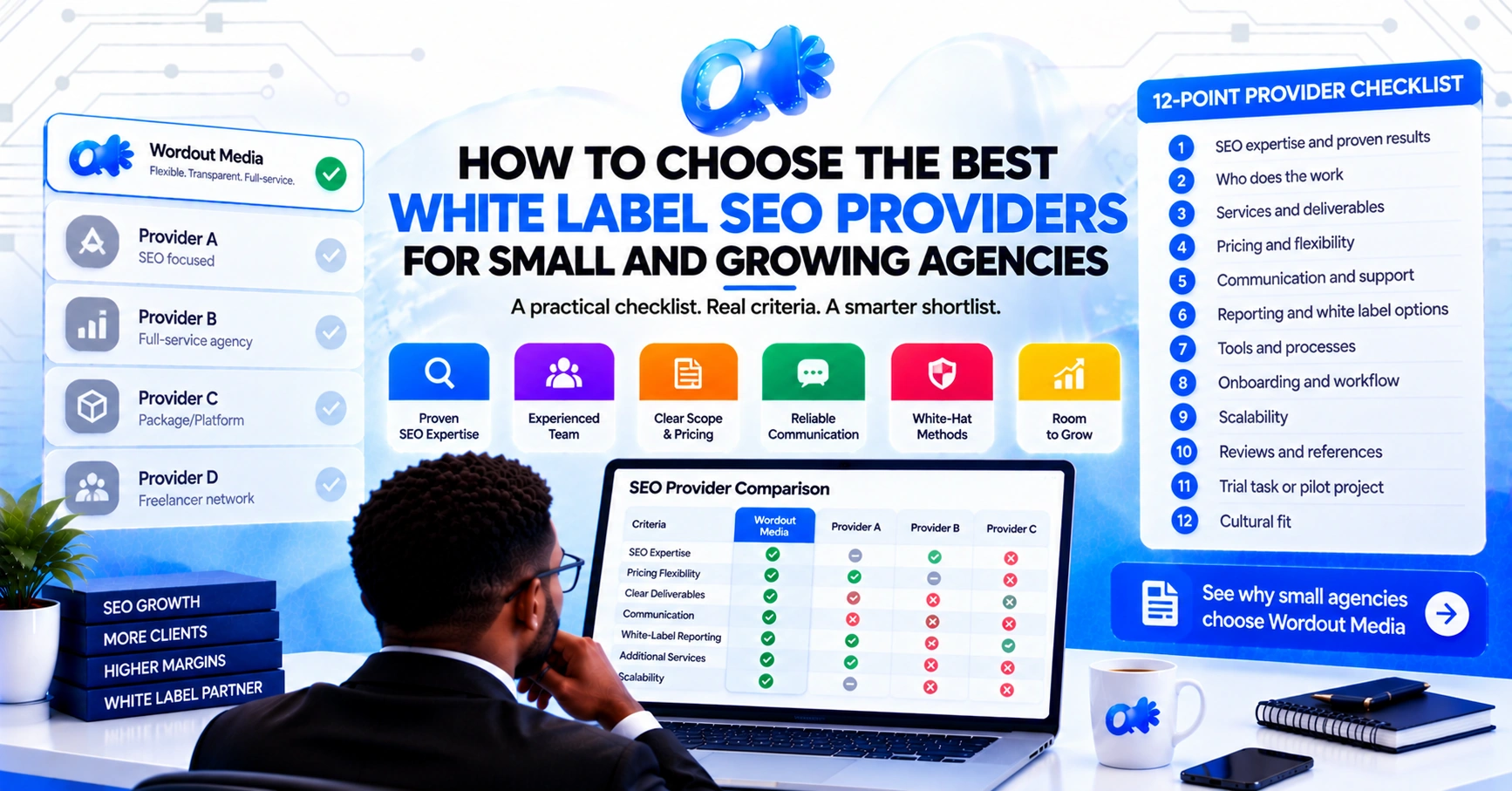
If you’re still defining the basics, start with What Does “White Label SEO” Actually Mean? For a shorter, provider-type view, see Best White Label SEO Providers for Small and Growing Agencies.
Before You Compare Providers: Define What You Need
Most bad partnerships start with an unclear need. Before you speak to anyone, write down:
- The type of clients you serve. Local businesses, e-commerce stores, professional services, B2B.
- The SEO work you need. Audits, on-page, content, links, local SEO, reporting.
- Your volume. Number of clients now and in six months.
- How much you can review. Hours per week you can spend checking work.
- Your margin target. What you need to charge your clients and keep.
- Your non-negotiables. For example: no paid-link schemes, EST overlap, in-house team only.
With that on paper, you can judge providers against your needs instead of against their sales pitch.
The 25-Point Checklist
Score each item 0 (unacceptable), 1 (partly), or 2 (clearly yes). Total possible: 50.
Section A: The People (Items 1 to 4)
1. The work is done by an in-house team. Ask: “Are the people doing my work your employees? Do you ever pass work to freelancers or another agency?” Look for a direct, specific answer. Subcontractor chains mean you’re several steps removed from whoever touches your client’s site. At Wordout Media, our team of fifteen is in-house, with no subcontractor chains.
2. You’ll have a single dedicated contact. Ask: “Who will I talk to day to day?” One account manager who learns your standards beats a rotating support queue.
3. The team has relevant experience. Ask: “What kinds of sites have you worked on? Can you describe a recent project?” Look for specifics, not general claims.
4. There’s continuity if someone is unavailable. Ask: “What happens if my contact leaves or is on holiday?” A real answer shows the provider has a process, not just a person.
Section B: The Methods (Items 5 to 9)
5. They explain their approach in plain language. If a provider can’t explain what they do and why, you won’t be able to explain it to your client. Be wary of “proprietary secret process” answers.
6. Keyword research is tied to your client’s business goals. Ask: “How do you decide which keywords to target?” Look for answers about search intent, relevance and conversion, not only search volume.
7. They have a clear technical SEO process. Ask: “What do you check in a technical audit, and how do you prioritize fixes?” Good answers cover crawlability, indexing, site structure, speed and prioritization by impact.
8. Their approach to links is clean. This is the highest-risk item on the list. Google’s published spam policies define link spam as “creating links to or from a site primarily for the purpose of manipulating search rankings,” and give examples such as buying or selling links for ranking purposes and excessive link exchanges. Ask: “What’s your link building approach, and what do you refuse to do?” Walk away from anyone who sells bulk link packages as the core strategy or can’t explain where links come from.
9. Content is created for users, not just for search engines. The same policies warn against scaled content abuse, meaning many pages generated primarily to manipulate rankings, including through generative AI without adding value for users. Ask: “How do you ensure content is useful and accurate?” Look for human review and subject-matter care.
Section C: The Deliverables (Items 10 to 13)
10. The service scope matches your needs. A solid white label SEO service typically covers keyword research and topic mapping, on-page optimization, technical audits, blog content optimization, internal linking and Google Business Profile optimization. If a provider skips one you need, ask why. Our own White Label SEO + GBP service covers all six.
11. Local SEO is handled properly. If you serve local businesses, ask how they set up and optimize Google Business Profile. Google’s own Business Profile help center is the authoritative source on how profiles work, and a good provider should be comfortable referencing it and its guidelines.
12. Deliverables are specific and checkable. “We’ll improve your SEO” isn’t a deliverable. “A technical audit report with prioritized fixes” or “on-page optimization for 15 priority pages” is.
13. Changes are applied safely. Ask: “Do you edit the live site? How do you test changes? Can you work on a staging copy?” A careless edit can break a client’s site. Look for caution and process.
Section D: Reporting and Communication (Items 14 to 17)
14. Reports are fully white labeled. Logos, file names, links, email addresses and file metadata should show only your brand. Ask for a sample.
15. Reports explain, not just display. A dashboard full of graphs isn’t a report. Look for plain-language summaries of what was done, why and what comes next.
16. Response times are fast and predictable. Pay attention to how quickly the provider replies to your first questions. It’s a preview of future communication.
17. Time zones overlap with yours. A partner who is asleep while your client is awake creates delays. We work EST hours, serving agencies in the US, Canada and Europe, so a brief sent in your morning is usually moving before lunch.
Section E: Commercial Terms (Items 18 to 21)
18. Pricing is clear and complete. Ask for the full cost, including setup fees, minimums, reporting charges and add-ons. Hidden fees turn cheap quotes into expensive ones. We cover how to compare in White Label SEO Pricing in 2026: What Agencies Actually Pay.
19. There’s no long lock-in before you’ve seen the work. Good providers earn your business over time. Be cautious about 6-to-12-month contracts presented before any test.
20. You can scale up and down. Client work is uneven. Ask how the provider handles busy months and quiet ones. With our model, hours don’t expire: if you buy 40 and use 25, the other 15 wait for you.
21. The terms about exit and ownership are fair. Ask: “If I leave, who owns the work and the access? What do I get back?” You should keep everything produced for your clients.
Section F: Risk and Protection (Items 22 and 23)
22. Confidentiality and access are handled responsibly. You’re sharing client logins and data. Ask about NDAs, how access is granted and revoked and who can see what.
23. They are honest about results. No honest provider guarantees rankings. Ask: “How do you set expectations about timelines?” SEO generally takes months to show clear movement, and a good partner will say so.
Section G: Proof (Items 24 and 25)
24. You can test on real work first. A trial or sample project tells you more than any sales call. We offer an 8-hour free trial with no contract, no card and no sales call required first.
25. The partner is willing to be compared. A confident provider doesn’t mind if you test others at the same time. Be wary of pressure to decide quickly.
How to Score the Checklist
| Total score (out of 50) | What it means |
|---|---|
| 42 to 50 | Strong candidate. Run a trial and proceed carefully. |
| 34 to 41 | Promising. Clarify the weak items before committing. |
| 26 to 33 | Risky. Only proceed if the gaps are fixable and the price reflects them. |
| Below 26 | Keep looking. |
Treat three items as automatic dealbreakers regardless of total score: item 8 (link practices), item 1 (undisclosed subcontracting) and item 23 (guaranteed rankings). A provider scoring 0 on any of these has told you something important.
A Weighted Version for Different Agencies
Not every item matters equally to every agency. Adjust the weight (multiply by 1.5) for the items most relevant to you.
- Local-focused agencies: items 11, 14 and 17.
- E-commerce-focused agencies: items 7, 9 and 13.
- Agencies with little review time: items 12, 15 and 16.
- Agencies with uneven demand: items 18, 19 and 20.
The Questions to Take Into Every Sales Call
You can use this as a script.
People
- Who does the work, and are they employees?
- Who will be my contact?
Methods
- How do you choose keywords?
- What’s your approach to links, and what don’t you do?
- How do you ensure content quality?
Deliverables
- What exactly will I receive each month?
- Can I see a sample audit and report?
- How do you apply changes to a live site?
Terms
- What’s the full cost, including any extras?
- Is there a contract or minimum?
- What happens if I leave?
Risk
- How do you handle access and confidentiality?
- How do you set expectations about results?
Proof
- Can I run a trial?
Write down the answers. Compare the transcripts across providers, not your impressions.
Red Flags: When to Walk Away
- “Guaranteed page one.” Nobody controls Google.
- Vague descriptions of methods. If they can’t explain it, they probably shouldn’t be doing it.
- Bulk link packages as the main strategy. This is where penalties and reputational damage come from.
- Dozens of pages produced for “scale.” Volume without value is exactly what search engines target.
- No samples, no trial. Confidence in quality usually permits a test.
- Pressure tactics. “Offer ends today” is not how good partners behave.
- Reports that don’t explain anything. Impressions and charts without interpretation.
- Reluctance to say who does the work. A direct question deserves a direct answer.
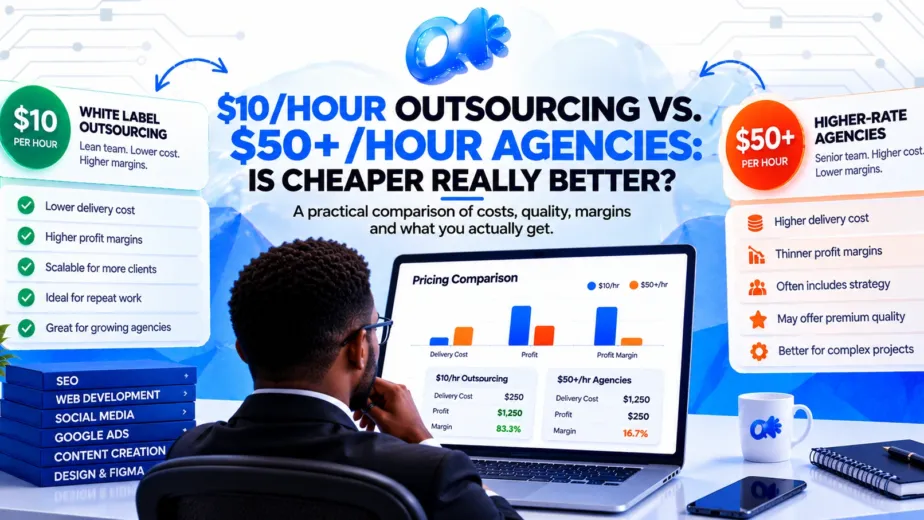
- Unusually low prices with no explanation. Low prices can be legitimate, but they need a reason, such as a lean team and low overhead, not a mystery.
How to Run a Fair Trial
Reading about a partner is useful. Testing one is decisive.
Step 1: Choose a real task. A technical SEO audit is ideal. It’s well defined, reveals how the provider thinks and is easy to compare across candidates.
Step 2: Write a proper brief. Include the site URL, goals, competitors, target locations and any known issues. If you send different briefs to different providers, the comparison is meaningless.
Step 3: Measure what matters.
- Quality: Are the findings real and the priorities sensible?
- Accuracy: Does it match the brief?
- Specificity: Are recommendations actionable, or general?
- Speed: Was it delivered when promised?
- Communication: Were questions asked early and answered clearly?
- Your time: How many hours did you spend managing it?
Step 4: Test the presentability. Could you explain this report to your client without embarrassment? If it needs heavy rewriting, add that time to the cost.
Step 5: Check the revision process. Give specific feedback and see how it’s handled.
Step 6: Compare total cost. Include your own hours. Our guide How to Use an Agency Profit Margin Calculator the Right Way shows how.
What You Can Verify Yourself
You don’t need to take a provider’s word for everything. Even without deep SEO knowledge, you can check:
- Whether recommendations match established guidance. Google publishes an SEO Starter Guide that covers fundamentals such as helping search engines find and understand pages, writing helpful titles and descriptions and creating useful content. If a partner’s advice contradicts the basics, ask why.
- Whether suggested links look natural. Ask for examples of where links will come from. If they look like directories of no relevance, be cautious.
- Whether the site works after changes. Check key pages, forms and mobile layouts yourself after any significant edit.
- Whether reporting matches reality. Cross-check key figures in the client’s own analytics or Search Console.
How Wordout Media Answers Its Own Checklist
In the spirit of fairness, here’s how we measure against it.
| Area | Our answer |
|---|---|
| People | Fifteen people, all in-house, no subcontractor chains; one dedicated account manager |
| Methods | Plain-language explanations; no guaranteed rankings |
| Deliverables | Keyword research, on-page optimization, technical audits, blog content optimization, internal linking, Google Business Profile optimization |
| Reporting | Everything under your branding; shared task tracker shows what each hour produced |
| Time zone | EST hours; US, Canada and Europe |
| Commercial | $10 an hour in blocks of 20, 40 or 80 hours ($200, $400, $800); same rate on every block; hours don’t expire |
| Proof | 8-hour free trial, no contract, no card, no sales call required first |
Where we might not be the best fit
- If you need one narrow, highly advanced specialism, such as enterprise-scale technical SEO, a specialist may suit you better.
- If you want a fixed, done-for-you package with minimal briefing, an hour-block model asks more of you.
- If your clients require in-country or employee-only delivery, an outsourced model may not satisfy the contract.
- If you need very large, round-the-clock capacity, a bigger provider may be the better match.
We’d rather you choose well than choose us by default.
Common Mistakes When Choosing a White Label SEO Partner
Choosing on price alone. Cheap partners who need constant correction can cost more than expensive ones who don’t.
Skipping the trial. Sales pages and real work are different things.
Ignoring link practices. This is where the biggest damage hides.
Starting with your hardest client. Build trust on a lower-stakes account first.
Not checking who does the work. Hidden subcontracting is a major risk.
Failing to brief properly. A vague brief tests your writing, not their skill.
Not planning for reporting. If you can’t explain results, retainers get cancelled.
Forgetting your own time. Review hours are part of the cost.
Treating the choice as permanent. Review the relationship regularly and be willing to change.
After You Choose: Making the Partnership Work
Selecting a partner is the beginning, not the end.
- Start small. One client or one task, then expand.
- Write clear briefs. Goals, competitors, access and constraints.
- Review before changes go live. Your name is on the result.
- Give specific feedback. “Shorten the title tags to under 60 characters” beats “this feels off.”
- Hold a monthly check-in. What worked, what didn’t, what’s next.
- Document everything. Keep records of access, changes and decisions.
- Share context. The more your partner knows about the client, the better the work.
For the full workflow, see How Does White Label Marketing Work, Step by Step?
Frequently Asked Questions
How do I choose a white label SEO partner?
Define your needs, then assess candidates on people, methods, deliverables, reporting, commercial terms, risk and proof. Ask direct questions, score the answers and run the same trial task with each shortlisted provider.
What’s the biggest risk when hiring a white label SEO provider?
Questionable link practices and undisclosed subcontracting. Manipulative links can harm a client’s site, and hidden subcontractors reduce accountability.
Should I ask for a trial?
Yes. A real task shows quality, speed and communication far better than a sales call. Our 8-hour free trial has no contract, no card and no sales call required first.
How much should white label SEO cost?
It varies widely by model and scope. Our rate is $10 an hour in blocks of 20, 40 or 80 hours. Compare total cost including your own review time, not only the headline rate.
Can a white label SEO partner guarantee rankings?
No honest provider can. Treat guarantees as a red flag.
What should reports include?
Plain-language summaries of what was done, why it matters, what changed and what comes next, all under your branding.
Do I need to know SEO to evaluate a partner?
You don’t need to be an expert, but you should understand the basics well enough to brief, review and explain the work. Google’s SEO Starter Guide is a good foundation.
Is it better to use one partner or several?
One full-service partner is simpler to manage. Several specialists may offer deeper expertise at a higher coordination cost.
Knowing how to choose a white label SEO partner comes down to asking better questions than the sales page invites. Who actually does the work? How do they build links? What exactly will I receive? Can I explain it to my client? What happens if it goes wrong? And will they let me test them first?
Use the 25-point checklist, treat the three dealbreakers as non-negotiable and run the same real task through every serious candidate. The evidence will be clearer than any review site.
See Why Agencies Choose Wordout Media
Want to measure us against the checklist?
See why agencies choose Wordout Media and read how our in-house team works. Then explore our White Label SEO + GBP service, and when you’re ready, claim your 8-hour free trial. Send us a technical SEO audit or another real task and judge the work for yourself. You can also read our FAQs or browse all our services.