

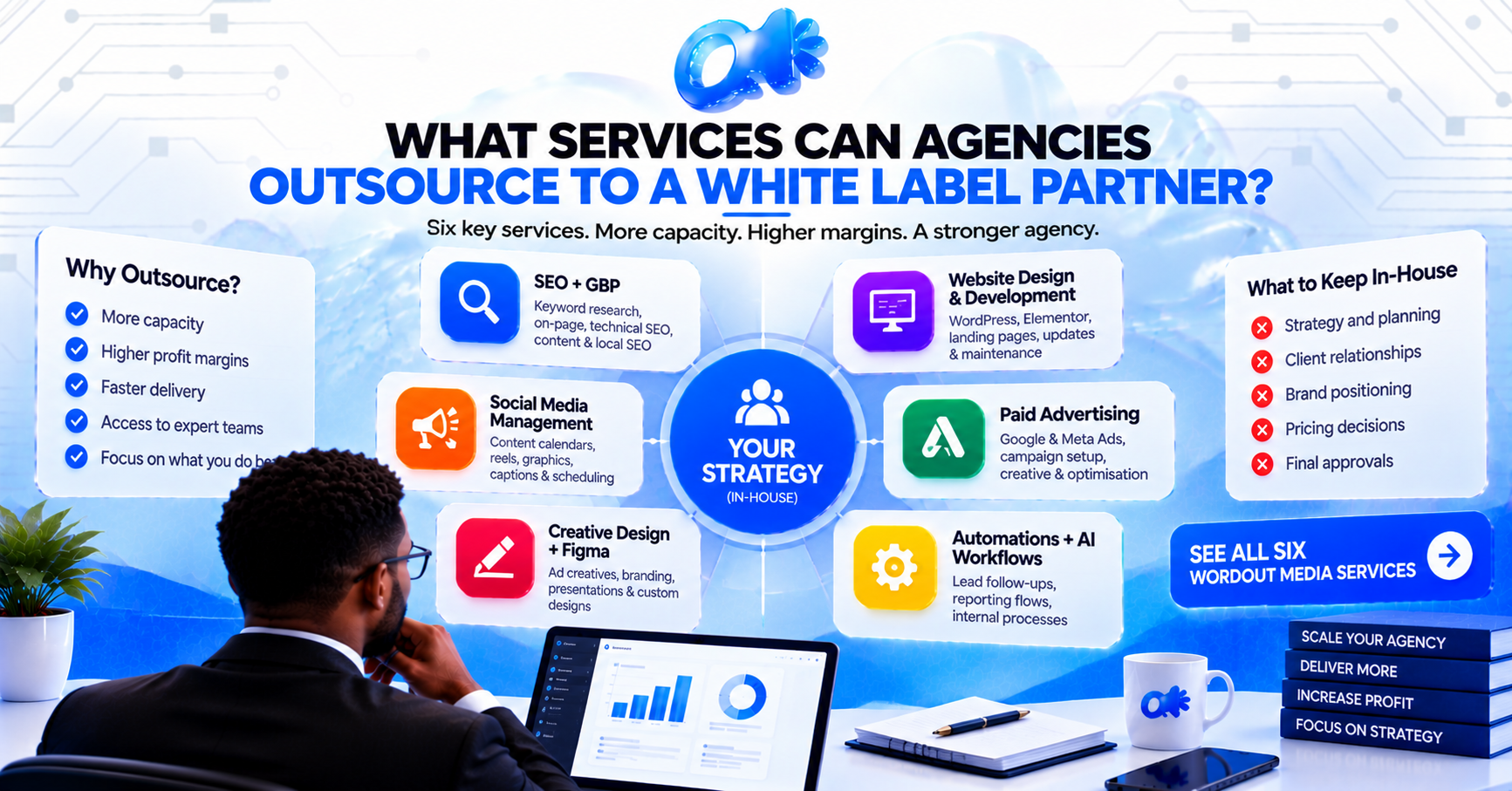
Almost any production task in a marketing agency can be outsourced. The harder question is which ones you should, and in what order.
Hand off too little, and you stay buried in work that doesn’t need you. Hand off the wrong things, such as strategy or client relationships, and you hollow out what clients pay you for. Hand off everything at once, and you’ll find out the hard way that a partner can’t read your mind.
This guide maps the services agencies can outsource to a white label partner, explains what each one typically includes, shows what to keep in-house and gives you a simple way to decide where to start. We’re Wordout Media, and we cover six services ourselves, so we’ll use them as the working map. If you’re new to the model, read What Is a White Label Digital Marketing Agency? first.
A Simple Rule for What to Outsource
Before we go service by service, here’s the rule of thumb we give agencies.
Outsource execution. Keep judgment.
Execution is the repeatable production work: building, designing, setting up, optimizing, formatting and reporting. Judgment is deciding what should be built, who it’s for, what success looks like and how to talk to the client about it.
Tasks are good candidates for outsourcing when they are:
- Repeatable. The same type of work recurs.
- Definable. You can describe what “done” looks like.
- Time-consuming. They drain hours from your calendar.
- Not the thing clients hire you for specifically.
Tasks are poor candidates when they’re strategic, relationship-driven or central to your agency’s identity.
The Six Services Agencies Can Outsource
1. SEO and Google Business Profile
SEO is one of the most commonly outsourced services because it’s repeatable, time-consuming and easy to define. Typical tasks include:
- Keyword research and topic mapping
- On-page optimization (titles, meta descriptions, headers, content)
- Technical SEO audits
- Blog content optimization
- Internal linking strategy
- Google Business Profile setup and optimization for local clients
Keep in-house: Client strategy, goal-setting and the conversation about what results to expect.
Good first task: A technical SEO audit. It’s well defined and easy to review.
See our White Label SEO + GBP service, and What Does “White Label SEO” Actually Mean? for the full explanation.
2. Website Design and Development
Web projects are a natural fit for outsourcing because they have a clear start and finish. Typical tasks include:
- Business websites
- Landing pages
- WordPress and Elementor builds
- Updates and fixes to existing sites
- Site maintenance tasks
Keep in-house: Site strategy, messaging, positioning and the decisions about what the site must achieve. If you’re thinking about how AI is changing website production, the strategy-versus-execution split matters even more.
Good first task: A single landing page.
See Website Design & Development.
3. Social Media Management
Social is high-volume, deadline-driven work that overwhelms small in-house teams quickly. Typical tasks include:
- Content calendars
- Reels and short video
- Carousels
- Graphics
- Captions and scheduling
Keep in-house: Brand voice decisions, content strategy and client approvals.
Good first task: A month of graphics and captions for one client.
4. Paid Advertising on Google and Meta
Paid media involves a lot of setup, creative variation and ongoing optimization. Typical tasks include:
- Campaign structure and setup
- Ad copy
- Audience building
- Creative production
- Optimization and reporting
Keep in-house: Budget decisions, goals, target return and the client conversation about spend.
Good first task: A single campaign build.
See Paid Advertising – Google & Meta.
5. Creative Design and Figma Work
Design is a constant flow of small tasks, which makes it ideal for a partner. Typical tasks include:
- Brand graphics
- Ad creative
- Mockups and interface design in Figma
- Presentations
- Marketing collateral
Keep in-house: Creative direction and brand guardianship.
Good first task: A set of ad creatives or a mockup.
6. Automations and AI Workflows
This is a newer service line for many agencies, and one where fresh retainer revenue is appearing. Typical tasks include:
- Lead follow-up sequences
- Reporting automations
- CRM workflows
- Internal process automation
- Workflows built with tools such as n8n and GoHighLevel
Keep in-house: Understanding the client’s process and deciding what should be automated.
Good first task: A single, well-defined workflow, such as automated lead follow-up.
See Automations + AI Workflows.
What Else Can Agencies Outsource?
Beyond the six core services, agencies often hand off supporting work, too. Depending on the partner, that can include:
- Reporting. Monthly client reports compiled and branded as yours.
- Video editing. Cutting, captioning and formatting short-form video.
- Content production. Blog posts, landing page copy and email sequences.
- Technical maintenance. Plugin updates, backups and fixes.
- Administrative production tasks. Formatting, asset preparation and uploads.
Whether a partner offers these varies, so ask before you assume.
What You Should Keep In-House
Some work shouldn’t leave your agency, whatever the cost savings.
Client relationships
The person who sold the work should stay the voice the client trusts. Clients pay for your attention and accountability.
Strategy and positioning
Deciding what to do and why is what clients hire you for. A partner can inform it. You should own it.
Pricing and commercial decisions
Setting prices, scoping work and negotiating contracts are your business decisions.
Quality control
The final review before anything reaches a client. This is the safeguard that protects your name.
Account management
Day-to-day client communication, expectation management and escalation.
Creative direction
If your agency’s identity depends on a distinctive style, keep the guardianship of it.
A fair summary: outsource the building, keep the thinking.
A Decision Matrix: Should You Outsource This Task?
Score a task from 1 to 5 on each question. A higher total suggests a stronger candidate.
| Question | 1 (No) to 5 (Yes) |
|---|---|
| Does this task repeat every month? | |
| Can I describe “done” clearly? | |
| Does it take more than a few hours each time? | |
| Is it executional rather than strategic? | |
| Could someone else do it to my standard with a good brief? | |
| Would freeing this time let me do paid or higher-value work? |
25 to 30: Strong candidate. Outsource it. 18 to 24: Good candidate. Try a trial first. Under 18: Probably keep it in-house, or fix the process first.
How to Decide Where to Start
You don’t need to outsource everything at once. Pick one starting point using these questions.
1. What’s causing the most pain right now? The service that’s missing deadlines or burning out your team is usually the best place to begin.
2. Where are your margins thinnest? If one service eats hours at a low price, outsourcing it may improve margins the most. Run the numbers with our Agency Profit Margin Calculator and How to Use an Agency Profit Margin Calculator the Right Way.
3. What can you define most clearly? Clear tasks produce clear results.
4. What has the lowest risk? Start with a lower-stakes client or task.
5. What would you sell more of if you had the capacity? Outsource the service that’s limiting your growth.
A Sample Rollout Plan
Here’s a realistic way to phase it in.
Month 1: One task, one trial. Choose one repeatable task. Send it as a trial. We offer an 8-hour free trial with no contract and no card. Judge quality, speed, communication and your own time.
Month 2: One client. Move one live client’s task across. Keep reviewing everything.
Month 3: Add a second service. If the first went well, add another, such as social if you started with web.
Month 4 onward: Expand gradually. Add clients and services as trust builds, and document what works.
The idea is to build confidence with evidence rather than faith. For a deeper walkthrough of the workflow, see How Does White Label Marketing Work, Step by Step?.
What It Costs to Outsource Different Services
Pricing structures vary, but with hour blocks the arithmetic is simple. Our rate is $10 an hour, in blocks of 20 hours for $200, 40 for $400 and 80 for $800. Hours work across services, so you can spend them on SEO one month and a website build the next. They don’t expire. If you buy 40 and use 25, the other 15 wait for you.
For illustration only, here’s how a month might look for a small agency with several clients:
| Task | Estimated hours | Cost at $10/hr |
|---|---|---|
| Technical SEO audit | 10 | $100 |
| Monthly on-page SEO for two clients | 20 | $200 |
| Landing page build | 12 | $120 |
| Social graphics for one client | 15 | $150 |
| Google Ads setup | 8 | $80 |
| Total | 65 | $650 |
Those hours are examples, not quotes. Real timelines depend on scope. Most agencies bill outsourced work at two to three times the cost, which is where the margin comes from. We compare cheaper and more expensive providers in $10/Hour Outsourcing vs. $50+/Hour Agencies.
Three Scenarios: What Different Agencies Outsource First
Abstract advice only goes so far, so here are three typical agency profiles and what they tend to hand off first.
The web design studio
A three-person studio builds good websites but keeps losing clients after launch. They’d like to add monthly SEO and social, but nobody on the team has the skills or the time.
What they outsource first: SEO audits and on-page optimization, so they can sell an “after launch” retainer to every new site.
What they keep: Design direction, client relationships and the sales conversation.
Result: A recurring revenue line with no new hires.
The social-first agency
A small agency runs content for local restaurants and gyms. Clients keep asking about Google Business Profile, ads and websites.
What they outsource first: Graphics and short-form video editing to free up the content lead, then Google Business Profile optimization.
What they keep: Content strategy, brand voice and client approvals.
Result: Faster turnaround on content and a path to cross-sell local SEO.
The freelancer becoming an agency
A freelance strategist is fully booked and turning clients away. She’s good at the thinking but spends half her week building pages and setting up campaigns.
What she outsources first: Landing page builds and ad setup.
What she keeps: Strategy, client calls and review of every deliverable.
Result: More clients served without hiring staff, and her time shifts toward sales and strategy.
Notice the pattern in all three: the first outsourced service is the one that’s repeatable, well defined and easy to review. The strategic and relationship work stays put.
Common Mistakes When Deciding What to Outsource
Outsourcing strategy too early. A partner can’t replace your understanding of the client.
Starting with your hardest client. Build trust on something lower-stakes first.
Handing over vague tasks. “Handle their marketing” isn’t a brief.
Skipping the review. Your name is on the work.
Outsourcing everything at once. You can’t learn how a partner works across six services in a week.
Ignoring your own capacity to manage. Outsourcing swaps production time for briefing and review time. Plan for it.
Choosing a partner by price alone. Look at who does the work, turnaround, communication and the ability to test.
Questions to Ask a Partner About Scope
Before you commit to outsourcing a service, ask:
- Which of my services do you cover, and which don’t you?
- Who does the work: in-house staff or subcontractors?
- How do I brief you, and what do you need from me?
- How long do typical tasks take?
- What’s included in a revision?
- Can I try a small piece first?
- How will I see what each hour was spent on?
- What happens if the person assigned to my work is unavailable?
At Wordout Media: we’re a fifteen-person in-house team with no subcontractor chains, you get one dedicated account manager, most design, ad setup and video editing tasks come back same day to 48 hours, and a shared task tracker shows what each hour produced.
Frequently Asked Questions
What services can agencies outsource?
Commonly SEO and Google Business Profile work, website design and development, social media management, paid advertising, creative design and automation or AI workflows. Reporting, video editing and content production are also frequently outsourced.
What should an agency never outsource?
Client relationships, strategy, pricing decisions and final quality control should stay with you. Those are what clients pay you for.
Which service is easiest to outsource first?
Whatever is most repeatable and clearly defined. A technical SEO audit, a landing page or a batch of social graphics are all common first tasks.
Can I outsource just one service?
Yes. Most agencies start with one and add more as trust builds.
Will clients know I outsource?
Not if it’s done properly. Deliverables and reports carry only your branding.
How much does it cost to outsource?
With us, $10 an hour in blocks of 20, 40 or 80 hours ($200, $400, $800). Hours don’t expire and can be spent across services.
How do I test a partner before committing?
Use a trial. Ours is 8 hours free, with no contract, no card and no sales call required first.
Do I need to know how to do the work myself?
You don’t need to be an expert, but you should know enough to brief it and review it properly.
The services agencies can outsource cover most of the production work in modern marketing: SEO, web, social, ads, design and automation. What shouldn’t be outsourced is the part clients actually value you for: strategy, relationships, pricing and the final say on quality.
Start small, choose a repeatable task and test before you commit. When production is handled well by a reliable partner, you get your time back for the work only you can do.
See All Six Wordout Media Services
Wondering which service to hand off first? See all six Wordout Media services: White Label SEO + GBP, Website Design & Development, Social Media Management, Paid Advertising on Google and Meta, Creative Design + Figma, and Automations + AI Workflows.
When you’re ready to test one on real work, claim your 8-hour free trial. You can also read our FAQs.
