There’s a pattern many agency owners will recognise. You land a couple of new clients. The team is stretched, so you hire someone. Things settle down for a few months. Then you land more clients, the new hire is full, and you hire again. Each hire feels like progress, and each one raises the monthly baseline you now have to cover, whether the pipeline is full or not.
Then a big client leaves. Or two small ones. Revenue dips, payroll doesn’t, and the thing you built to grow the agency is now the thing keeping you awake.
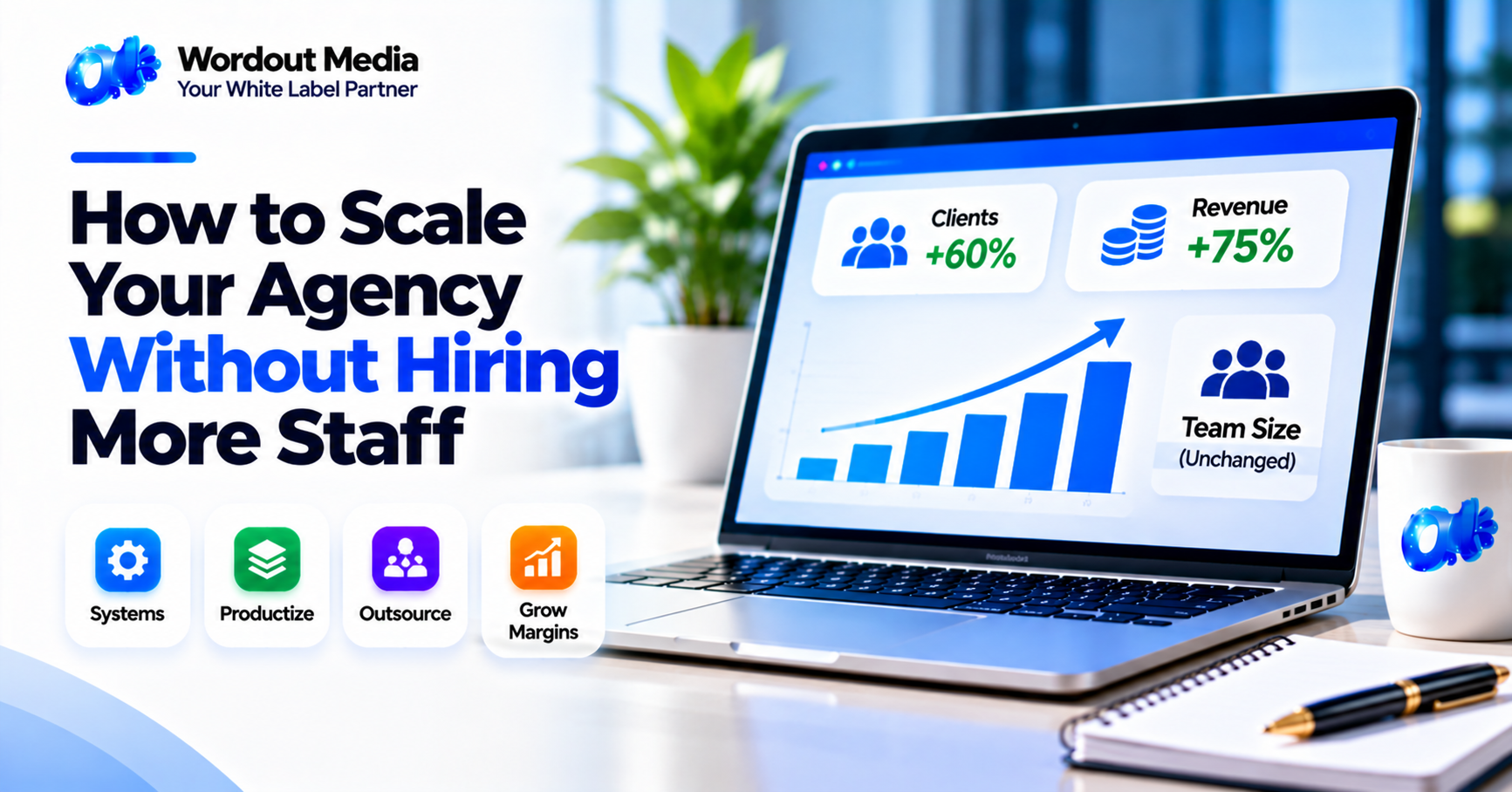
That’s not an argument against ever hiring. Great teams are built by great hires. But it’s worth asking whether hiring is the only way to grow, because for many agencies it isn’t, and for some, it isn’t even the best one. This guide explains how to scale an agency without hiring more staff: how to find out where your capacity really goes, the levers you can pull, how to protect margin as you grow, a 90-day plan and the honest limits of the whole idea.
First, What “Scaling” Actually Means
Scaling isn’t just getting bigger. A bigger agency with the same margins and twice the stress is growing, not scaling.
Scaling means revenue grows faster than cost and effort. Each new client adds more profit than the work it requires. If you’re doubling your clients and your headcount and your workload, you’ve grown, but you haven’t scaled.
That definition is useful because it shifts the question from “how do I get more people?” to “how do I get more output without a proportional increase in cost?” Hiring is one answer. There are others.
If you want to know how to scale agency without hiring in practice, the short version is: measure first, fix leaks, document, then add flexible capacity only where the numbers justify it.
Step Zero: Find Out Where Your Capacity Actually Goes
Before changing anything, look honestly at your current capacity. Most agencies are surprised by what they find.
Spend two weeks tracking how your team’s time is actually spent, in rough categories:
- Billable delivery. Work you charge clients for.
- Rework. Fixing things that should have been right the first time.
- Client communication. Emails, calls, approvals.
- Admin and internal meetings.
- Sales and proposals.
- Waiting. For client assets, feedback or access.
Then ask two questions:
- What percentage of paid hours is actually billable? Many agencies find it’s well under what they assumed.
- What work is repeatable and doesn’t need a senior person? That’s the best candidate for systems or outsourcing.
This is the same trap we describe in Why Being Constantly Busy Is Killing Your Agency’s Profit: busyness isn’t profit, and capacity is often lost in places nobody is measuring.
The Six Levers for Scaling Without Hiring
Lever 1: Fix the leaks
Before adding capacity, recover what you’re losing.
- Tighten scope. Write deliverables clearly and cap revisions. Scope creep quietly consumes capacity.
- Standardize onboarding. A consistent checklist for new clients cuts back-and-forth.
- Require assets early. Delays waiting for content are dead time.
- Reduce meetings. Replace status calls with a shared tracker.
- Review pricing. If you’ve never raised prices, your best clients may be underpaying for the effort.
Recovering even 10% of lost time is the equivalent of getting a tenth of a hire for free.
Lever 2: Build systems that don’t depend on memory
Documented processes mean any capable person can do a task the same way.
- Templates for reports, proposals, briefs and audits.
- Checklists for recurring work such as launching a site or setting up a campaign.
- A standard operating procedure for each repeatable service.
- A shared project tracker so nobody asks “where are we on that?”
We explore this idea in Stop Doing More: Why Smart Agencies Build Systems Instead. Systems also make outsourcing far easier, because a clear process is half of a good brief.
Lever 3: Productize your services
Instead of selling open-ended custom work, package your most common services with a clear scope, deliverables and price. For example, “Local SEO Starter: one audit, monthly on-page updates and Google Business Profile management for one location.”
Productizing helps because:
- Work becomes predictable, so hours are easier to estimate.
- Sales are quicker, because clients understand what they’re buying.
- Delivery is more repeatable, which suits both systems and outsourcing.
- You can price for margin rather than guessing.
Lever 4: Automate the repetitive parts
Many agency tasks follow predictable patterns: reporting, lead follow-up, onboarding emails, social scheduling, data pulls. Automation tools can handle a surprising amount of this. We build workflows in tools such as n8n and GoHighLevel as part of Automations + AI Workflows.
Automation isn’t magic. It’s best applied to tasks that are boring, frequent and rule-based, and it still needs a human to check the results. But removing even a few recurring chores gives time back every week.
Lever 5: Outsource delivery, not judgment
This is the lever most relevant to us, so let’s be direct about what it is and isn’t.
Outsourcing means handing defined production work to a partner while you keep the client relationship, strategy, pricing and final quality control. The business logic is old and well documented. According to the overview of outsourcing, the standard reasons companies outsource include cost savings, focusing on core strengths, access to specialist skills, speed, flexibility and converting fixed costs into variable ones.
For an agency, that translates to:
- More capacity without payroll. You can say yes to a new client in a busy month.
- A wider menu. You can offer services you don’t have staff for.
- Flexible cost. You buy hours when demand is high and fewer when it’s quiet.
- Time back for sales and strategy.
We cover the motivations in more detail in Why Do Agencies Outsource SEO, PPC and Web Design?
Lever 6: Raise the value of what you sell
Sometimes the answer to “how do I scale?” is “sell fewer things for more.” If a client pays $800 a month for 20 hours of work, you’re capped by hours. If you sell the outcome, such as a specific result or a premium package, you can often price above your time. This isn’t about overcharging. It’s about making sure you’re paid for expertise and responsibility, not only effort.
Why This Approach Works for Small Agencies in Particular
Small agencies feel the pain of fixed costs more sharply than large ones, because one lost client is a bigger share of revenue. That’s why how to scale agency without hiring is such a common question among teams of two to fifteen people. The same levers apply at any size, but the flexibility matters most when your cushion is thin.
The Margin Math of Scaling With Outsourced Hours
Let’s put numbers on it. These figures are illustrative, so replace them with your own.
You run a small agency with two employees handling delivery. Each costs about $44 per productive hour (a fully loaded figure you’d calculate yourself). You charge a client $1,200 a month for a retainer that takes 25 hours to deliver.
Delivered in-house:
- Delivery: 25 × $44 = $1,100
- Your review time: 3 hours × $40 = $120
- Total cost: $1,220
- Profit: −$20
Delivered through outsourced hours at $10 an hour:
- Delivery: 25 × $10 = $250
- Your review time: $120
- Total cost: $370
- Profit: $830, a margin of about 69%
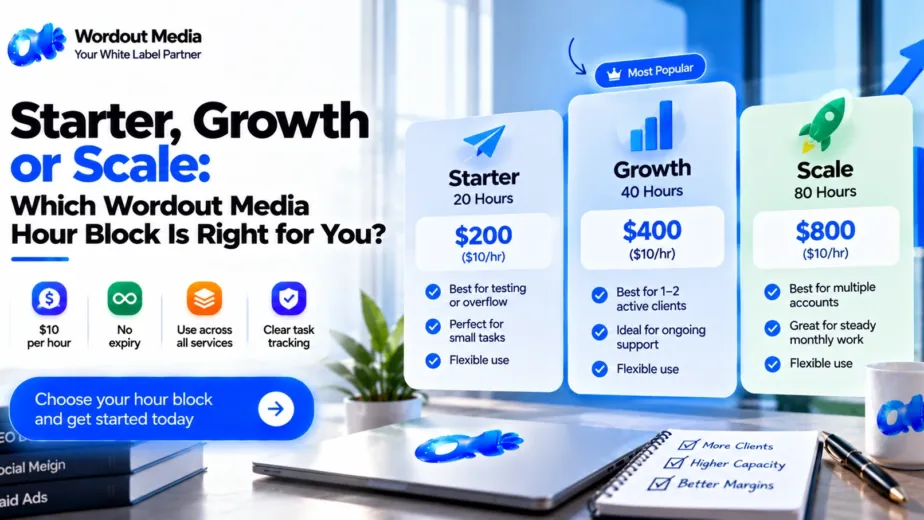
Scale that up. Five clients on the same retainer would need 125 hours a month. Hiring for that is a serious commitment. Buying it as outsourced hours means, for instance, Scale (80 hours, $800) plus a Growth block (40 hours, $400) and a few extra hours, which flexes up and down as clients come and go.
For context on what employees really cost, the U.S. Bureau of Labor Statistics’ Employer Costs for Employee Compensation release for June 2026 reports that total employer compensation for private industry workers averaged $46.89 per hour worked, with benefits making up 30.0% of that. That’s an all-industry average, not an agency figure, but it shows why true employee cost sits well above wages. Our guide to calculating profit margin shows how to work out your own, and the Agency calculator does it for you.
One caution: Savings only become profit if you use them well. Cheaper delivery that you don’t bill for isn’t margin. And outsourcing doesn’t remove review time, which you should always count.
What to Keep In-House
Smart agencies are deliberate about what they don’t hand off.
- The client relationship. You’re the voice clients trust.
- Strategy and positioning.
- Pricing and commercial decisions.
- Final quality control.
- Creative direction, if it’s central to your identity.
A useful rule: outsource execution, keep judgment. For ideas on what to delegate, see What Services Can Agencies Outsource to a White Label Partner?
A 90-Day Plan to Scale Without Hiring
Here’s a practical sequence. Adjust it to your situation.
Days 1 to 14: Measure
- Track time for two weeks.
- Calculate your real cost per productive hour.
- List your services and mark which are repeatable.
- Note where rework and delays happen.
Days 15 to 30: Fix and document
- Tighten scope and revision limits in your agreements.
- Write checklists and templates for your top two services.
- Set up a shared tracker if you don’t have one.
- Identify one task that’s repeatable, time-consuming and not your core craft.
Days 31 to 45: Test outsourcing
- Write a proper brief for that task.
- Use a free trial or the smallest paid block. Our trial is 8 hours free, with no contract, no card and no sales call required first.
- Review the output honestly: quality, speed, communication and the time you spent managing it.
Days 46 to 60: Move a live task
- Move one real client task across, keeping your usual review.
- Track hours and compare cost and margin with doing it in-house.
- Refine your brief based on what you learned.
Days 61 to 90: Expand carefully
- Add a second service or a second client.
- Consider productizing your most common offer.
- Estimate your monthly hours using the method in Starter, Growth or Scale and choose a block.
- Decide what you’ll do with the freed-up time. Selling? Strategy? Rest?
That last point matters. Time you save is only valuable if you invest it deliberately.
Mistakes That Stall Scaling
Hiring to solve a systems problem. If work is chaotic, a new person inherits the chaos.
Outsourcing chaos. A vague process produces vague output wherever it’s done. Fix the brief first.
Starting with your hardest client. Build trust on lower-stakes work.
Not counting your own time. Review, briefing and communication are real costs.
Cutting prices to win volume. Scaling on thin margins just makes a bigger problem.
Doing everything at once. Change one thing, measure it, then add another.
Neglecting sales. Capacity without clients is just cost. Use freed-up time to find more of the right clients.
Ignoring client contracts. Check whether your agreements allow third-party delivery. How to Keep White Label Work Invisible to Your Clients covers the practical and contractual details.
A Quick Self-Check Before You Post That Job Ad
Before you hire, answer these honestly:
- Is the work steady enough to keep a full-time person busy every month?
- Is it work only an employee could do, such as deep daily involvement in your clients’ businesses?
- Have you already fixed scope creep, onboarding and reporting?
- Could a trial of outsourced hours cover the same need for a few weeks at a fraction of the cost?
- If revenue fell 20% next quarter, could you carry this salary comfortably?
If most answers point away from hiring, learning how to scale agency without hiring is probably your better next step.
When Hiring Is the Right Answer
To be fair, there are cases where hiring is better.
- Steady, high-volume work in one discipline, where a full-time person would be consistently busy.
- Work central to your identity, like a signature creative style.
- Roles that need deep daily involvement, such as a head of strategy.
- Contracts that require employee-only delivery.
- Situations where you want to build institutional knowledge in a way a partner can’t.
The goal isn’t “never hire.” It’s to hire deliberately, when the work justifies it, rather than reflexively every time capacity tightens. Many agencies end up with a hybrid: a small core team they trust deeply, plus flexible outsourced capacity for peaks and for services they don’t specialize in. For a full comparison, see White Label vs. In-House Marketing Team.
How Wordout Media Fits Into a No-Hire Growth Plan
In plain terms, here’s what we offer an agency that wants to grow without adding headcount:
- $10 an hour, sold as Starter ($200 for 20 hours), Growth ($400 for 40 hours) and Scale ($800 for 80 hours), with the same rate on every block and hours that never expire.
- Six services from one balance: SEO + GBP, web, social, paid ads, design and automation.
- A team of fifteen, all in-house, with one dedicated account manager for your agency.
- Turnaround of same day to 48 hours on most design, ad setup and video tasks, with scoped timelines for larger builds.
- 100% white labeled, so clients only ever see your agency.
- A shared task tracker showing where every hour went.
Where we might not fit: If you want a fully hands-off package with no briefing, if you need very large round-the-clock capacity or if your contracts require employee-only delivery, we’ll tell you.
Frequently Asked Questions
How can I scale my agency without hiring?
Combine several levers: fix capacity leaks, build systems, productize your services, automate repetitive work, outsource delivery and raise the value of what you sell.
Is outsourcing cheaper than hiring?
Often, especially at low and medium volumes and when demand is uneven, because you pay only for hours used. At steady, high volume, hiring can make sense. Calculate your own cost per productive hour.
Will outsourcing hurt quality?
Not necessarily. A good partner can raise quality through specialization, but a poor one can lower it. Test with a trial and review everything.
What should I never outsource?
Client relationships, strategy, pricing and final quality control should stay with you.
How quickly can I add capacity through outsourcing?
Much faster than hiring. A brief sent in your morning is often moving by lunch at Wordout Media, and most small tasks come back same day to 48 hours.
Can I scale on a small budget?
Yes. Starter is $200 for 20 hours, and the 8-hour trial is free.
What if demand drops?
Because hours don’t expire, you simply stop buying more. There’s no payroll to cover.
How do I know which block to buy?
Estimate your monthly hours using the method in our hour block guide, or start with the free trial.
Learning how to scale an agency without hiring is mostly about changing the question. Instead of asking “who do I need to hire?”, ask “where does my capacity go, what’s repeatable and what could be done by someone else under my standards?” Fix the leaks, build the systems, package what you sell and use flexible delivery for the rest.
Hiring has its place. But for many agencies, growth that doesn’t depend on payroll is calmer, cheaper and easier to reverse. And you don’t have to bet the agency to find out: start with one task and one trial.
Start Scaling With a Free 8-Hour Trial
The easiest way to learn whether outsourcing can add capacity to your agency is to try it on real work.
Start scaling with a free 8-hour trial: send us a landing page, a technical SEO audit, a batch of social creative or a Google Ads build, and judge the work yourself. No contract, no card, no sales call required first. You can also read our FAQs or browse our services.