An agency owner (this one is fictional, but the story is common) decides it’s time to bring SEO in-house. She hires an SEO specialist who seems great. For two months things go well. Then the workload shows what SEO actually involves. Technical audits need developer-level skills. Content optimization needs a writer’s eye. Local profile work needs consistency and patience. Reporting needs analytics skills. The new hire is strong in two of those areas and average in the rest, and when they take leave, SEO delivery pauses.
Nobody made a mistake. She just hired one person to do the work of a small team.
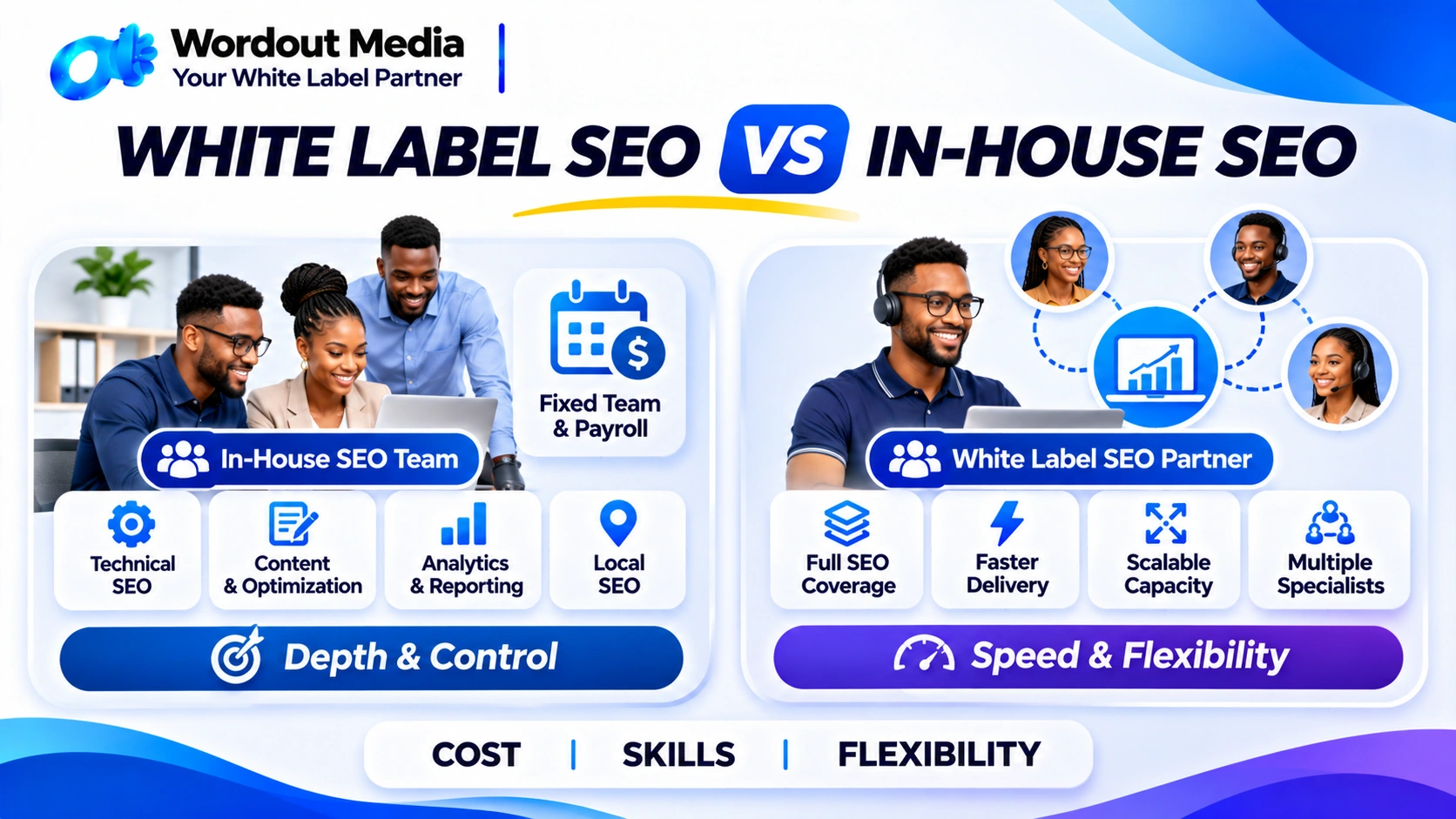
This guide sets white label SEO vs an in-house SEO team side by side so you can decide with clear eyes. We cover what each model really involves, a comparison across ten factors, a worked cost example, a decision framework, the hybrid option and the honest limits of outsourcing. We’re Wordout Media, a white label partner, so we’ll try to be fair to hiring where hiring is better.
Put simply, the white label seo vs in house seo team question is a build-versus-buy decision, and like any build-versus-buy decision it turns on volume, skills and cost.
What an SEO Team Actually Has to Cover
Before comparing models, it helps to see the range of work. Google’s own SEO Starter Guide frames SEO around helping search engines understand your content and making sites useful to people, which in practice spans many disciplines.
Typical SEO work includes:
- Technical SEO: crawlability, site speed, indexing, structured data and site architecture
- Keyword research and topic mapping
- On-page optimization: titles, headings, content structure and internal linking
- Content optimization and updates
- Local SEO and Google Business Profile management
- Analytics and reporting
- Link and authority strategy, done carefully and within Google’s rules
A single person can handle a small amount of each. A growing agency with several clients needs depth across all of them.
Option 1: Build an In-House SEO Team
What it looks like: you hire one or more SEO specialists as employees, possibly with a content writer, a developer partner and an analyst over time.
Strengths
- Deep, daily knowledge of your clients and their sites
- Direct control over priorities and quality
- Institutional knowledge that stays in the business
- Easy to align with your culture and standards
Weaknesses
- High, fixed cost whether work is heavy or light
- Hiring is slow, and good SEO specialists are in demand
- Skills are narrower than the full discipline
- Single point of failure when someone is absent or leaves
- Management time from you or a senior hire
Option 2: Use a White Label SEO Partner
What it looks like: a partner carries out SEO tasks under your brand, and you buy capacity as needed.
Strengths
- Capacity in days, not months
- A team’s worth of skills without a team’s payroll
- Flexible cost, scaling up or down with demand
- Coverage when individuals are away
- Lower fixed risk
Weaknesses
- Less immersion in each client’s business, so briefs matter more
- Quality depends on partner choice and on your review
- Some loss of direct control over timing and process
- You must manage access and confidentiality carefully
- Dependence on an outside provider
For the basics of how this works, see What Does “White Label SEO” Actually Mean? and our scope on the White Label SEO + GBP page.
The Side-by-Side Comparison
| Factor | In-house SEO team | White label SEO partner |
|---|---|---|
| Cost structure | Fixed (salary, benefits, tools) | Variable (pay for hours or deliverables) |
| Cost per productive hour | Often well above wages once fully loaded | Set by the provider’s rate |
| Speed to start | Weeks to months (hire, onboard) | Days |
| Breadth of skills | Limited to who you hire | Wider, across a team |
| Depth of client knowledge | High over time | Lower at first, grows with briefing |
| Control | Direct | Through briefs and review |
| Flexibility | Low | High |
| Risk if someone leaves | High | Lower |
| Management time | Ongoing | Briefing and review |
| Scalability | Slow, step-wise | Quick, incremental |
| Best for | Steady, high volume | Uneven or growing demand |
The Cost Comparison (Illustrative)
These numbers are hypothetical, so use your own. First, a reference point: the U.S. Bureau of Labor Statistics’ Employer Costs for Employee Compensation release for June 2026 reports private industry employer compensation averaging $46.89 per hour worked, with benefits making up 30.0%. That’s an all-industry average, not an SEO figure, but it shows true cost runs well above wages.
In-house SEO specialist (illustrative)
| Cost line | Annual |
|---|---|
| Salary | $60,000 |
| Payroll taxes and benefits (about 30%) | $18,000 |
| Tools (SEO software, analytics, etc.) | $5,000 |
| Training, recruiting and ramp-up | $3,500 |
| Management time (about 3 hours a week at $40) | $6,000 |
| Total | $92,500 |
With roughly 1,540 productive hours, that’s about $60 per productive hour. One person, with one skill profile.
White label partner (at Wordout Media’s rate)
- $10 an hour, in blocks of Starter ($200 for 20 hours), Growth ($400 for 40) and Scale ($800 for 80), same rate on every block, hours that don’t expire.
- For the same 1,540 hours: $15,400, plus your review time (say 10% to 20% of hours at $40, or about $6,000 to $12,000).
Even after review time, there’s a large gap for work that fits an outsourcing model. But it’s the shape of the work, not just the price, that decides. Test your own with the Agency profit margin calculator, and see The Real Cost of Hiring an In-House Marketing Team for the full cost checklist.
An honest limit: an outsourced hour isn’t automatically equal to an in-house hour. A partner may need more time at first to learn your clients, and in-house staff may be more efficient on accounts they know deeply. The calculation is about your work, not an average.
A Decision Framework
Answer these seven questions.
1. How steady is your SEO demand? Steady and high favors hiring. Uneven favors a partner.
2. How many SEO clients do you have? Fewer than four or five often can’t keep a specialist fully productive.
3. Which skills do you need? If you need technical, content, local and reporting together, one hire won’t cover it.
4. How fast do you need capacity? Days points to a partner.
5. How central is SEO to your brand? If it’s your signature, in-house control may matter more.
6. What can you afford to keep fixed? If a quiet quarter would hurt, favor variable costs.
7. How much time can you spend managing? Both models need it, but in different ways.
Rough guide:
| Your situation | Likely fit |
|---|---|
| Fewer than 5 SEO clients, mixed needs | White label |
| Steady 8+ SEO clients, similar needs | In-house, or hybrid |
| Rapid growth, uncertain demand | White label first |
| SEO is your core specialty | In-house core, partner for peaks |
| Need to launch SEO this quarter | White label |
The Hybrid Model
For many agencies, the best answer isn’t either/or.
In-house: one senior person who owns strategy, client communication, quality control and priorities.
Partner: production and specialist work such as audits, on-page updates, content optimization, local profile management and reporting data.
This keeps judgment and client knowledge close while giving you flexible, wide-ranging capacity. It’s the same rule we use everywhere: outsource execution, keep judgment. See How to Scale Your Agency Without Hiring More Staff.
What a Full In-House SEO Team Looks Like
Agencies sometimes underestimate how many roles a complete SEO function implies. A mature team typically includes:
- An SEO lead or strategist who sets priorities and owns client relationships
- A technical SEO specialist who handles site audits, speed, indexing and structured data
- A content specialist or editor who optimizes pages and posts
- A local SEO specialist who manages business profiles, citations and reviews strategy
- An analyst who handles tracking, dashboards and reporting
- Developer support, in-house or on call, for implementing technical fixes
Most small agencies can afford one or two of these, not six. That’s the heart of the comparison: when you build in-house you buy specific people, while when you use a white label partner you buy access to a range of skills in the hours you need them.
The First 90 Days, Side by Side
It helps to picture how the first three months unfold under each approach.
Hiring in-house
- Weeks 1 to 6: write the job description, advertise, screen and interview.
- Weeks 7 to 10: negotiate, hire, notice period and onboarding.
- Weeks 11 to 13: the new hire learns your clients, tools and standards. Productive output is limited.
- After 90 days: capacity arrives, and so does the fixed cost.
White label partner
- Week 1: choose a first project, write the brief and start the free trial.
- Week 2: review the output, give feedback and check the tracker.
- Weeks 3 to 4: move one live client task across.
- Weeks 5 to 13: add clients and services as trust builds, buying hours as needed.
The difference isn’t that one is better. It’s that the partner route gives you real evidence in the time the hiring route takes to get someone through the door. If you decide to hire later, you’ll do it with real data about workload and skills. Choosing between white label seo vs in house seo team options often comes down to this: test first, hire later if the numbers justify it.
Common Mistakes in the Build-vs-Buy Decision
- Hiring before the workload is proven. A salary is a long commitment.
- Comparing salary to an hourly rate. Compare cost per productive hour.
- Ignoring skill breadth. One person cannot be the whole SEO function.
- Skipping the test. A trial is cheap evidence.
- Choosing a partner on price alone. Ask who does the work and check quality.
- Forgetting review time on the outsourced side.
- Treating it as permanent. The right answer at five clients may not be the right answer at twenty. ## Risks of Each Path
In-house risks: a bad hire, turnover, skill gaps, idle time and fixed costs through a downturn.
White label risks: inconsistent quality if you choose poorly, communication gaps, confidentiality and hidden subcontracting. Reduce them by asking who does the work and testing first. How to Choose the Right White Label SEO Partner lists the questions that matter.
Both: bad tactics. Google’s spam policies describe link spam as links created “primarily for the purpose of manipulating search rankings.” Nobody, in-house or outsourced, can guarantee rankings, and shortcuts can hurt clients.
How to Test Before You Decide
You don’t have to choose blindly.
- Pick one real SEO task, such as a technical audit or a Google Business Profile cleanup.
- Write a proper brief.
- Run it through a partner, using the 8-hour free trial (no contract, no card, no sales call required first).
- Compare quality, speed and your own time against what you’d get in-house.
- Check the hours in the shared task tracker and calculate cost per deliverable.
- Decide using evidence.
Our guide Start Outsourcing Your SEO Projects This Week has a 7-day plan and a brief template.
Where We Might Not Be the Right Fit
- If SEO fills several full-time roles for you year-round, in-house may be more economical.
- If you need very large, round-the-clock capacity, a bigger provider may suit you better.
- If your contracts require employee-only delivery.
- If you want a fully hands-off package with no briefing.
- If you need senior strategic consulting. We’re an execution partner.
Frequently Asked Questions
Is white label SEO cheaper than hiring an in-house SEO team?
Often, especially at low and medium volumes and when demand is uneven, because you pay only for the hours you use. At steady high volume, in-house can be competitive. Calculate cost per productive hour.
How many clients do I need to justify hiring an SEO specialist?
There’s no fixed number. A rough test: can you keep the person productive for most of the year, across the skills they have? Fewer than four or five similar clients often can’t.
Can one SEO specialist do everything?
Rarely. SEO spans technical, content, local, analytics and strategy, and few people are excellent across all of them.
What can I outsource while keeping an SEO lead in-house?
Audits, on-page updates, content optimization, local profile work and reporting data are common. Keep strategy, client communication and final review.
Will clients know I use a partner?
Not if it’s done properly. Everything is 100% white labeled.
Can anyone guarantee SEO rankings?
No. Be wary of anyone who does.
How do I try a partner without committing?
Use our 8-hour free trial. No contract, no card, no sales call required first.
What if I hire later?
That’s fine. A partner can cover the gap until in-house hiring makes sense, and you keep your documentation, templates and processes.
When agencies ask us about white label seo vs in house seo team options, our honest answer is “it depends on your volume, and you can find out cheaply.”
White label SEO vs an in-house SEO team isn’t a contest with one winner. In-house gives depth and control, but at a fixed cost and with a narrow skill set. A partner gives breadth, speed and flexibility, with more reliance on briefs and review. Choose based on the shape of your demand, the skills you need and how much cost you can afford to keep fixed. If you’re unsure, test the partner side first. It costs little, takes a week and gives you real numbers to compare.
Compare Costs, Then Start a Free Trial
Run your own numbers first.
Compare costs with our Profit Margin Calculator, then start a free trial and send us a real SEO task to judge. No contract, no card, no sales call required first. You can also see our White Label SEO + GBP service, read our FAQs or browse all service.