Ask most agency owners how they set their prices and you’ll hear one of three answers. “I looked at what competitors charge.” “I picked a number that felt right.” “I charge what the client said they could afford.”
None of those are pricing strategies. They’re guessing wearing a suit. And because pricing sits at the top of the profit equation, a small error there outweighs almost any other efficiency you can find. A 10% increase in price with no change in cost drops straight to profit. A 10% cut in price can wipe out half your margin.
This guide covers how to price digital marketing services in a way you can defend: the main pricing models, how to work out your true cost, the formulas for hitting a target margin, how to price retainers and projects, how to handle scope, when and how to raise prices and how delivery cost, including outsourcing, shapes what’s possible. We’re Wordout Media, a white label partner, so we’ll show the outsourcing math, but the principles apply however you deliver the work.
Step One: Know Your True Cost
You can’t price confidently until you know what the work costs you. Most agencies understate it. Your delivery cost has four parts.
1. Direct labor
Hours multiplied by hourly cost. For employees, the hourly cost should include payroll taxes, benefits, software and equipment, divided by genuinely productive hours rather than paid hours. A $55,000 salary with 25% overhead is about $68,750 a year, which over 1,560 productive hours is roughly $44 an hour, not the $26 you’d get from a salary over 2,080 paid hours.
2. Outsourced cost
If a partner does the work, their fee. At our rate of $10 an hour, 25 hours costs $250.
3. Management and review time
Your own time briefing, reviewing, communicating and reporting. It’s a real cost, even if you don’t invoice it to yourself.
4. Direct expenses
Tools, licenses, stock assets and anything bought specifically for the client.
Add those together and you have your delivery cost. Everything else in pricing builds on it. Our guide How to Calculate Your Agency’s Profit Margin walks through the formula, and the Agency Profit Margin Calculator runs the comparison for you.
Step Two: Choose a Target Margin
A target margin is the share of the price you want to keep as profit after delivery cost. Pick it deliberately, because it flows into every quote.
To choose one, work backward:
1. Decide the net profit you want from the business.
2. Add your overheads: rent, software, admin, marketing, your own salary.
3. Work out the gross profit needed to cover both.
4. Divide by expected revenue to find the gross margin required.
Benchmarks vary widely by service and location, so treat any generic “industry standard” with caution. Use your own requirements.
Step Three: Use the Right Formula
Here’s the formula agencies get wrong most often.
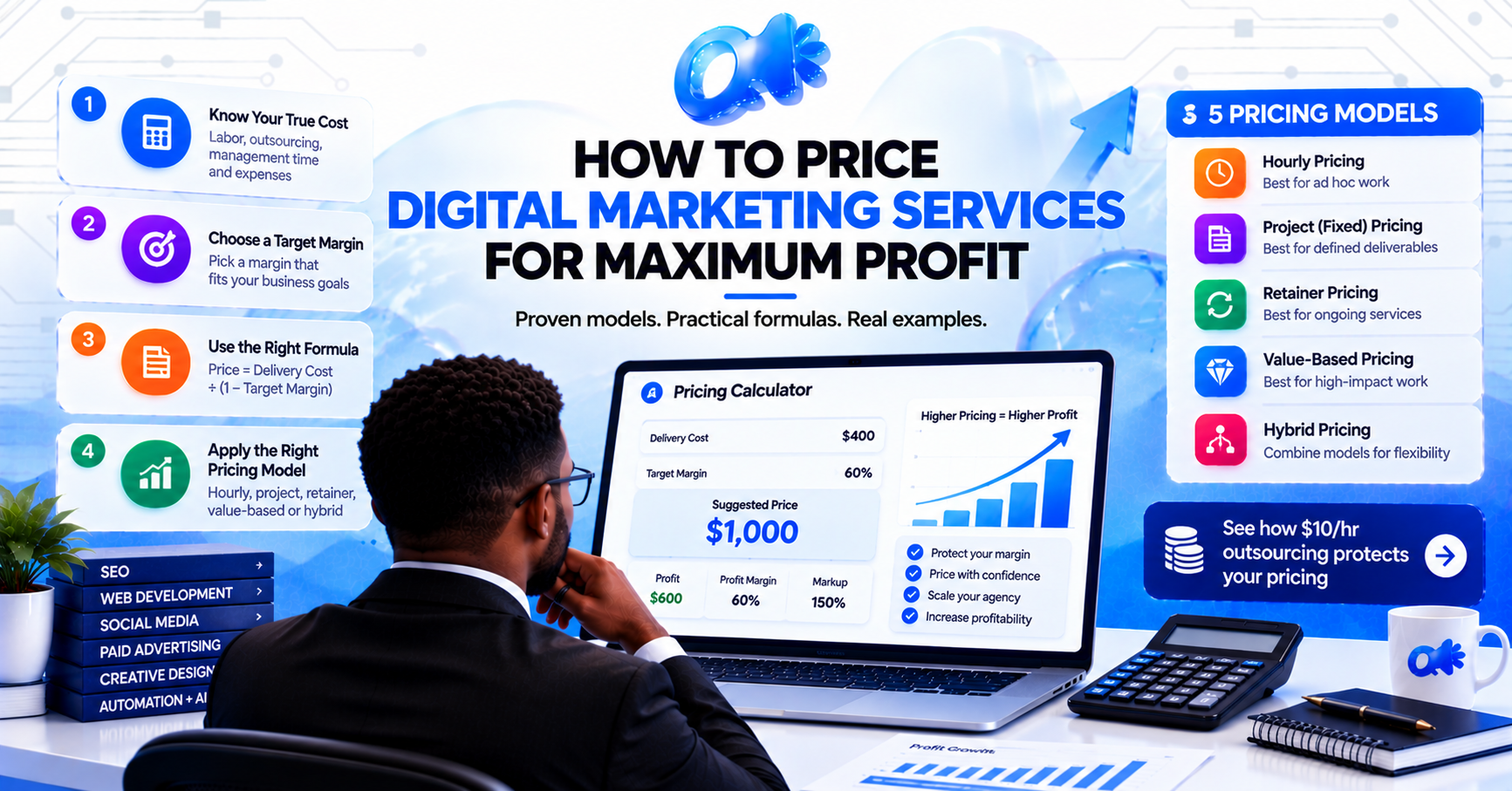
Price = Delivery Cost ÷ (1 − Target Margin)
Example: Delivery cost is $400 and you want a 60% margin
Price = $400 ÷ (1 − 0.60) = $400 ÷ 0.40 = $1,000
Don’t confuse this with markup. A 60% markup on $400 is only $640, which is a 37.5% margin, far below what you intended. Markup is profit as a percentage of cost. Margin is profit as a percentage of price. Mixing them up is how agencies end up charging much less than they planned.
The Main Pricing Models
There’s no single best model. Here are the five most common, with their strengths and weaknesses.
1. Hourly pricing
You charge for time spent
Strengths: Simple, transparent, easy to explain.
Weaknesses: Rewards slowness and punishes efficiency. The faster you get, the less you earn. Clients also tend to scrutinize hours.
Best for: Ad hoc work, consulting and uncertain scopes.
2. Project (fixed) pricing
You charge a flat fee for a defined deliverable.
Strengths: Clear for clients. Rewards efficiency.
Weaknesses: Scope creep can destroy the margin. Requires accurate estimation.
Best for: Websites, audits, brand work and anything with a clear end.
3. Retainer pricing
You charge a recurring monthly fee for an agreed scope.
Strengths: Predictable revenue, stable relationships, easier planning.
Weaknesses: Hours can creep upward while the fee stays fixed. Clients may feel they’re not getting enough.
Best for: SEO, social, ads management and ongoing support.
4. Value-based pricing
Your price is based on the value the work creates for the client rather than the time it takes.
Strengths: Can produce the highest margins. Aligns with results.
Weaknesses: Requires understanding the client’s economics, confident selling and a track record. Hard when outcomes are uncertain.
Best for: Work with clear financial outcomes, such as lead generation for high-value services.
5. Tiered (package) pricing
You offer fixed packages, such as Bronze, Silver and Gold, with defined scopes.
Strengths: Easy to sell, easy to scale, fewer custom negotiations. Anchors clients toward the middle option.
Weaknesses: May not fit every client. Needs careful scoping.
Best for: Agencies with repeatable services and many similar clients.
A comparison at a glance:
| Model | Predictability | Rewards efficiency | Risk of scope creep | Margin potential |
| Hourly | Low | No | Low | Capped |
| Project | Medium | Yes | High | Medium to high |
| Retainer | High | Yes | Medium to high | Medium to high |
| Value-based | Medium | Yes | Medium | Highest |
| Tiered | High | Yes | Medium | Medium to high |
Many agencies blend them: tiered retainers for ongoing services, fixed fees for projects and value-based pricing for premium work.
A Worked Example: Pricing an SEO Retainer
These figures are illustrative.
You want to price a monthly SEO retainer for a local business. The work will take about 25 hours a month.
Option A: Delivered by your own team
• Hourly cost: $40
• Delivery cost: 25 × $40 = $1,000
• Management time: 3 hours × $40 = $120
• Total cost: $1,120
• Target margin: 55%
• Price = $1,120 ÷ 0.45 = $2,489
That’s a price many local businesses will find high.
Option B: Delivered through a white label partner at $10 an hour
• Delivery cost: 25 × $10 = $250
• Management time: 3 hours × $40 = $120
• Total cost: $370
• Target margin: 55%
• Price = $370 ÷ 0.45 = $822
The same retainer can be priced at about $822 and still deliver a 55% margin. Or you can price it at $1,500 and earn a margin of 75%.
What that means for strategy
Lower delivery cost gives you options:
• Keep the price and widen the margin. Price at $1,500: profit is $1,130, a margin of 75%.
• Lower the price and win more clients. Price at $1,000: profit is $630, a margin of 63%, with a more competitive offer.
• Keep the price and add value. Spend recovered hours on reporting, content or conversion improvements.
Notice that none of these options requires you to guess. Pricing becomes a choice between known alternatives. For more on how delivery models compare, read White Label vs. In-House Marketing Team.
How to Price Projects Accurately
Fixed-price projects fail when estimates are wrong. Here’s how to get them right.
- Break the project into tasks. List every task: discovery, design, build, content, revisions, testing, launch, handover.
- Estimate hours for each. Use records from past projects wherever you can.
- Add a buffer. 15% to 25% is common, because every project has surprises.
- Include non-production time. Meetings, emails, approvals, project management.
- Calculate cost, then apply your margin formula.
- State what’s included and excluded. Number of pages, revision rounds, content responsibilities and timelines.
If you outsource the production, ask your partner for a scoped estimate before quoting. We scope larger builds, such as full websites and multi-page SEO projects, before work begins, so you can price with confidence.
How to Price Retainers Without Losing Money
Retainers are profitable when scope is controlled and unprofitable when it isn’t. Protect yours with:
- A clear scope. List deliverables, not vague promises.
- Hour or deliverable limits. For example, “up to 25 hours a month” or “4 blog posts and 10 page optimizations.”
- A change process. Extra requests are quoted separately.
- Regular review. Compare actual hours to the budgeted hours every month.
- A review clause. Prices are reviewed every 6 to 12 months.
Track hours on every account, even if clients never see them. Without tracking, you can’t tell which retainers are healthy.
Value-Based Pricing: When and How
Value-based pricing means anchoring your price to the outcome, not the effort.
When it works well:
- The client can attach a financial value to the result (for example, a new customer is worth $3,000).
- You can reasonably predict or influence the outcome.
- You’ve got proof from similar work.
How to approach it:
- Ask the client what a new customer or lead is worth.
- Estimate how many the work might realistically produce.
- Price as a fraction of the value created, not a multiple of your hours.
Caution: Never promise results you can’t control, especially rankings. Frame estimates as ranges and assumptions, not guarantees.
Packaging and Tiers
If you serve many similar clients, packages simplify everything.
A typical three-tier structure:
- Essentials: The core work, for smaller budgets.
- Growth: The core work plus more output and reporting, for most clients.
- Premium: Everything plus strategy time and priority support.
Tips for tiers:
- Make the middle tier the one you want most clients to choose.
- Define deliverables in numbers, not adjectives.
- Keep each tier’s margin healthy, not only the top one.
- Review tiers yearly.
Scope Creep: The Silent Margin Killer
You can price perfectly and still lose money if scope grows unchecked. Common patterns:
- “Can you just quickly change this?” repeated twenty times.
- Extra revision rounds no one agreed to.
- New requests added to the same fee.
- Meetings and emails that were never budgeted.
Protect yourself by:
Writing scope in the contract.
- Capping revision rounds.
- Treating extras as paid additions, with a price.
- Tracking time against budget.
- Having an easy, polite script: “Happy to do that. Here’s the quote for the additional work.”
We explain how time and cost leak out of agencies in Why Being Constantly Busy Is Killing Your Agency’s Profit.
When and How to Raise Your Prices
Most agencies underprice for far too long. Signs it’s time to raise prices:
- You’re always busy but profit is flat.
- Almost every prospect says yes immediately.
- Your costs have increased.
- You’ve improved in skill and results.
- Your best clients would struggle to replace you.
How to do it well:
- Raise prices for new clients first. It’s the lowest-risk move.
- Give existing clients notice, usually 30 to 60 days, with a clear reason.
- Frame it around value. Explain what’s improved and what they receive.
- Offer a choice. An option to pay more for added value, or keep the current scope at the new price.
- Be prepared to lose a few price-sensitive clients. If your margin is thin, that may be healthy.
How Delivery Cost Shapes Your Pricing Power
The lower your cost to deliver, the more freedom you have in pricing. That’s the central point of this guide.
With high delivery cost, you must charge high prices to protect margin, and high prices narrow your market. With low delivery cost, you can price competitively, protect your margin or invest more in each client.
That’s what $10 an hour outsourcing changes. Our rate is $10 an hour, sold in blocks of 20, 40 or 80 hours ($200, $400, $800), with the same rate on every block, hours that don’t expire and flexibility across SEO, web, social, ads, design and automation. Most agencies bill outsourced work at two to three times its cost, and that multiple is what widens margin.
But we’d be doing you a disservice if we said it solves everything. You still brief, review and manage. If your pricing is too low or your scope is loose, cheaper delivery helps, but it doesn’t fix the underlying problem. Fix pricing and scope first, then optimize delivery.
For a comparison with higher-rate providers, see $10/Hour Outsourcing vs. $50+/Hour Agencies.
Common Pricing Mistakes
- Pricing from competitors only. You don’t know their costs or goals.
- Using markup when you mean margin. The result is far less profit than planned.
- Ignoring your own time. It’s a real cost.
- Not tracking hours. You can’t price accurately without data.
- Discounting too easily. Every discount comes straight out of profit.
- Charging by the hour while getting faster. Efficiency shouldn’t lower your income.
- Never reviewing prices. Costs rise, so should prices.
- Underpricing to win work. The wrong clients at the wrong price drain you.
A Simple Pricing Checklist
Before you send any quote, confirm:
- ☐ I know my true delivery cost, including my own time.
- ☐ I’ve chosen a target margin.
- ☐ I’ve applied the margin formula, not a markup.
- ☐ Scope is clearly listed, with limits.
- ☐ A buffer is included for surprises.
- ☐ Extras are priced separately.
- ☐ The price reflects value, not just hours.
- ☐ I’ve checked the result against my annual profit goal.
Frequently Asked Questions
How do I price digital marketing services?
Work out your true delivery cost, choose a target margin, apply the formula Price = Cost ÷ (1 − Margin), then adjust for the value you deliver and what the market will bear.
What’s the best pricing model for agencies?
There isn’t one. Retainers suit ongoing services, project pricing suits defined deliverables, tiers suit repeatable offers, and value-based pricing suits work with clear financial outcomes.
Should I charge hourly?
It’s simple, but it penalizes efficiency. Many agencies use hourly pricing for ad hoc work and move to retainers or fixed fees for core services.
How do I know my true cost?
Include direct labor (or outsourced fees), your own management time and direct expenses. For employees, use cost per productive hour, not salary over paid hours.
What’s the difference between markup and margin?
Markup is profit divided by cost. Margin is profit divided by price. A 100% markup equals a 50% margin.
How often should I raise prices?
Review them at least once a year, and whenever your costs, skills or results change significantly.
How does outsourcing affect pricing?
Lower delivery cost lets you protect your margin, price more competitively or invest more in each client. You still need to include your review time in the calculation.
Can I use your calculator to test prices?
Yes. The Agency Profit Margin Calculator on our homepage compares internal and outsourced delivery for any project price you enter.
Learning how to price digital marketing services is mostly about replacing feelings with arithmetic: know your true cost, choose a target margin, use the correct formula and protect the scope. Then choose a pricing model that fits the work, test it against reality and review it regularly.
Delivery cost matters as much as price. When production is cheaper and more flexible, you can protect your margin without pricing yourself out of the market.
See How $10/Hr Outsourcing Protects Your Pricing
Put your own numbers through the math.
See how $10/hr outsourcing protects your pricing with our Agency Profit Margin Calculator, then compare internal and outsourced margins on a real project. When you want to test the outsourced side on real work, claim your 8-hour free trial.
You can also browse our services or read our FAQs.
Related Reading
• How to Calculate Your Agency’s Profit Margin (With Formula & Examples)
• Try the Agency Profit Margin Calculator: See Your Numbers in Minutes