If you’ve typed “what is white label SEO” into a search bar, here’s the answer in two sentences.
White label SEO is search engine optimization work that one company does and another company sells under its own name. The agency owns the client relationship, sets the price and receives finished work with its own branding, while the SEO partner handles the actual execution behind the scenes.
That’s the definition. The rest of this guide is about what the definition leaves out: what white label SEO actually includes on a Tuesday afternoon, how the hand-offs work, what it costs, where it goes wrong and how to tell whether it’s right for your agency.
We’re Wordout Media, and white label SEO is one of the services we deliver, so we have a stake in how you think about it. We’ve tried to explain it the way we would to an agency owner in a meeting, including the parts that don’t make a sales page.
White Label SEO Explained in Plain Terms
Think about a restaurant that sells a house-branded sauce. The sauce might be made by a specialist producer and bottled with the restaurant’s label. Customers trust the restaurant, buy from the restaurant and never deal with the producer. The restaurant doesn’t need a sauce factory. The producer doesn’t need a dining room.
White label SEO works the same way. You, the agency, have the client relationship: the trust, the strategy conversations, the invoice. Your SEO partner has the production capability: keyword research, on-page optimization, technical audits and the hours to do them properly.
The “white label” part simply means the partner’s name is absent. Reports carry your logo. Deliverables carry your logo. The client only ever sees you.
Why the Term Is Confusing
A lot of people get tripped up by the term, so let’s clear up the common mix-ups.
White label SEO is not a different type of SEO. The techniques are the same as any SEO work. What’s different is the business arrangement: who does the work and whose name is on it.
It isn’t the same as “private label.” In retail, a private label usually means a retailer commissions a product made to its specifications. In agency services, the two terms are often used interchangeably, but “white label” is the one marketers use.
It isn’t reselling software. Some people confuse white label SEO with reselling an SEO tool. Reporting platforms can be white labeled, but the work behind the reports, the strategy and the actual fixes, comes from people.
It isn’t automatic. Good SEO needs judgment: what to target, what to fix first, what to leave alone. Any partner promising fully automated results is selling something other than SEO.
What White Label SEO Services Typically Include
The scope varies by provider. At Wordout Media, our White Label SEO + GBP service covers six areas, which makes a useful map of what’s commonly offered.
1. Keyword Research and Topic Mapping
Finding the exact terms your client’s target audience is searching for, then organizing them into topics and matching them to pages. This is the foundation. Get it wrong, and everything built on top of it points at the wrong target.
2. On-Page Optimization
Improving the elements of individual pages: title tags, meta descriptions, headers, body content, image text and calls to action. It’s the most visible kind of SEO work and one of the most repeatable, which makes it well suited to outsourcing.
3. Technical SEO Auditing
Checking the site for problems that stop search engines from crawling, understanding or indexing it properly: broken links, crawl errors, indexing problems, slow pages and structural issues. A technical audit is often the first piece of work on a new client.
4. Blog Content Optimization
Refining existing posts so they perform better: updating outdated information, tightening headings, improving structure and aligning them with what searchers actually want.
5. Internal Linking Strategy
Building sensible links between pages on the same site so authority flows to the pages that matter and visitors can find related content. It’s one of the most underused SEO levers, and one that suits systematic, careful execution.
6. Google Business Profile Setup and Optimization
For local businesses, the Google Business Profile often drives more leads than the website itself. Setup and optimization covers the profile’s categories, descriptions, services, photos and consistency with the rest of the business’s online presence.
Not every client needs all six. A local plumber may need mostly Google Business Profile work and a few on-page fixes. An e-commerce store may need technical audits and content optimization. Part of the skill is matching the scope to the client.
What White Label SEO Does Not Include
Honest scoping matters, so here’s what you shouldn’t assume is part of a standard white label SEO arrangement.
- Guaranteed rankings. Nobody controls Google. Be wary of any partner who promises a specific position or timeline.
- Client strategy and relationship management. That’s your job, and it’s the part clients pay you for.
- Unlimited work for a fixed price. SEO is open-ended, so scope needs boundaries.
- Everything else in marketing. SEO is one channel. Websites, ads, social and design are separate services, though many partners, including us, offer them too.
- Results without client cooperation. Clients who won’t approve changes, provide access or publish content will limit what any SEO can achieve.
How White Label SEO Works, Step by Step
The process differs between partners, but it usually looks something like this.
1. You have a client who needs SEO. You’ve sold the retainer or project and set the price.
2. You brief your partner. Share the client’s goals, website, competitors, target locations and any access needed. A good brief saves days.
3. The partner researches and plans. Keyword research, an audit or a content review, depending on the scope.
4. The work is carried out. On-page changes, technical fixes, optimization and so on, applied either directly to the site (if you’ve given access) or delivered as instructions for your team or the client’s developer.
5. You receive branded deliverables and reports. Everything carries your logo.
6. You review and present. You remain the quality gate and the voice the client hears.
7. The cycle repeats. SEO is ongoing. Monthly work builds on the previous month’s.
For a wider look at how outsourcing arrangements run day to day, see our guide on what a white label digital marketing agency is.
Who Uses White Label SEO?
Web design studios that build sites and want to add monthly SEO retainers on top, turning one-off projects into recurring revenue.
Social media and content agencies whose clients keep asking about search.
Freelancers who’ve outgrown their own capacity and want to take on more SEO clients without hiring.
Marketing consultancies that sell strategy and want reliable execution.
IT and software companies that get asked “can you also get us found on Google?”
Established agencies with overflow, covering busy periods without taking on permanent staff.
They have the same problem: the demand for SEO is bigger than their ability to deliver it in-house, or they want to offer it without building a team.
The Benefits of White Label SEO (and the Honest Limits)
You can sell SEO without hiring for it
SEO needs several skills: research, technical knowledge, content sense and patience. Building that team takes time and fixed costs. A partner makes it available immediately.
Predictable cost
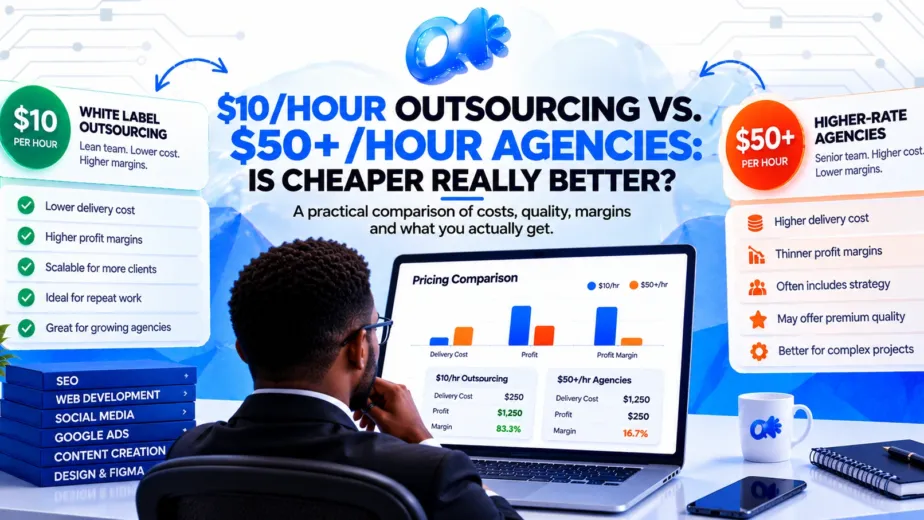
Particularly with hourly or block pricing, you know what you’re paying before you start. Our hours cost $10 each, sold in 20, 40 and 80-hour blocks ($200, $400 and $800).
Better margins
If you charge your client a retainer and your delivery cost drops, your margin widens. Most agencies bill outsourced work at two to three times its cost. You can see what that does to your own numbers with the Agency Profit Margin Calculator
More time for the work only you can do
When you’re not buried in audits and meta descriptions, you can spend time on sales, strategy and keeping clients happy.
The honest limits
White label SEO isn’t magic.
- You still need to understand SEO well enough to brief and review. You don’t need to be an expert, but you do need to know good work from bad.
- Results take time. SEO usually takes months to show clear movement. Set client expectations early.
- Quality varies by partner. Ask who does the work and how.
- Access matters. Without access to a client’s site, analytics and Google Business Profile, the work slows down.
White Label SEO Pricing: What to Expect
Pricing models vary widely.
Monthly retainers give you a set package for a fixed fee each month. They’re predictable, but you may pay for capacity you don’t use.
Per-project pricing covers one-off work like a technical audit or a site-wide optimization.
Wholesale rate cards let the partner set prices for each deliverable, which you then mark up.
Hour blocks let you buy time and spend it as needed. This is how we work. Our rate is $10 an hour, the same on every block, and hours don’t expire. If you buy 40 hours and use 25, the other 15 are waiting when you come back. You can put the hours into SEO one month and a website build the next.
Whatever the model, ask what’s included, what’s extra and whether there are setup fees or lock-in contracts. We go deeper into how cheap and expensive providers compare in $10/Hour Outsourcing vs. $50+/Hour Agencies.
How to Tell Good White Label SEO From Bad
Here’s a checklist you can use with any provider.
Good signs
- They tell you clearly who does the work and whether the team is in-house.
- They explain their process in plain language.
- They’re willing to run a trial on real work.
- They give honest timelines and don’t guarantee rankings.
- Reports explain what was done and why, not just vanity numbers.
- They ask questions about your client before starting.
Warning signs
- Promises of “page one in 30 days.”
- Vague answers about methods, especially around links.
- No visibility into what each hour or task produced.
- Pressure to sign long contracts before seeing any work.
- Reports full of jargon and no explanations.
- Cheap link packages sold as a core strategy.
If the provider can’t explain what they’re doing and why, you’ll struggle to explain it to your client.
Common Mistakes Agencies Make With White Label SEO
Underscoping the retainer. Agencies often price SEO too low, then discover the real hours far exceed the fee. Know your margin before you quote. Our guide on how to calculate agency profit margin shows how.
Promising rankings. The fastest way to damage a client relationship is to promise a position you can’t control.
Skipping the review. Even great partners benefit from your oversight. Check changes before they go live.
Thin briefs. “Do their SEO” isn’t a brief. Include goals, competitors, target areas and anything the client has already tried.
Ignoring local search. For local businesses, an unoptimized Google Business Profile is a missed opportunity.
Not reporting clearly. Clients stay when they understand what’s happening. Plain-language reports beat dashboards full of numbers.
A Realistic Example
Imagine you run a small web design agency. You’ve built a site for a dental practice. The owner asks, “Can you help us show up when people search for dentists nearby?”
Without white label SEO, you’d have two options: say no, or try to learn SEO on the client’s time.
With a partner, you’d do this:
- Sell a monthly local SEO retainer.
- Brief your partner on the practice, its services and its service area.
- Receive a technical audit and a keyword plan under your branding.
- Have on-page improvements and Google Business Profile optimization completed over the first month.
- Review everything, present it to the client in your own words and invoice at your own rate.
- Repeat each month, adjusting based on results.
You’ve added a recurring revenue line without hiring anyone. Your client has one agency to talk to. And you’ve spent your own time on the relationship rather than on meta descriptions.
How to Start With White Label SEO Safely
You don’t need to commit your whole client list.
Step 1: Choose one client or one task. Something repeatable, like a technical audit or Google Business Profile optimization.
Step 2: Write a proper brief. Include goals, access, competitors and examples.
Step 3: Run a trial. We offer an 8-hour free trial, with no contract, no card and no sales call required first. A technical SEO audit is one of the most popular things to send.
Step 4: Judge the result. Quality, clarity, speed and how much of your time it took.
Step 5: Expand gradually. Add clients and services as trust builds.
Frequently Asked Questions
What is white label SEO in simple terms?
It’s SEO work done by a partner and delivered under your agency’s brand. You sell and manage the client relationship, and the partner handles execution.
Will my clients know I use a white label SEO provider?
They shouldn’t. Reports and deliverables carry only your branding, and communication runs through you.
What does white label SEO include?
Typically keyword research, on-page optimization, technical audits, content optimization, internal linking and Google Business Profile work. Exact scope varies by provider.
Is white label SEO legitimate?
Yes. It’s a normal business arrangement. What matters is that the work is ethical, the methods are sound and you remain accountable to your client.
How much does white label SEO cost?
It depends on the model. Ours is $10 an hour, sold in blocks of 20, 40 or 80 hours.
How long does white label SEO take to show results?
SEO generally takes months to show clear movement, and timelines depend on the site, the competition and the work done. Be wary of anyone who promises fast, guaranteed results.
Do I need to know SEO to resell it?
You don’t need to be an expert, but you should understand the basics well enough to brief the work, review it and explain it to clients.
Can white label SEO include local SEO?
Yes. Google Business Profile setup and optimization is a common part of it, and it’s often essential for local clients.
So, what is white label SEO? It’s a division of labor. You focus on winning clients, building trust and setting strategy. Your partner focuses on the research, the audits and the optimization. Done well, it lets you add SEO to what you sell without building a team and without sacrificing your standards.
Done badly, it means putting your name on work you haven’t checked. The difference lies in choosing a partner who’s open about their methods, honest about timelines and willing to prove themselves on a real task first.
Explore Our White Label SEO + GBP Service
If you’re ready to add SEO to your agency’s offer, start with the details.
Explore our White Label SEO + GBP service to see exactly what we handle: keyword research, on-page optimization, technical audits, blog content optimization, internal linking and Google Business Profile optimization. You keep the client. We handle the execution.
When you’re ready to test it, claim your 8-hour free trial and send us real SEO work to judge for yourself. You can also read our FAQs first.