Picture a small agency with a handful of clients and a good idea: sell monthly content. Blog posts, social posts, maybe a few graphics. Clients love the pitch. Three months later, the pattern looks familiar. Month one, the content goes out on time. Month two, one article slips a week. Month three, nobody can say who owns the editorial calendar, and a client asks why the blog hasn’t updated since the middle of last month.
It isn’t a lack of ideas. Content marketing is simply a volume job. According to Wikipedia’s overview of content marketing, it means creating, publishing and distributing content for a targeted audience, and it calls for steadily delivering large amounts of content, ideally as part of a content strategy. Steady volume is exactly what small teams struggle to sustain alongside everything else.
That’s the case for white label content marketing: let a partner carry the production load so your agency can keep promises month after month. But content is also the service where outsourcing can go most wrong, because quality is subjective, accuracy matters and search engines are watching for low-effort material. This guide covers what white label content marketing includes, how it works, where the risks sit, what to keep in-house, how pricing works and how to choose a partner. We’ll also be clear about what Wordout Media does and doesn’t provide.
What is white label content marketing?
White label content marketing is an arrangement in which a partner helps produce content for your agency’s clients (planning topics, drafting or improving articles, designing visuals, preparing social posts and reporting) and delivers it under your brand. You own the strategy, the client relationship and final approval. The partner handles production capacity.
What Is Content Marketing,
Content marketing creates and shares useful material to attract and keep an audience, rather than interrupting people with ads. The same Wikipedia overview lists forms such as videos, white papers, e-books, podcasts and case studies, plus shorter formats like blog posts and social media posts. Typical goals include attracting leads, building brand awareness and credibility and engaging online communities.
For agencies, the services around content typically include:
- Strategy and topic planning: what to publish and why
- Writing: new blog posts, articles, guides and landing page copy
- Optimization: improving existing content for structure, keywords and readability
- Design: graphics, carousels, infographics and brand templates
- Video and short-form: Reels and similar formats
- Distribution: social posts, newsletters and scheduling
- Reporting: showing what was published and how it performed
What Does “White Label” Add?
White label means a partner produces the work and your agency presents it as its own. Wikipedia describes white-label products as items made by one company and rebranded by others. In content, that means drafts, files, calendars and reports carry your brand, and your clients deal only with you.
This is common practice. Agencies have long used freelance writers, editors and designers behind the scenes. What’s changed is that more agencies now use structured partners, which gives them a team and a process rather than one person’s availability.
What Wordout Media Provides (and What It Doesn’t)
Being precise here matters, because “content marketing” is a wide label. Based on our current services, here’s where we help:
On the SEO side (White Label SEO + GBP):
- Keyword research and topic mapping: finding terms and mapping them across a site.
- Blog content optimization and updates: improving existing posts by refining structure, keywords, readability and internal linking.
- Internal linking strategy and execution.
- Technical SEO auditing and reporting.
On the social side (Social Media Management):
- Monthly content calendars, captions and hashtag strategy, Reels and short-form video, carousels, graphics and templates, story sequences and white-labeled reporting.
On the design side (Creative Design + Figma):
- Graphics, mockups and creative assets that support content.
What we don’t list as a standalone service: writing new long-form articles from scratch. Our SEO page describes optimizing and updating existing posts, not authoring new ones. If you need a partner to draft new long-form content, ask us about your specific case before assuming. We’d rather tell you what fits than oversell. Everything we do is white labeled and built in-house by our team of fifteen.
Why Agencies Outsource Content Production
Volume without payroll. Writers, editors, designers and video editors add up fast. Outsourcing turns that fixed cost into a flexible one, one of the standard reasons companies outsource, along with access to specialist skills and focus on core strengths, as listed in the overview of outsourcing.
Consistency. A partner with a process keeps publishing when your team gets busy.
Specialist skills. Optimization, design and short-form video are different crafts.
A wider offer. A web studio can sell blogs and social without building a content department.
Margin. Cheaper, flexible delivery leaves more of the client’s fee with you. See How to Price Digital Marketing Services for the formulas.
The Big Risk: Low-Effort Content at Scale
This is the part many agencies skip, so let’s spend time on it.
Google’s guidance on creating helpful, reliable, people-first content says its systems aim to prioritize helpful, reliable information created to benefit people, not content made to manipulate search rankings. It also lists warning signs around scaled content, including extensive automation producing content on many topics and content “mass-produced by or outsourced to a large number of creators.” And on generative AI, it says mass-producing text with no manual oversight or curation represents little to no effort.
Note the nuance: outsourcing isn’t the problem. Mass-produced, unreviewed, low-effort content is. A partner writing a carefully briefed, expert-reviewed article is not the same as an anonymous pipeline generating hundreds of generic posts.
So the safeguards matter.
1. Brief for people, not search engines. Start with what the reader needs, not just the keyword.
2. Add real expertise. The client’s knowledge, examples and data make content original. A partner can’t invent those.
3. Review everything. Facts, claims, tone and links get checked by a human who understands the client.
4. Avoid scale for its own sake. Fewer, better pieces usually beat many thin ones.
5. Be thoughtful about authorship. Google’s guidance suggests making authorship clear where readers would expect it and explaining how content was made where that’s reasonably expected, including AI use. Using a partner behind the scenes is normal, but fabricated author profiles or misleading bylines aren’t. If your client’s content carries a byline, it should belong to a real person who actually stands behind it.
6. Take extra care on sensitive topics. Health, finance, legal and safety content (“your money or your life” topics) needs qualified review.
If you use AI tools anywhere in the workflow, treat them as drafting aids, not authors. Review every line.
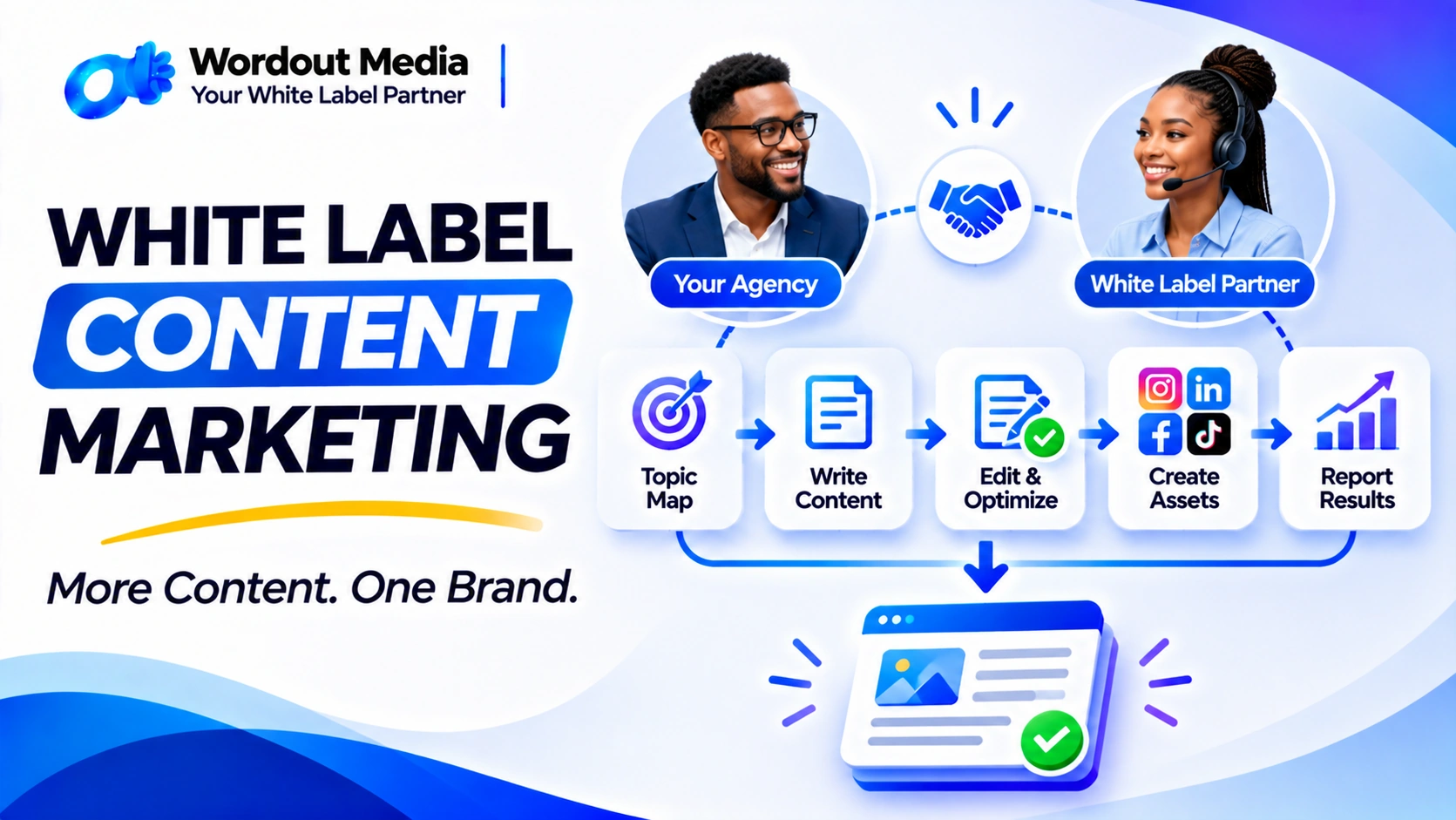
How the Process Usually Works
Step 1: Strategy and mapping. You set goals, audiences and priorities. The partner supports with keyword research and topic mapping.
Step 2: Editorial calendar. A monthly plan of what’s published, where and when.
Step 3: Briefs. For each piece: audience, goal, angle, sources, client expertise to include, links, tone and deadline.
Step 4: Production. Drafting, optimizing, designing and formatting, under your brand.
Step 5: Your review. You check accuracy, voice and compliance, then send consolidated feedback.
Step 6: Client approval and publishing. Under your name.
Step 7: Distribution. Social posts, newsletter snippets and graphics.
Step 8: Reporting and refresh. What performed, what to update and what to retire. Updating older posts is often better value than writing new ones. See How to Build a White Label Reporting System Clients Trust.
What to Outsource and What to Keep
| Outsource | Keep in-house |
|---|---|
| Keyword research and topic mapping | Content strategy and positioning |
| Optimizing and updating existing posts | Subject-matter facts and claims |
| Internal linking | Brand voice approval |
| Graphics, carousels and templates | Sensitive or regulated topics |
| Short-form video and captions | Client relationship and expectations |
| Calendar building and scheduling | Final quality control |
| Reporting data | Pricing and commercial decisions |
The rule is the same as for any service: outsource execution, keep judgment. More in What Services Can Agencies Outsource to a White Label Partner?
Pricing Models for White Label Content
- Per piece: a price per article, graphic or video.
- Monthly packages: a set volume of content for a fixed fee.
- Hourly or hour blocks: you buy time and spend it where needed.
- Strategy plus production bundles.
Our model is hours: $10 an hour, sold as Starter ($200 for 20 hours), Growth ($400 for 40 hours) and Scale ($800 for 80 hours), with the same rate on every block, hours that don’t expire and flexibility across all six services. A shared task tracker shows where each hour went.
Illustrative margin example
Say you charge a client $1,500 a month for a content package: refreshing four existing blog posts, a topic map update, internal linking, a month of social posts with graphics and reporting. Suppose the partner work takes 26 hours and you spend 4 hours reviewing at $40.
- Partner cost at $10 an hour: $260
- Your review time: $160
- Total cost: $420
- Profit: $1,080, a margin of 72%
These numbers are hypothetical. Real hours depend on post length, how much needs fixing and revision rounds. Test your own with the Agency Profit Margin Calculator, and see Starter, Growth or Scale for help choosing a block.
How to Choose a White Label Content Partner
- What exactly is included? Writing, optimizing, design, video, scheduling and reporting are different things.
- Who produces it? Employees or subcontractors? Hidden chains cause quality problems.
- How do you protect quality? Ask about editing, fact-checking and review steps.
- How is AI used, if at all? Ask for an honest answer.
- Can I see samples relevant to my clients’ industries?
- How do you take on brand voice? Good partners ask for examples and guidelines.
- How do revisions work? We include revisions on paid and trial work.
- Is it truly white labeled? Files, links and reports should carry only your brand. See How to Keep White Label Work Invisible to Your Clients.
- Who owns the content? You should own all deliverables once delivered. At Wordout Media, you do, and we keep no rights.
- Can I test first? A trial shows more than any sales call.
Red Flags
- Guaranteed rankings or traffic from content. Nobody controls them.
- Very cheap per-article prices with fast volume. Quality usually pays the difference.
- No review or editing step.
- Reluctance to say how content is produced or whether AI is used.
- Reused or lightly rewritten material across clients.
- Fake bylines or invented expert profiles.
- No interest in your client’s expertise or goals.
- No access plan. You should know who can publish to client sites.
Where We Might Not Be the Right Fit
- If you need new long-form articles written from scratch, confirm scope with us first, because our listed SEO service is about optimizing and updating existing posts.
- If you want a fully hands-off package with no briefing or review from you.
- If your clients are in tightly regulated fields and require credentialed expert authors.
- If you need very large, round-the-clock capacity.
- If your contracts require employee-only delivery.
How to Start Small
- Choose one client and one content type, such as refreshing existing blog posts or a month of social content.
- Gather brand guidelines, past content the client likes and a few facts only they know.
- Write a clear brief for each piece.
- Test with our 8-hour free trial: no contract, no card, no sales call required first.
- Review for accuracy, voice, usefulness and formatting.
- Check the hours in the tracker and compare against your usual cost.
- Scale gradually.
FQAs on White Label Content Marketing
What is white label content marketing?
It’s an arrangement where a partner produces content for your clients (planning, optimizing, designing, preparing social posts and reporting) and delivers it under your agency’s brand.
What does white label content marketing include?
It varies by provider. At Wordout Media it includes keyword research and topic mapping, blog content optimization and updates, internal linking, social content, graphics and white-labeled reporting.
Do you write new blog posts from scratch?
Our listed SEO service covers optimizing and updating existing posts, not authoring new long-form articles. Ask us about your specific needs.
Is outsourced content bad for SEO?
Not by itself. Google’s guidance targets low-effort, mass-produced content aimed at manipulating rankings, not content that’s helpful, reviewed and made for people.
Can AI-generated content rank?
Google’s guidance warns against mass-producing text with generative AI with no manual oversight or curation. Treat AI as a drafting aid and review everything.
Who owns the content?
You do. You own all deliverables once delivered, and we keep no rights.
Will my clients know I use a partner?
No. Everything is 100% white labeled.
How much does it cost?
Ours is $10 an hour in blocks of 20, 40 or 80 hours ($200, $400, $800). Other providers price per piece or per month.
Can anyone guarantee content will rank?
No. Rankings depend on many factors outside anyone’s control.
White label content marketing works when it’s treated as a quality system, not a content factory. A good partner gives you capacity and consistency. You supply strategy, real expertise and a review step that makes sure what goes out is genuinely useful.
Start small, review hard and put readers first. That’s what keeps content working for clients, and it’s what keeps your agency’s name on work you’re proud of.
Explore Our White Label SEO + GBP Service
Want to see the content-related work we handle for agencies?
Explore our White Label SEO + GBP service for keyword research, topic mapping and blog content optimization, then claim your 8-hour free trial and send us a real client brief. No contract, no card, no sales call required first. You can also see our Social Media Management service, read our FAQs or browse all services.